-

Bachelor's

-

Masters
-

MBA
-

Doctorate
-

Micro Credit
-

Explore all Courses
-
Postgraduate Certifications

-
Postgraduate Diploma
-
Undergraduate Diploma
-
Diploma



What is Industrial Safety & Why Does It Matter?

Author: munazzah ali
|6
MINS READ
| 0
| 155
Created On: 04 May, 2026
Share




Table of Contents (TOC):
- Introduction
- Key Takeaways
- What is Industrial Safety?
- Why Industrial Safety Matters: Looking Beyond Compliance
- Objectives of Industrial Safety: What It Aims to Achieve
- The Most Common Industrial Safety Hazards
- How to Control and Eliminate Industrial Safety Hazards
- Building Core Knowledge with UniAthena
- Conclusion
- FAQs
Introduction
Nothing felt urgent—and that’s what made it dangerous.
Goals were being achieved. Processes were flowing. People were doing what they were expected to do. On the surface, everything pointed to efficiency. However, in high-stakes settings, risk does not necessarily stop any progress, but it tends to keep up with it.
The faster things run, the easier it is to believe the rhythm. Checks become quicker. Assumptions go unchallenged. And gradually, what was previously a managed system starts to depend on habit instead of awareness.
Industrial environments do not collapse due to one obvious mistake. They break open in a chain of “it’s probably fine” moments, decisions that seem too small to question, until they aren’t.
This is where Industrial Safety earns its place. The importance of industrial safety is to break that rhythm—forcing a pause, introducing a specific degree of scrutiny, and ensuring that speed never comes at the price of certainty. Because the real risk isn’t when things go wrong—it’s when everything feels so right that no one thinks to look closer.
Key Takeaways:
- Industrial safety is about foresight, that is, anticipating risks before they escalate.
- Strong safety practices have a direct impact on operational stability and workforce confidence.
- Hazard knowledge is the basis of an efficient control system.
- Safety is a changing aspect with technology, and it needs to be upskilled.
What is Industrial Safety?
So, what is industrial safety in practice? It is the discipline of creating systems in which risk is anticipated and minimized early, rather than managed only after it occurs. It is a combination of systematic procedures, human awareness, and technical measures to keep conditions in industrial workspaces safe, predictable, and effective.
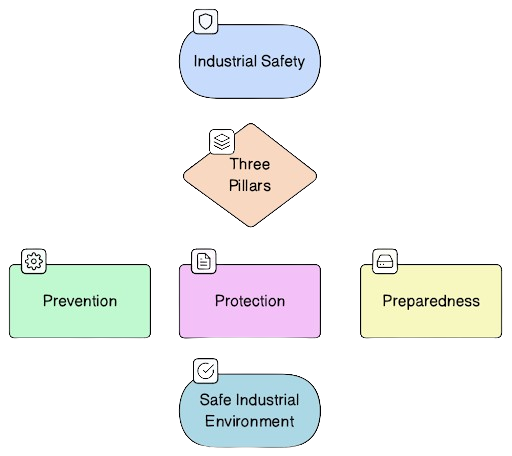
At a deeper level, the industrial safety works on three pillars:
- Prevention: Identifying risks before they occur.
- Protection: Implementing systems to reduce impact.
- Preparedness: Making sure that we are ready when things don’t go as planned.
It is not limited to compliance manuals or protective equipment. It is ingrained in the decision-making process, the functioning of teams, and the way organizations perceive responsibility.
That way, industrial safety is not much about preventing accidents, but rather about engineering reliability into everyday operations.
Why Industrial Safety Matters: Looking Beyond Compliance
It protects the most important things, that are people
All the protocols and all the precautions are developed to make sure that people can work without facing damage. Having a safe place of work is not only ethical but also basic.
It stabilizes operations in an unpredictable environment
One incident can cause the entire workflow to stop, production lines to be paralyzed, and supply chains to be impacted. Safety ensures continuity by creating less uncertainty in risky situations.
It minimizes hidden financial drains
The cost of an accident is not often confined to immediate harm. Legal obligations, compensation, and reputational impact are added up. Powerful safety measures serve as a cost control mechanism in the long run.
It influences the organizational culture and accountability
When safety is addressed, it indicates that the organization appreciates responsibility rather than shortcuts. This will foster confidence, boost morale, and promote proactive behavior within the teams.
It aligns with evolving global standards
The contemporary industries exist within the interconnected ecosystems. It is no longer a choice to meet safety benchmarks, but rather a requirement of credibility, partnerships, and long-term growth.
Objectives of Industrial Safety: What It Aims to Achieve
Proactive Risk Identification
The aim is not to wait and expect that something will happen, but rather to prevent it at an early stage. This entails constant monitoring, analysis, and enhancement of hazard and safety management processes.
Reduction of Workplace Incidents
By addressing root causes—whether mechanical, human, or environmental—industrial safety aims to systematically reduce the frequency and severity of accidents.
Uniformity of the Safe Practices
It is important. Standard procedures guarantee that safety is not at will, but a part of daily activities.
Stronger Emergency Readiness
Despite the most effective systems, the risks cannot be removed completely. Preparedness makes sure that in case of incidents, the responses are prompt, organized, and efficient.
The Most Common Industrial Safety Hazards
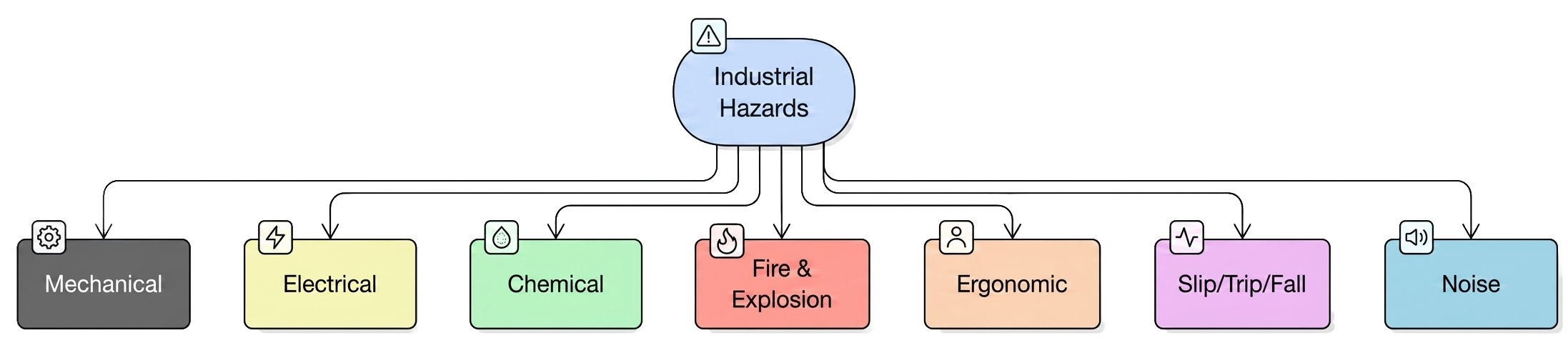
Mechanical & Machine-Related Hazards
Moving parts, unguarded equipment, and lockout/tagout failures pose instant physical dangers. These risks are usually brought about by daily contact with the equipment.
Electrical Hazards
Live wires, inadequate insulation, faulty grounding, and exposure to live wires may cause shocks, burns, or arc flash—most of which are devastating.
Chemical Hazards
Misstorage, labeling, or handling of hazardous substances heightens the danger of toxic exposures, fire, and long-term health impacts.
Fire and Explosion Hazards
This occurs when ignition sources are in contact with combustible materials and can cause high impact levels, which can quickly grow out of control.
Ergonomic Hazards
The repetitive work, bad posture, and handling of heavy work are contributive factor to the chronic injuries that are undervalued.
Slip, Trip, and Fall Hazards
Apparently insignificant problems, such as wet floors or littered corridors, continue to be one of the most common causes of workplace accidents.
Noise Hazards
Noise at high decibel levels is not only harmful to hearing, but also to concentration and general productivity.
Also Read: What is Workplace Safety?
How to Control and Eliminate Industrial Safety Hazards
- Perform formal risk evaluation to detect possible threats at an early stage.
- Implement standardized procedures through a structured safety management system across all operations
- Provide good examples of industrial safety equipment, including PPE, sensors, and monitoring systems.
- Have regular maintenance and inspection of machinery.
- Offer ongoing scenario-based safety training.
- Promote the reporting of near-misses and unsafe conditions.
- Have well-defined emergency response structures.
These measures show the real advantages of industrial safety management, where risks are anticipated, not reacted to.
Building Core Knowledge with UniAthena
Also Read: How AI and IoT Are Transforming Workplace Safety Management
Conclusion
Industrial safety does not demonstrate its worth during the moments when everything goes right; it demonstrates itself during the moments that never happen. It is here that we find the real impact, the incidences avoided, the inconveniences avoided, and the risks that never escalate.
In that sense, safety is not a visible accomplishment, but a silent benefit. And companies that realize this do not just secure their business, they create structures that are meant to last.
FAQs
Q1. How can companies build a strong safety culture in the workplace?
A: By promoting awareness, frequent training, well-defined procedures, and motivating employees to report risks without fear.
Q2. What is the distinction between hazard and risk in industrial safety?
A: A hazard is a possible cause of damage, and risk is the probability and effect of the damage.
Q3. What are the effects of emerging technologies on industrial safety?
A: They enhance monitoring and prevention with automation, real-time data, and predictive safety systems, yet also present new risks that must be addressed.
Explore Related Courses







COMMENTS(0)
Explore Related Courses
Our Popular Insights
Careers are shifting faster than ever, and staying relevant takes more than experience. Explore UniAthena’s most-read blogs for sharp insights, emerging skills, and practical pathways that help you move forward with clarity and confidence in a changing professional world.

Best AI Tools for Content Creation
Read More
9
mins read


🌟 Top Project Performer – June 2026 🌟
Read More
1
mins read



🌟 Top Project Performer – May 2026 🌟
Read More
1
mins read


Best AI Tools for Content Creation
Read more
9
mins read
🌟 Top Project Performer – June 2026 🌟
Read more
1
mins read
🌟 Top Project Performer – May 2026 🌟
Read more
1
mins read
Get in Touch

It’s Time to Start
Join NowMost Popular Online Specialization
- Master of International Business Administration
- Master of Business Administration
- MBA in General Management- FastTrack
- Master in Innovation and Entrepreneurship
- MBA-Family Business Management
- Master in Procurement and Contract Management
- Extended Diploma in Business Analytics (SCQF Level 11)
- Diploma in Supply Chain and Logistics Management (SCQF Level 11)
- Strategic Human Resource Management Practitioner
- Master in Data Science
- Master in Engineering Management
Trending Online
- Integrated Doctorate of Business Administration
- Postgraduate Certificate in Finance for Next Generation Managers
- Master of Business Administration- General Management (Fast Track)
- Postgraduate Certificate in Socio-Economic and Legal Framework
- Postgraduate Certificate in Business Sustainability
- Certified Manager
- Supply Chain Management Practitioner
- MBA - AI in Business
- MBA - Accounting & Finance
- Master in Supply Chain and Logistics Management
Top Universities Online Certificates
- Postgraduate Certificate in International Marketing Management
- Postgraduate Certificate In International Human Resource Management
- Postgraduate Certificate in Strategic Management
- Postgraduate Certificate in Procurement & Contracts Management
- Postgraduate Certificate in Business Analytics
- Postgraduate Certificate in Strategic Supply Chain & Logistics Management
- Postgraduate Certificate in Human Resource and Leadership
- Project Management Practitioner
- Postgraduate Certificate in Supply Chain Design & Implementation
- Postgraduate Certificate in Management Accounting and Finance
Accredited Online Degree Program
- MBA - Digital Transformation
- MBA - Family Business Management
- MBA - Marketing Management
- MBA in Quality Management
- MBA - Business Intelligence & Data Analytics
- MBA in Operations & Project Management
- MBA in Energy Management
- MBA In Construction & Safety Management
- Master in Organisational Leadership
- Master in Public Health
- Master in Construction Management
- Bachelor of Arts in Business Administration


 Install Now


UniAthena is an Ed-Tech, offering flexible, affordable learning solutions, including Free-Learning Upskilling Courses and Academic Programs in partnerships with accredited and globally renowned universities and professional qualification bodies.


Do you have any questions ?
Feel free to send us your questions or request a free consultation
Send a message
UK
Athena Global Education
Magdalen Centre,
Robert Robinson Avenue,
Oxford, OX4 4GA, UK
Phone : 01865 784299
MIDDLE EAST
Athena Global Education FZE
Block L-03, First Floor,
P O Box 519265, Sharjah Publishing City,
Free Zone, Sharjah, UAE
Phone : +971 55 879 5492
INDIA
Uniathena Private Limited
9A,Midas Tower
Phase 1
Hinjewadi Rajiv Gandhi Infotech Park
Pune-411057
Phone: +91 9145665544
All Copyrights Reserved @ Athena Global Education 2021-2026