-

Bachelor's

-

Masters
-

MBA
-

Doctorate
-

Micro Credit
-

Explore all Courses
-
Postgraduate Certifications

-
Postgraduate Diploma
-
Undergraduate Diploma
-
Diploma



Top 5 Most In-Demand IT Jobs & Skills in 2026

Author: maharajan p
|9
MINS READ
| 0
| 12
Created On: 23 July, 2026
Share




Table of Contents (TOC):
- Key Takeaways
- Key Tech Domains Powering IT Job Demand in 2026
- Top 5 Most In-Demand IT Jobs & Skills in 2026
- Start Building Future-Ready Skills with UniAthena
- Conclusion
- FAQs
“If I had to choose a career in IT right now — which one should I pick?”
That's exactly the right question to start with. Because the IT sector today looks nothing like it did a few years ago. New technologies keep coming in, and with them come entirely new roles, responsibilities, and skill sets that didn't even exist before.
Jumping in without knowing where the real demand is? That's the actual risk. Below, we've listed the top 5 in-demand IT jobs worth knowing about in 2026. Read on and find yours.
Key Takeaways:
- AI, cloud, data, cybersecurity, and software engineering continue to shape the most in-demand IT jobs across industries in 2026.
- Companies hiring for these roles increasingly value practical IT skills over broad knowledge of tools or technologies alone.
- AI and data roles are becoming central as businesses shift toward automation and data-driven systems, creating some of the fastest-growing IT careers in demand.
- Strong foundational skills like programming, cloud basics, and security awareness remain essential across all IT roles.
Key Tech Domains Powering IT Job Demand in 2026
The demand for IT jobs in 2026 is not spread evenly across all areas of technology. Some domains are emerging as major talent magnets in the IT industry, driven by hiring momentum across job platforms, rising enterprise adoption, and growing demand over years.
To understand where the real opportunity is, we’ve benchmarked these domains based on signals like recent job posting growth, skill demand trends, and how deeply each technology is being adopted across industries.
Below are the key technology domains currently shaping IT hiring demand:
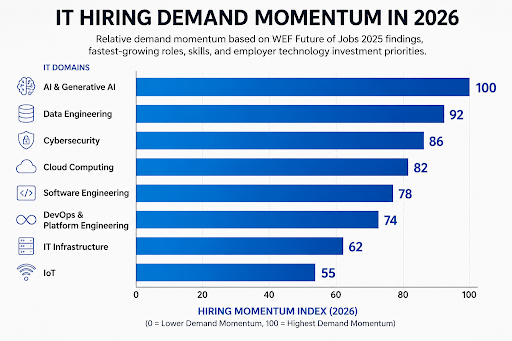
- AI & Generative AI: AI adoption is moving from experimentation to large-scale implementation. Companies are actively hiring talent to build, train, and deploy AI systems that improve automation, decision-making, and customer experience.
- Data Engineering: With increasing data generation across digital systems, organizations need strong data pipelines, storage systems, and real-time processing capabilities to power analytics and AI models.
- Cybersecurity: Rising digital threats, stricter regulations, and expanding cloud environments are pushing cybersecurity to the center of enterprise hiring priorities.
- Cloud Computing: Businesses are continuing their shift to cloud-first infrastructure, increasing demand for professionals who can design, manage, and optimize cloud environments.
- Software Development & Engineering: Despite automation tools, software engineers remain essential for building applications, integrating systems, and developing scalable digital products.
- DevOps & Platform Engineering: Companies are focusing on faster deployment cycles and automation, making DevOps and platform engineering critical for continuous delivery and system reliability.
- IT Infrastructure: Even in a cloud-heavy world, infrastructure remains foundational, especially for hybrid systems, enterprise networks, and internal IT operations.
- IoT (Internet of Things): The rise of connected devices across industries like manufacturing, healthcare, and smart cities is increasing demand for IoT integration and system-level engineering skills.
Top 5 Most In-Demand IT Jobs & Skills in 2026
As technology continues to evolve, IT hiring is shifting toward roles that support AI adoption, data-driven decision-making, cloud transformation, and digital security. While new tools and technologies keep emerging, companies are increasingly looking for professionals with strong technical skills that can solve real business problems.
Here are the top IT roles expected to see strong demand in 2026, along with the key skills needed to build a career in these areas.
1. AI Engineer / Machine Learning Engineer
AI and ML engineers build systems that can learn from data and make predictions or generate outputs. Their work usually sits between data, software, and product teams, making sure AI features actually work in real applications, not just in experiments.
A large part of the role includes training models, testing performance, improving accuracy, and deploying them into production systems. With generative AI becoming more common, the role is also shifting toward building applications that use LLMs and other foundation models in practical ways.
Key skills:
- Python: Core language for AI/ML development
- Machine Learning: Model building and training fundamentals
- Deep Learning: Neural networks for complex tasks
- Generative AI tools: Working with LLMs and AI APIs
- MLOps: Deploying and maintaining models in production
It’s a good fit for those interested in combining coding, data, and problem-solving to build AI-driven products.
2. Security Analyst / Cybersecurity Engineer
Security analysts and cybersecurity engineers focus on protecting systems, networks, and data from threats. Their work is less about building new systems and more about making sure existing ones stay safe, stable, and resistant to attacks.
On a day-to-day level, this can include monitoring security alerts, identifying suspicious activity, responding to incidents, and strengthening weak points in systems. As more companies move to cloud and remote infrastructure, the role is also expanding into securing distributed environments and managing risks across multiple platforms.
Key skills:
- Threat Detection: Identifying unusual patterns and potential security risks
- Network Security: Protecting internal and external network systems
- Ethical Hacking: Testing systems to find vulnerabilities before attackers do
- SOC Operations: Working in Security Operations Centers for monitoring and response
- Cloud Security: Securing cloud-based systems and applications
A good fit for individuals with the ability to understand system vulnerabilities and work with security monitoring tools and frameworks.
3. Data Scientist / Data Engineer
This role sits at the center of how modern companies use data. The focus is on collecting data from different systems, cleaning and structuring it, and then turning it into something that can be analyzed or used for decision-making. In many cases, this also supports AI and business intelligence systems that depend heavily on well-organized data.
While data scientists focus more on analysis and insights, data engineers spend more time building the pipelines and systems that make that data usable in the first place. For learners exploring how to become a data scientist, understanding the role of data engineering is equally important because strong analytical work depends on accurate, accessible, and well-structured data.
Key skills:
- SQL: Querying and managing structured data
- Python: Data processing and analysis
- Data Pipelines (ETL): Moving and transforming data across systems
- Data Visualization: Presenting insights clearly through charts and dashboards
- Cloud Data Tools: Working with platforms like AWS, Azure, or GCP for scalable data systems
Best suited for individuals with strong logical thinking, comfort working with large datasets, and the ability to translate raw data into structured, usable information for technical or business use.
4. Cloud Architect / Cloud Engineer
Cloud architects and cloud engineers focus on building and managing the infrastructure that modern applications run on. Their work ensures that systems are scalable, reliable, and can handle increasing user demand without breaking or slowing down.
In practice, this role involves designing cloud-based environments, setting up deployment systems, and making sure applications run efficiently across platforms. A big part of the job is also optimizing cost, improving performance, and maintaining system availability as businesses grow and shift toward cloud-first setups.
Key skills:
- AWS / Azure / GCP: Core cloud platforms used to design and host systems
- Kubernetes: Managing containerized applications at scale
- Docker: Packaging and running applications consistently across environments
- CI/CD Pipelines: Automating code deployment and updates
- Infrastructure as Code: Managing infrastructure through code instead of manual setup
Best suited for individuals with strong systems thinking, comfort working with distributed environments, and the ability to design and manage large-scale technical infrastructure.
5. Software Engineer (Full Stack / Backend)
Software engineers in full stack and backend roles are responsible for building the applications people use every day, along with the systems that power them behind the scenes. This includes everything from user-facing features to the server-side logic, databases, and integrations that keep applications running smoothly.
A large part of the work involves writing clean, scalable code, connecting different services through APIs, and making sure applications can handle real-world traffic and usage. As systems grow, system design also becomes important to ensure performance, reliability, and long-term maintainability.
Key skills:
- JavaScript / TypeScript: Building modern web applications
- APIs: Connecting services and enabling data exchange between systems
- System Design: Structuring applications for scale and performance
- Databases: Storing and managing application data efficiently
- Backend Frameworks: Building server-side logic and services
Best suited for individuals with strong coding fundamentals, logical problem-solving skills, and the ability to build and structure end-to-end application systems.
Start Building Future-Ready Skills with UniAthena
Technology roles are changing quickly, and staying relevant is about building the right skills that companies are actively looking for.
Whether you are exploring AI, data, or programming, developing strong fundamentals can help you understand how these technologies work and where they fit in real-world applications.
Learn In-Demand IT Skills Faster with UniAthena:
UniAthena’s short courses are designed to help learners build practical skills in a focused and structured way. Instead of spending months covering an entire technology domain, these courses help you learn specific skills that are useful across different roles.
From understanding AI concepts to working with data and building programming foundations, you can learn at your own pace and strengthen the technical skills needed for modern IT careers.
- Diploma in Artificial Intelligence: Learn the fundamentals of AI, including AI concepts, algorithms, learning models, and how intelligent systems solve real-world problems.
- Executive Diploma in Machine Learning: Learn how to apply machine learning concepts, algorithms, Python programming, and AI techniques to build predictive models and make data-driven decisions.
- Diploma in Data Analytics: Learn how to work with data, apply analytical techniques, and use insights to support better business decisions.
- Basics of Cyber Attacks & Threats: Learn how common cyber threats work and understand the basic practices used to identify and protect against security risks
- Basics of Python: Learn the fundamentals of Python programming, including syntax, variables, data structures, loops, functions, and basic coding concepts to build a strong programming foundation.
- Diploma in Management Information System: Learn how management information systems support business operations through data management, system development, decision support tools, cybersecurity fundamentals, and enterprise applications.
👉 Explore more short courses from UniAthena and find programs across technology, marketing, finance, supply chain, and other professional domains to build skills that match your career goals.
Conclusion
The IT job market in 2026 is being shaped by a few key technology areas — AI, data, cloud, cybersecurity, and software engineering. While specific job titles may continue to evolve, the demand for professionals with strong technical skills is expected to remain consistent.
Instead of trying to learn every new technology, focus on building strong foundations in skills that are widely used across industries. Whether you choose AI, data, security, cloud, or development, developing practical skills can help you prepare for the changing IT landscape.
FAQs
Q1. What are the most in-demand IT jobs in 2026?
A: AI engineers, cybersecurity professionals, data specialists, cloud engineers, and software developers are expected to see strong demand.
Q2. Which IT skills will be most valuable in 2026?
A: AI, cloud computing, cybersecurity, data analytics, programming, and automation skills will remain highly relevant.
Q3. Is AI a good career option in 2026?
A: Yes, AI offers growing opportunities as companies adopt machine learning and generative AI solutions across industries.
Q4. Do I need programming skills for an IT career?
A: Many IT roles require programming knowledge, especially in AI, software development, data, and automation-related fields.
Q5. Which cloud skills should I learn in 2026?
A: Cloud platforms like AWS, Azure, and GCP, along with Kubernetes and DevOps skills, are valuable.
Our Popular Courses

$14000


Doctoral Degree in Business Administration
Universidad Catolica De Murcia (UCAM), Spain
Duration:
2 - 3 Years
$17,500*
Integrated Doctorate of Business Administration
Guglielmo Marconi University, Italy
Universidad Catolica De Murcia (UCAM), Spain
Duration:
2.5 - 3.5 Years
$5,600*
Master of Business Administration
Guglielmo Marconi University, Italy
Duration:
12 - 24 Months
$5,600*
MBA in Operations & Project Management
Guglielmo Marconi University, Italy
Duration:
12 - 24 Months
$5,600*
Master in Supply Chain and Logistics Management
Guglielmo Marconi University, Italy
Duration:
12 - 24 Months
$5,950*
Master in Data Sciences
Guglielmo Marconi University, Italy
Duration:
12 - 24 Months
$5,600*
Master in Engineering Management
Guglielmo Marconi University, Italy
Duration:
12 - 24 Months
$5,600*
Master in Procurement and Contract Management
Guglielmo Marconi University, Italy
Duration:
12 - 24 Months
$5,600*
Master in Public Health
Guglielmo Marconi University, Italy
Duration:
12 - 24 MonthsOur Popular Courses
COMMENTS(0)
Our Popular Courses
$14000
Doctoral Degree in Business Administration
Universidad Catolica De Murcia (UCAM), Spain
Duration:
2 - 3 Years
$17,500*
Integrated Doctorate of Business Administration
Guglielmo Marconi University, Italy
Universidad Catolica De Murcia (UCAM), Spain
Duration:
2.5 - 3.5 Years
$5,600*
Master of Business Administration
Guglielmo Marconi University, Italy
Duration:
12 - 24 Months
$5,600*
MBA in Operations & Project Management
Guglielmo Marconi University, Italy
Duration:
12 - 24 Months
$5,600*
Master in Supply Chain and Logistics Management
Guglielmo Marconi University, Italy
Duration:
12 - 24 Months
$5,950*
Master in Data Sciences
Guglielmo Marconi University, Italy
Duration:
12 - 24 Months
$5,600*
Master in Engineering Management
Guglielmo Marconi University, Italy
Duration:
12 - 24 Months
$5,600*
Master in Procurement and Contract Management
Guglielmo Marconi University, Italy
Duration:
12 - 24 Months
$5,600*
Master in Public Health
Guglielmo Marconi University, Italy
Duration:
12 - 24 MonthsOur Popular Courses
Our Popular Insights
Careers are shifting faster than ever, and staying relevant takes more than experience. Explore UniAthena’s most-read blogs for sharp insights, emerging skills, and practical pathways that help you move forward with clarity and confidence in a changing professional world.









Get in Touch

It’s Time to Start
Join NowMost Popular Online Specialization
- Master of International Business Administration
- Master of Business Administration
- MBA in General Management- FastTrack
- Master in Innovation and Entrepreneurship
- MBA-Family Business Management
- Master in Procurement and Contract Management
- Extended Diploma in Business Analytics (SCQF Level 11)
- Diploma in Supply Chain and Logistics Management (SCQF Level 11)
- Strategic Human Resource Management Practitioner
- Master in Data Science
- Master in Engineering Management
Trending Online
- Integrated Doctorate of Business Administration
- Postgraduate Certificate in Finance for Next Generation Managers
- Master of Business Administration- General Management (Fast Track)
- Postgraduate Certificate in Socio-Economic and Legal Framework
- Postgraduate Certificate in Business Sustainability
- Certified Manager
- Supply Chain Management Practitioner
- MBA - AI in Business
- MBA - Accounting & Finance
- Master in Supply Chain and Logistics Management
Top Universities Online Certificates
- Postgraduate Certificate in International Marketing Management
- Postgraduate Certificate In International Human Resource Management
- Postgraduate Certificate in Strategic Management
- Postgraduate Certificate in Procurement & Contracts Management
- Postgraduate Certificate in Business Analytics
- Postgraduate Certificate in Strategic Supply Chain & Logistics Management
- Postgraduate Certificate in Human Resource and Leadership
- Project Management Practitioner
- Postgraduate Certificate in Supply Chain Design & Implementation
- Postgraduate Certificate in Management Accounting and Finance
Accredited Online Degree Program
- MBA - Digital Transformation
- MBA - Family Business Management
- MBA - Marketing Management
- MBA in Quality Management
- MBA - Business Intelligence & Data Analytics
- MBA in Operations & Project Management
- MBA in Energy Management
- MBA In Construction & Safety Management
- Master in Organisational Leadership
- Master in Public Health
- Master in Construction Management
- Bachelor of Arts in Business Administration


 Install Now


UniAthena is an Ed-Tech, offering flexible, affordable learning solutions, including Free-Learning Upskilling Courses and Academic Programs in partnerships with accredited and globally renowned universities and professional qualification bodies.


Do you have any questions ?
Feel free to send us your questions or request a free consultation
Send a message
UK
Athena Global Education
Magdalen Centre,
Robert Robinson Avenue,
Oxford, OX4 4GA, UK
Phone : 01865 784299
MIDDLE EAST
Athena Global Education FZE
Block L-03, First Floor,
P O Box 519265, Sharjah Publishing City,
Free Zone, Sharjah, UAE
Phone : +971 55 879 5492
INDIA
Uniathena Private Limited
9A,Midas Tower
Phase 1
Hinjewadi Rajiv Gandhi Infotech Park
Pune-411057
Phone: +91 9145665544
All Copyrights Reserved @ Athena Global Education 2021-2026