-

Bachelor's

-

Masters
-

MBA
-

Doctorate
-

Micro Credit
-

Explore all Courses
-
Postgraduate Certifications

-
Postgraduate Diploma
-
Undergraduate Diploma
-
Diploma



Are You Making Decisions — Or Is AI Making Them for You?

Author: malik basit ahmad
|6
MINS READ
| 0
| 71
Created On: 26 May, 2026
Share




Table of Contents (TOC):
- Introduction
- What is AI Decision Making?
- The Role of AI in Daily Life
- How AI Influences Everyday Decisions
- The Rise of Data-Driven Thinking
- Decision-Making AI Tools in Action
- The Mechanics: AI Decision-Making Algorithms
- Digital Behavior Tracking
- Disadvantages and Risks of AI in Daily Life
- AI Ethics and Responsibility
- Are We Still in Control?
- Final Thoughts
- References
Introduction
Decision-making has shifted significantly in recent years. What was once driven by human intuition is now increasingly influenced by algorithms, machine learning systems, and predictive analytics. AI decision-making is embedded in everyday experiences, often operating quietly in the background before users even realize it.
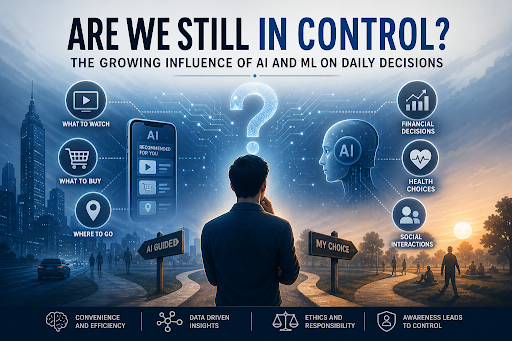
Modern AI systems do not simply predict behavior. They increasingly shape the options users see before decisions are even made.
From shopping recommendations and financial approvals to hiring systems and social media feeds, algorithmic systems influence visibility, attention, and choice at an unprecedented scale. This raises an increasingly important question: are individuals still making independent choices, or are digital systems gradually shaping decision-making environments on their behalf?
What is AI Decision Making?
To understand the shift, it is necessary to define what AI decision-making is. It involves the use of machine learning models and algorithms to analyze data and either support or automate decisions.
Key characteristics include:
- Dependence on large datasets
- Continuous learning and adaptation
- Ability to process complex patterns quickly
- Application across both personal and professional contexts
This form of AI-based decision-making is central to modern digital systems. However, unlike traditional software, these systems often evolve dynamically based on user behavior and ongoing data collection.
The Role of AI in Daily Life
The role of AI in daily life has expanded rapidly. AI is no longer limited to isolated technical systems; it increasingly influences routine activities, consumer behavior, and professional workflows.
Common examples include:
- Content recommendations on streaming platforms
- Smart assistants managing schedules and reminders
- E-commerce personalization systems
- Navigation systems adjusting routes in real time
- Algorithmic hiring systems filtering job applications
- AI credit scoring models influencing financial approvals
- Social media ranking systems determining content visibility
- Predictive policing systems used in some public-sector environments
These applications rely heavily on data-driven decisions. While they improve efficiency and personalization, they also create invisible layers of influence that shape how users interact with information, products, and opportunities.
How AI Influences Everyday Decisions
AI’s presence in daily life can be better understood through structured examples:
This reflects a broader shift toward algorithmically guided decision-making, where systems influence not only outcomes but also the information users are exposed to before making choices themselves.
The convenience is significant. However, the trade-off between personalization and autonomy is becoming increasingly important.
The Rise of Data-Driven Thinking
Modern organisations increasingly rely on data-informed decision-making to improve efficiency, reduce uncertainty, and strengthen competitiveness.
However, this shift has also changed how judgment itself is perceived.
Rather than relying primarily on intuition or professional experience:
- Metrics increasingly guide strategic choices
- Predictive systems influence operational priorities
- Optimization models shape performance expectations
- Algorithms evaluate probabilities faster than humans can
This has created what many describe as an “optimization culture,” where measurable outcomes are prioritized over qualitative judgment.
While data-driven systems improve speed and analytical precision, overreliance on metrics can also reduce independent thinking, discourage contextual judgment, and create decision paralysis when conflicting analytics emerge.
The challenge is no longer simply accessing information. It is determining when human judgment should override algorithmic confidence.
Decision-Making AI Tools in Action
A wide range of decision-making AI tools now support individuals and businesses.
Examples include:
- Budgeting apps analyzing spending behavior
- Career platforms recommending job pathways
- Health applications providing personalized insights
- Predictive analytics dashboards for marketing teams
- AI-powered financial reconciliation systems
- Educational platforms adapting learning pathways dynamically
Some tools are even marketed as the best free AI for decision-making, making advanced analytics increasingly accessible to non-technical users.
However, accessibility also increases dependency. As AI systems become embedded in routine workflows, many users may gradually outsource not only repetitive tasks but also portions of critical thinking and prioritization.
Also Read: Intelligent Analytics Explained: How AI Is Transforming Data Decisions
The Mechanics: AI Decision-Making Algorithms
Every AI system relies on an AI decision-making algorithm. These algorithms:
- Analyze structured and unstructured data
- Detect correlations, trends, and behavioral signals
- Generate predictions, rankings, or recommendations
- Continuously refine outputs using new data
Algorithmic outcomes are shaped by:
- Training data quality
- Model assumptions
- Optimization objectives
- Platform incentives
- Human design decisions
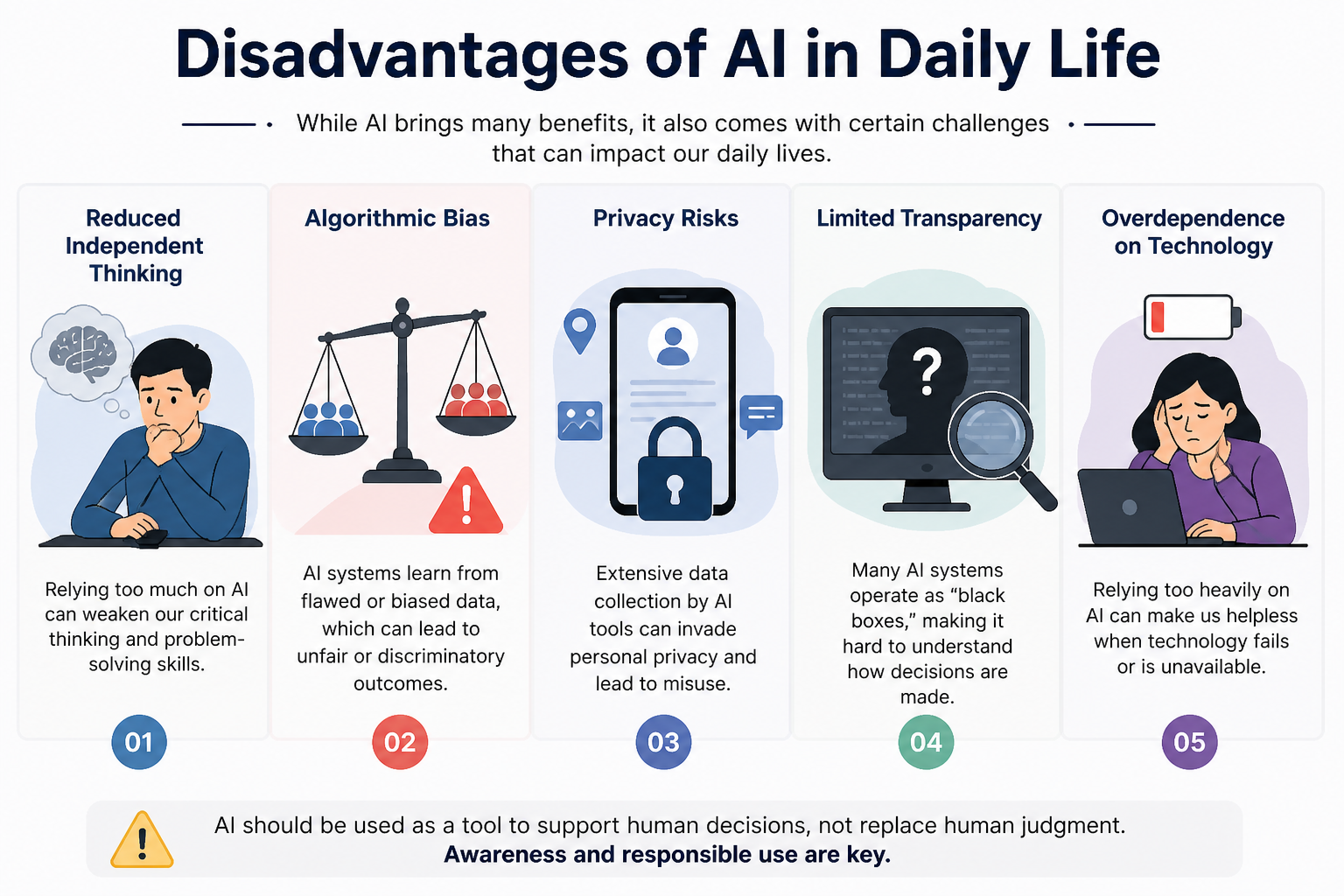
This means AI systems may unintentionally reinforce bias, prioritize engagement over accuracy, or influence behavior in ways users do not fully recognize.
Digital Behavior Tracking
AI systems function through continuous digital behavior tracking. This includes:
- Monitoring user interactions
- Collecting browsing and usage data
- Building detailed behavioral profiles
- Predicting preferences and future actions
This constant feedback loop improves personalization, but it also strengthens algorithmic influence.
In many digital ecosystems, recommendation systems do not simply respond to user behavior. They actively shape future behavior by controlling visibility, prioritizing content, and reinforcing engagement patterns.
This creates an important tension between convenience and surveillance, as well as between personalization and privacy.
Also Read: Agentic AI: Revolutionizing Autonomous Decision-Making in IT Systems
Disadvantages of AI in Daily Life
AI Ethics and Responsibility
As AI becomes more influential, AI ethics and responsibility are becoming central concerns rather than secondary discussions.
Critical issues include:
- Accountability for AI-driven outcomes
- Fairness and bias in algorithms
- Transparency in recommendation systems
- Opaque prioritization mechanisms
- Manipulative behavioral targeting
- Governance gaps around automated decision-making
Responsible implementation requires:
- Ethical data handling
- Clear governance frameworks
- Explainable AI systems
- Human oversight in high-impact decisions
- Stronger regulatory accountability
Without transparency, users may not fully understand how algorithmic systems shape the information, opportunities, and decisions presented to them.
Are We Still in Control?
AI does not completely replace human decision-making, but it increasingly shapes the environments in which decisions occur.
Control becomes more complicated when algorithms influence:
- What users see
- Which options are prioritized
- How information is ranked
- Which recommendations receive attention first
In many cases, influence happens before conscious decision-making even begins.
The most powerful AI systems do not force decisions directly. They quietly shape the context surrounding those decisions.
Maintaining meaningful autonomy, therefore, depends on:
- Awareness of algorithmic influence
- Critical evaluation of recommendations
- Willingness to challenge automated outputs
- Understanding how AI systems prioritize information
The central issue is no longer whether AI can make decisions efficiently. It is whether individuals still recognize how much of their thinking is already being shaped by algorithmic systems.
Also Read: How to Stay Relevant in a Future Powered by AI?
Final Thoughts
The integration of AI into modern decision-making has improved efficiency, personalization, and analytical precision across industries. However, it has also introduced new tensions involving autonomy, surveillance, bias, privacy, and cognitive dependency.
The future challenge is not simply balancing human and AI decision-making. It is understanding how invisible algorithmic systems increasingly influence attention, behavior, and judgment itself.
The professionals and individuals best prepared for this future may not be those who reject AI entirely, but those who remain capable of questioning how these systems shape the choices they believe they are making independently.
References:
1. Russell, S. and Norvig, P. (2021) Artificial Intelligence: A Modern Approach. 4th edn. Pearson.
2. McKinsey & Company (2023). The State of AI in 2023: Generative AI’s breakout year.
3. World Economic Forum (2022) Global Risks Report 2022.
4. MIT Sloan Management Review (2020) Expanding AI’s Impact With Organizational Learning.
Explore Related Courses












COMMENTS(0)
Explore Related Courses
Our Popular Insights
Careers are shifting faster than ever, and staying relevant takes more than experience. Explore UniAthena’s most-read blogs for sharp insights, emerging skills, and practical pathways that help you move forward with clarity and confidence in a changing professional world.






What is the Role of AI in Education?
Read More
4
mins read



What is the Role of AI in Education?
Read more
4
mins read
Get in Touch

It’s Time to Start
Join NowMost Popular Online Specialization
- Master of International Business Administration
- Master of Business Administration
- MBA in General Management- FastTrack
- Master in Innovation and Entrepreneurship
- MBA-Family Business Management
- Master in Procurement and Contract Management
- Extended Diploma in Business Analytics (SCQF Level 11)
- Diploma in Supply Chain and Logistics Management (SCQF Level 11)
- Strategic Human Resource Management Practitioner
- Master in Data Science
- Master in Engineering Management
Trending Online
- Integrated Doctorate of Business Administration
- Postgraduate Certificate in Finance for Next Generation Managers
- Master of Business Administration- General Management (Fast Track)
- Postgraduate Certificate in Socio-Economic and Legal Framework
- Postgraduate Certificate in Business Sustainability
- Certified Manager
- Supply Chain Management Practitioner
- MBA - AI in Business
- MBA - Accounting & Finance
- Master in Supply Chain and Logistics Management
Top Universities Online Certificates
- Postgraduate Certificate in International Marketing Management
- Postgraduate Certificate In International Human Resource Management
- Postgraduate Certificate in Strategic Management
- Postgraduate Certificate in Procurement & Contracts Management
- Postgraduate Certificate in Business Analytics
- Postgraduate Certificate in Strategic Supply Chain & Logistics Management
- Postgraduate Certificate in Human Resource and Leadership
- Project Management Practitioner
- Postgraduate Certificate in Supply Chain Design & Implementation
- Postgraduate Certificate in Management Accounting and Finance
Accredited Online Degree Program
- MBA - Digital Transformation
- MBA - Family Business Management
- MBA - Marketing Management
- MBA in Quality Management
- MBA - Business Intelligence & Data Analytics
- MBA in Operations & Project Management
- MBA in Energy Management
- MBA In Construction & Safety Management
- Master in Organisational Leadership
- Master in Public Health
- Master in Construction Management
- Bachelor of Arts in Business Administration


 Install Now


UniAthena is an Ed-Tech, offering flexible, affordable learning solutions, including Free-Learning Upskilling Courses and Academic Programs in partnerships with accredited and globally renowned universities and professional qualification bodies.


Do you have any questions ?
Feel free to send us your questions or request a free consultation
Send a message
UK
Athena Global Education
Magdalen Centre,
Robert Robinson Avenue,
Oxford, OX4 4GA, UK
Phone : 01865 784299
MIDDLE EAST
Athena Global Education FZE
Block L-03, First Floor,
P O Box 519265, Sharjah Publishing City,
Free Zone, Sharjah, UAE
Phone : +971 55 879 5492
INDIA
Uniathena Private Limited
9A,Midas Tower
Phase 1
Hinjewadi Rajiv Gandhi Infotech Park
Pune-411057
Phone: +91 9145665544
All Copyrights Reserved @ Athena Global Education 2021-2026