-

Bachelor's

-

Masters
-

MBA
-

Doctorate
-

Micro Credit
-

Explore all Courses
-
Postgraduate Certifications

-
Postgraduate Diploma
-
Undergraduate Diploma
-
Diploma



Could Quantum Tech Crack Your Encryption Tomorrow? Here’s What You Must Know
Author: priyanka chatterjee
|6
MINS READ
| 0
| 159
Created On: 27 October, 2025
Share




The digital world is evolving at a faster rate than ever. Encryption is essential to the security of every file we upload, payment we make, and business activity we conduct on the cloud. Traditional cryptography has protected our online privacy for many years. Despite its strength, it was not designed to withstand quantum computers. This presents a critical challenge for the future of encryption.
Imagine if a machine had the power to crack the most secure encryption keys available today in a few minutes. That device is the quantum computer, not science fiction, but a real technology emerging now. Even though it is still in the early stages of research, its emergence presents a significant threat to encrypted cloud storage and cloud network security. Organizations need to adopt quantum-safe cryptography, a new era of security, to stay ahead.
Source: Quantum-Safe Cryptography
The Reasons Cloud Security Is a Quantum Challenge
The core of modern business is cloud computing. Nowadays, practically everything relies on the cloud, from managing large internet services to storing images and corporate documents. We rely on it to protect and preserve our information.
Strong locks, or digital codes, have been the foundation of cloud security for many years. These codes keep hackers from accessing our data. These locks are strong enough to prevent the majority of modern cyberattacks. However, a new technology called quantum computing is emerging that has the potential to break these locks more quickly than before.
Normal computers are not the same as quantum computers. They execute multiple calculations simultaneously by utilizing the strange laws of quantum science. They can therefore resolve issues that would take modern computers thousands of years to resolve in a matter of minutes.
Even the most robust cloud data security may be unlocked by such devices if they grow sufficiently powerful. Experts have already issued a warning that hackers may start storing encrypted data now in order to decode it when quantum computers become available. This indicates that the threat is present and is already gradually growing.
For this reason, businesses and researchers are already developing quantum-safe cryptography, a novel form of digital security that will remain robust even in the era of quantum computing. This new strategy seeks to protect cloud data from both today's hackers and tomorrow's powerful computers.
Basically, our protection needs to change along with technology. The emergence of quantum computing indicates that we need to reconsider how we secure the cloud, which has provided us with speed, storage, and flexibility.
What is Quantum-Safe Cryptography?
A modern way of protecting digital information that will remain secure even when powerful quantum computers expand in the future is quantum-safe cryptography. It is often referred to as quantum-secure cryptography or post-quantum cryptography.
Our online data, such as emails, bank account information, and cloud files, has long been secured through traditional encryption techniques. Although these techniques are effective against conventional computers, quantum computers' extraordinary speed and power may eventually overcome them.
Currently, the majority of internet systems, such as those used for online shopping and cloud file storage, employ conventional encryption techniques to protect data. These techniques are robust against modern computers, but given their incredible speed and processing capacity, future quantum machines could quickly surpass them.
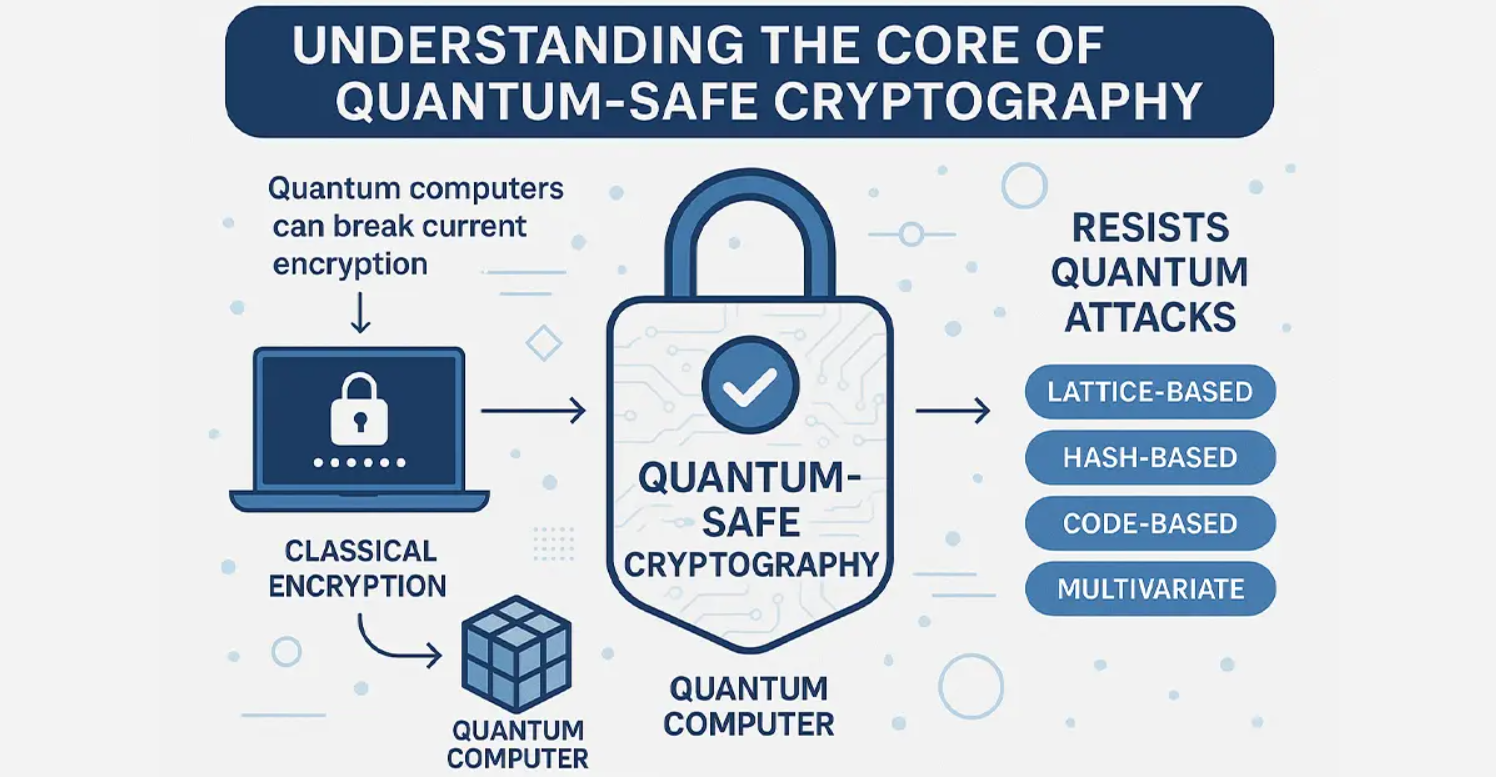
The new kinds of digital locks created by quantum-safe cryptography are difficult for even quantum computers to crack. Smarter mathematical designs that are impervious to quantum attacks are used in these new locks.
Some of the primary categories of quantum-safe techniques in development are as follows:
- Lattice-based cryptography:
Consider a lattice as a large three-dimensional numerical grid. The "key" to unlocking information is hidden deep within this grid in this approach. This method is particularly safe since it would take a very long time for even a quantum computer to detect it.
- Hash-based signatures:
By assigning a distinct "fingerprint" or code to each digital message or file, this technique secures them. The fingerprint no longer matches if the message is altered, which contributes to the message's authenticity and integrity.
- Multivariate polynomial cryptography:
This method locks data by combining multiple mathematical equations. Even with quantum computers, hackers cannot readily obtain the correct key since the equations are simple to build but very difficult to reverse-engineer.
- Code-based encryption:
This technique hides data within complex, lengthy patterns, or "codes." These codes are extremely difficult to understand and read without the correct key, even for highly capable quantum computers.
To put it simply, quantum-safe cryptography is similar to creating unbreakable digital boundaries that protect data from future supercomputers.
Source: Quantum-safe cryptography
What Is the Technique of Post-Quantum Cryptography?
Post-quantum cryptography operates solely using mathematics, whereas quantum cryptography applications, such as quantum key distribution (QKD), depend on physics. Like current encryption, it may be implemented in software and doesn't require specialized hardware.
For instance, lattice-based systems use intricate geometric issues that are computationally challenging for both classical and quantum computers to produce keys. One-way mathematical functions that are resistant to quantum decryption are used in hash-based signatures. The goal is to make sure that the encryption time cannot be shortened from thousands of years to a few minutes, not even by a quantum computer.
Because of this, post-quantum cryptography is a viable way to improve cloud computing security without completely rebuilding existing infrastructures.
Why Cloud Security Requires Quantum-Safe Encryption
The stakes are really high. Cloud service providers and businesses handle private financial, medical, and personal information. A quantum-enabled breach might reveal intellectual property, private data, or national security secrets globally.
Here's how cloud security encryption is strengthened by quantum-safe cryptography:
- Encrypted Cloud Storage: Prevents future quantum attacks from decrypting files.
- Cloud Network Security: Preserves end-user and cloud service communications
- Cybersecurity Quantum Computing Defense: Increases resistance to novel attack types powered by quantum computing.
- Future-Proof Compliance: Prepares for laws that might ask for quantum-resistant cryptography in the near future.
Quantum-Safe Algorithms: A Key Step Toward a Secure Future
It will take time for cryptographic algorithms to switch to quantum-resistant ones. Governments, businesses, and cloud service providers need to begin implementing hybrid strategies that blend quantum-safe algorithms with traditional encryption. This prepares for the quantum era while guaranteeing compatibility.
Companies that start implementing quantum-safe encryption algorithms now will have a competitive edge in security and compliance as research continues to advance globally.
Final Thoughts
The quantum future is unavoidable, and it carries risk and innovation. The competition between quantum computing and cryptographers is already underway. Even though it might take a few years for quantum computers to completely crack encryption, adversaries are already storing encrypted data for later decryption. Therefore, now is the ideal moment to implement quantum-safe cryptography.
Adopting quantum-safe encryption methods is essential for businesses using cloud platforms in order to guarantee resistance against future cyber threats. Organizations may protect data, uphold trust, and remain ahead of the curve in the rapidly changing field of cloud security by adopting quantum secure cryptography.
Explore Related Courses









COMMENTS(0)
Explore Related Courses
Our Popular Insights
Careers are shifting faster than ever, and staying relevant takes more than experience. Explore UniAthena’s most-read blogs for sharp insights, emerging skills, and practical pathways that help you move forward with clarity and confidence in a changing professional world.




How to Switch Career to Data Analytics?
Read More
6
mins read



How to Switch Career to Data Analytics?
Read more
6
mins read

Get in Touch

It’s Time to Start
Join NowMost Popular Online Specialization
- Master of International Business Administration
- Master of Business Administration
- MBA in General Management- FastTrack
- Master in Innovation and Entrepreneurship
- MBA-Family Business Management
- Master in Procurement and Contract Management
- Extended Diploma in Business Analytics (SCQF Level 11)
- Diploma in Supply Chain and Logistics Management (SCQF Level 11)
- Strategic Human Resource Management Practitioner
- Master in Data Science
- Master in Engineering Management
Trending Online
- Integrated Doctorate of Business Administration
- Postgraduate Certificate in Finance for Next Generation Managers
- Master of Business Administration- General Management (Fast Track)
- Postgraduate Certificate in Socio-Economic and Legal Framework
- Postgraduate Certificate in Business Sustainability
- Certified Manager
- Supply Chain Management Practitioner
- MBA - AI in Business
- MBA - Accounting & Finance
- Master in Supply Chain and Logistics Management
Top Universities Online Certificates
- Postgraduate Certificate in International Marketing Management
- Postgraduate Certificate In International Human Resource Management
- Postgraduate Certificate in Strategic Management
- Postgraduate Certificate in Procurement & Contracts Management
- Postgraduate Certificate in Business Analytics
- Postgraduate Certificate in Strategic Supply Chain & Logistics Management
- Postgraduate Certificate in Human Resource and Leadership
- Project Management Practitioner
- Postgraduate Certificate in Supply Chain Design & Implementation
- Postgraduate Certificate in Management Accounting and Finance
Accredited Online Degree Program
- MBA - Digital Transformation
- MBA - Family Business Management
- MBA - Marketing Management
- MBA in Quality Management
- MBA - Business Intelligence & Data Analytics
- MBA in Operations & Project Management
- MBA in Energy Management
- MBA In Construction & Safety Management
- Master in Organisational Leadership
- Master in Public Health
- Master in Construction Management
- Bachelor of Arts in Business Administration


 Install Now


UniAthena is an Ed-Tech, offering flexible, affordable learning solutions, including Free-Learning Upskilling Courses and Academic Programs in partnerships with accredited and globally renowned universities and professional qualification bodies.


Do you have any questions ?
Feel free to send us your questions or request a free consultation
Send a message
UK
Athena Global Education
Magdalen Centre,
Robert Robinson Avenue,
Oxford, OX4 4GA, UK
Phone : 01865 784299
MIDDLE EAST
Athena Global Education FZE
Block L-03, First Floor,
P O Box 519265, Sharjah Publishing City,
Free Zone, Sharjah, UAE
Phone : +971 55 879 5492
INDIA
Uniathena Private Limited
9A,Midas Tower
Phase 1
Hinjewadi Rajiv Gandhi Infotech Park
Pune-411057
Phone: +91 9145665544
All Copyrights Reserved @ Athena Global Education 2021-2026