-

Bachelor's

-

Masters
-

MBA
-

Doctorate
-

Micro Credit
-

Explore all Courses
-
Postgraduate Certifications

-
Postgraduate Diploma
-
Undergraduate Diploma
-
Diploma



How to Become a Chief Marketing Officer (CMO)

Author: aishwarya sancheti
|9
MINS READ
| 0
| 3
Created On: 28 July, 2026
Share




Table of Contents (TOC):
- Introduction
- Key Takeaways
- What Is a Chief Marketing Officer?
- What Does a CMO Do? Roles and Responsibilities
- Steps to Become a Chief Marketing Officer
- Chief Marketing Officer Requirements and Qualifications
- Marketing Leadership Skills That Actually Matter at the Executive Level
- Chief Marketing Officer Salary
- Career Growth in Marketing: The Bigger Picture
- Chief Marketing Officer Certification: Does It Help?
- DBA for Marketing Professionals: Why It's Becoming the CMO Differentiator
- CMO Career Path with a DBA: What Changes
- Conclusion
- FAQs
Introduction
The CMO chair is the shortest-tenured seat in the C-suite - Spencer Stuart's 2026 tenure study puts the average at just 4.1 years for S&P 500 companies, versus 9 years for CEOs. That's not a reason to avoid the role. It's a reason to walk in prepared, with the strategic depth that keeps you in the room when budgets get cut, and boards start asking "what's the ROI on marketing?"
Let's break down what a CMO actually does, the real path to get there, what the role pays, and why a growing number of senior marketers are adding a Doctor of Business Administration (DBA) to their credentials before they make the jump.
Key Takeaways:
- Modern CMOs are strategic business leaders responsible for driving revenue, customer growth, and long-term business performance, not just marketing campaigns.
- The most successful CMOs combine marketing expertise with financial acumen, executive leadership, research capability, and cross-functional decision-making.
- Career progression typically moves from marketing specialization to leadership roles with increasing responsibility for teams, budgets, and business outcomes.
- Advanced qualifications such as a Doctor of Business Administration (DBA) in Marketing help experienced professionals strengthen strategic thinking, boardroom credibility, and evidence-based decision-making.
- As organizations become increasingly data-driven and AI-enabled, executive marketers who can connect marketing strategy with business strategy are better positioned for long-term C-suite success.
What Is a Chief Marketing Officer?
A Chief Marketing Officer is the senior-most executive responsible for a company's marketing function - brand strategy, demand generation, customer experience, product marketing, and increasingly, revenue growth. CMO stands for Chief Marketing Officer in business, and the role typically reports directly to the CEO, sitting alongside the CFO and COO in strategic decision-making.
Unlike a VP of Marketing, who usually owns execution within a defined budget, a CMO owns the marketing P&L, sets multi-year strategy, and is accountable to the board for how marketing spend translates into revenue.
What Does a CMO Do? Roles and Responsibilities
CMO roles and responsibilities vary by company size and industry, but the core mandate is consistent:
- Brand Strategy and Positioning: Defining how the company is perceived across every market it competes in.
- Revenue and Growth Ownership: Increasingly, CMOs are measured on pipeline and revenue contribution, not just awareness metrics.
- Marketing P&L Management: Budgeting, forecasting, and justifying spend to the CFO and board.
- Cross-Functional Leadership: Aligning marketing with sales, product, and customer success (the strength of the CMO-sales relationship is one of the strongest predictors of how long a CMO stays in the role).
- Data and Martech Strategy: Overseeing the analytics, AI, and automation stack that marketing now runs on.
- Talent Development: Building and retaining a marketing organization that can execute at speed.
Steps to Become a Chief Marketing Officer
There's no single door into the CMO office, but the path almost always runs through these stages.
1. Build a functional specialty first. Most CMOs don't start as generalists; they go deep in one channel (content, performance marketing, product marketing, or brand) before broadening out. Depth builds credibility; breadth comes later.
2. Move into people management early. Executive search data consistently shows that CMOs who managed teams and budgets by their early career stages advanced faster than those who stayed purely individual contributors.
3. Take a P&L or revenue-adjacent role. VP of Marketing, VP of Growth, or Head of Demand Generation - any role where you're accountable for a number the CFO cares about is a near-mandatory stepping stone.
4. Get board and cross-functional exposure. Present to leadership, sit in on sales and product planning, and learn to speak the language of financial performance, not just campaign metrics.
5. Formalize your strategic credentials. This is where many experienced marketers hit a ceiling not because they lack marketing skill, but because they lack the formal strategic, financial, and research credentials boards look for at the CMO level. This is the gap a Doctor of Business Administration in Marketing is built to close (more on this below).
6. Target the CMO seat - internally or externally. Internal promotions happen when a company sees you already operating at the strategic level. External moves happen when your track record and credentials are strong enough for a search firm or board to bet on you.
Chief Marketing Officer Requirements and Qualifications
Typical chief marketing officer qualifications include:
- A bachelor's degree in marketing, business, or a related field (near-universal baseline)
- 10 - 15+ years of progressive marketing experience, including significant P&L or budget ownership
- A master's degree (MBA or marketing-focused) - increasingly common, though not universally required
- Demonstrated revenue impact, not just campaign output
- Strong cross-functional and board-level communication skills
For candidates competing at the top end of the market, an advanced doctoral qualification, such as a DBA, may serve as a valuable differentiator for certain executive opportunities.
Marketing Leadership Skills That Actually Matter at This Level
Chief marketing officer skills split into two categories: the marketing craft itself, and the executive skills that determine whether you survive in the seat.
- Marketing Craft: Brand architecture, customer segmentation, marketing analytics, digital and AI-driven marketing, pricing strategy.
- Executive-Level Skills: Financial literacy (P&L fluency, forecasting, ROI modeling), strategic decision-making under ambiguity, organizational leadership, negotiation with the C-suite, and applied research skills to validate strategy before it's presented to the board.
That second list is exactly what a doctoral-level business program is designed to build, which is why marketing leadership skills and DBA coursework overlap so heavily.
Chief Marketing Officer Salary
CMO compensation varies widely by data source and company size, so it's worth looking at the range rather than a single number:
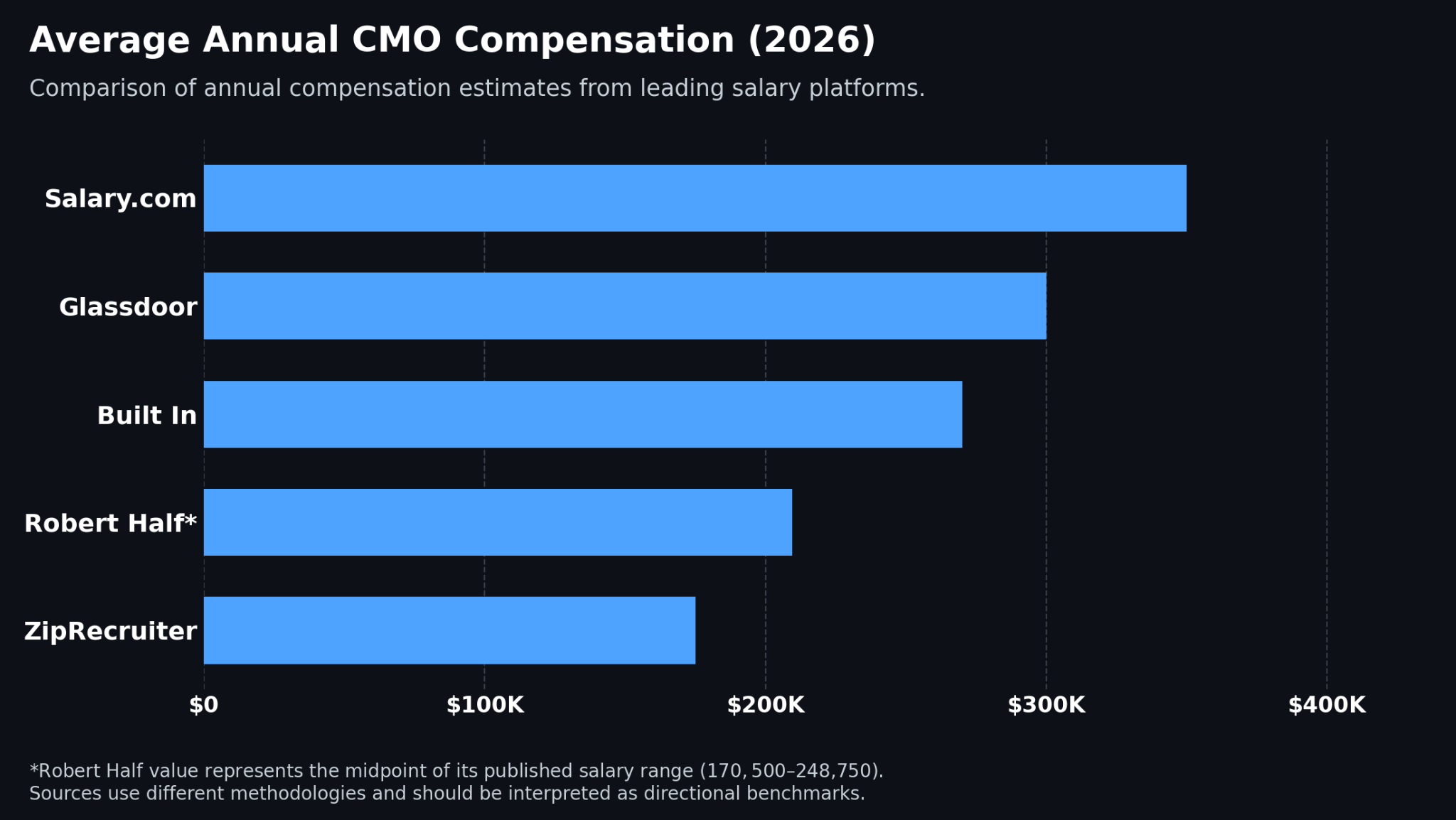
The spread reflects methodology (crowdsourced vs. employer-reported), company size, and geography; CMOs in Palo Alto, San Jose, and New York consistently earn 30-60% above the national average.
Compensation also climbs sharply with an advanced degree: Glassdoor's data specifically flags a graduate degree as one of the clearest levers for pushing into the top salary bracket.
Career Growth in Marketing: The Bigger Picture
The job market backs up the opportunity. The U.S. Bureau of Labor Statistics projects employment of advertising, promotions, and marketing managers to grow 6% from 2024 to 2034 - faster than the average for all occupations with about 36,400 openings projected annually. Marketing managers held roughly 407,000 jobs in 2024, and the median annual wage for the occupation was $161,030 as of May 2024.
Career opportunities in marketing are also expanding upward, not just outward. More companies are creating Chief Growth Officer and Chief Revenue Officer roles alongside the traditional CMO seat, which means marketing leaders with strong financial and strategic training are being pulled into broader P&L roles beyond marketing alone.
Chief Marketing Officer Certification: Does It Help?
Certifications (Google, HubSpot, Kellogg, or specialized brand and growth marketing credentials) are useful for staying current on specific tools and channels. But at the CMO level, boards and CEOs are evaluating something certifications don't fully capture: your ability to conduct original strategic analysis, defend decisions with data, and think like an owner of the business, not just a marketing department.
That's the exact gap a doctoral qualification is designed to close, and it's why more senior marketers are looking past short-form certifications toward a full DBA.
DBA for Marketing Professionals: Why It's Becoming the CMO Differentiator
A Doctor of Business Administration is a practice-oriented doctoral degree, distinct from a PhD, built for experienced professionals who want to apply rigorous research to real business problems rather than pursue purely academic careers.
The data on its value is compelling:
- Professionals with a doctoral degree earn a median weekly wage of $2,278, compared to $1,840 for a master's degree - a meaningful, measurable gap according to BLS-sourced data.
- 85% of professional doctorate graduates report that their degree directly facilitated a promotion or career change, and 97% received a full-time offer within six months of graduating.
- Roles commonly pursued by DBA graduates, including marketing management, are projected to grow significantly faster than average, with marketing management roles specifically projected to rise around 80% through 2033.
CMO Career Path with a DBA: What Changes
An Online DBA in Marketing Management doesn't teach you marketing from scratch; you already know that. What it adds is the layer boards are increasingly demanding:
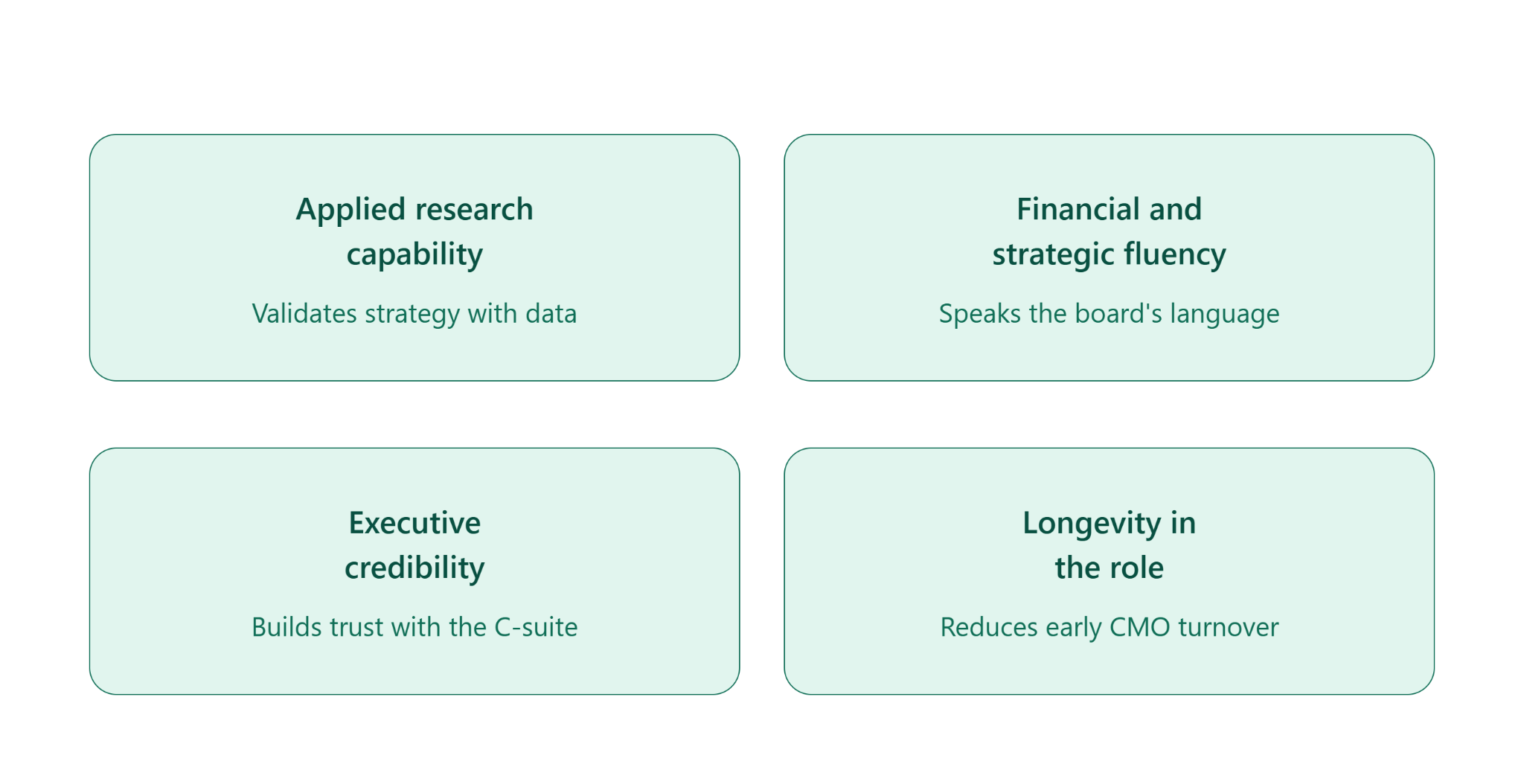
- Applied Research Capability: the ability to validate a market strategy with original data before it goes to the board, not just intuition or a competitor benchmark.
- Financial and Strategic Fluency: closing the gap between "marketing leader" and "business leader," which is often the exact reason internal candidates get passed over for the CMO seat.
- Executive Credibility: a doctoral credential signals to search firms and boards that you can operate at the same strategic altitude as the CFO and CEO, not just report to them.
- Longevity in the Role: given how short CMO tenure already is, arriving with strategic and financial depth, not just campaign expertise, is one of the clearest ways to avoid becoming a fast statistic.
If you're already operating at VP or senior director level and the next step is the C-suite, a Doctor of Business Administration in Marketing Management - 180 ECTS, completed online, alongside your current role is one of the most direct ways to build that credibility without pausing your career to do it.
Conclusion
Great marketers build brands. Great CMOs build businesses.
The difference lies in how they think, not just what they know. As marketing continues to evolve into a boardroom function, the professionals who combine commercial insight, research capability, and strategic leadership will be the ones shaping the next generation of organizations.
FAQs
Q1. What is a Chief Marketing Officer?
A: A CMO is the senior executive responsible for a company's overall marketing strategy, brand, and increasingly its revenue growth, reporting directly to the CEO.
Q2. What does CMO stand for in business?
A: CMO stands for Chief Marketing Officer - the top marketing role in a company's executive leadership team.
Q3. How do you become a Chief Marketing Officer?
A: Through 10 - 15+ years of progressive marketing experience with increasing P&L and leadership responsibility, typically moving through VP-level roles, and increasingly, advanced credentials like an MBA or DBA to compete for the seat at larger companies.
Q4. What does a CMO do day to day?
A: A CMO splits time between strategic planning, board and executive reporting, budget management, cross-functional alignment with sales and product, and oversight of the marketing organization's execution.
Q5. What is the average Chief Marketing Officer salary?
A: Estimates range from roughly $161,000 to $374,000+ depending on the data source, company size, and location, with top earners at large companies exceeding $500,000 in total compensation.
Q6. How long do CMOs typically stay in the role?
A: About 4.1 years on average at S&P 500 companies as of 2026.
Q7. Do you need an MBA or DBA to become a CMO?
A: It's not always mandatory, but advanced degrees are increasingly common among sitting CMOs, and a DBA in particular is gaining traction as a differentiator for marketers targeting the top of the C-suite, since it builds financial and research rigor beyond standard marketing expertise.
Q8. What's the difference between a DBA and an MBA for marketing professionals?
A: An MBA builds broad managerial knowledge, typically earlier in a career. A DBA is a terminal doctoral degree aimed at experienced professionals, focused on applied research to solve real strategic problems - better suited to marketers already in senior roles who need to justify strategy at the board level.
Q9. Is an online DBA in Marketing respected by employers?
A: Yes, online doctoral programs are now mainstream for working executives, and what matters to employers is accreditation and applied rigor, not delivery format. Most DBA candidates are already working professionals completing the degree alongside full-time roles.
Our Popular Courses

$14000


Doctoral Degree in Business Administration
Universidad Catolica De Murcia (UCAM), Spain
Duration:
2 - 3 Years
$17,500*
Integrated Doctorate of Business Administration
Guglielmo Marconi University, Italy
Universidad Catolica De Murcia (UCAM), Spain
Duration:
2.5 - 3.5 Years
$5,600*
Master of Business Administration
Guglielmo Marconi University, Italy
Duration:
12 - 24 Months
$5,600*
MBA in Operations & Project Management
Guglielmo Marconi University, Italy
Duration:
12 - 24 Months
$5,600*
Master in Supply Chain and Logistics Management
Guglielmo Marconi University, Italy
Duration:
12 - 24 Months
$5,950*
Master in Data Sciences
Guglielmo Marconi University, Italy
Duration:
12 - 24 Months
$5,600*
Master in Engineering Management
Guglielmo Marconi University, Italy
Duration:
12 - 24 Months
$5,600*
Master in Procurement and Contract Management
Guglielmo Marconi University, Italy
Duration:
12 - 24 Months
$5,600*
Master in Public Health
Guglielmo Marconi University, Italy
Duration:
12 - 24 MonthsOur Popular Courses
COMMENTS(0)
Our Popular Courses
$14000
Doctoral Degree in Business Administration
Universidad Catolica De Murcia (UCAM), Spain
Duration:
2 - 3 Years
$17,500*
Integrated Doctorate of Business Administration
Guglielmo Marconi University, Italy
Universidad Catolica De Murcia (UCAM), Spain
Duration:
2.5 - 3.5 Years
$5,600*
Master of Business Administration
Guglielmo Marconi University, Italy
Duration:
12 - 24 Months
$5,600*
MBA in Operations & Project Management
Guglielmo Marconi University, Italy
Duration:
12 - 24 Months
$5,600*
Master in Supply Chain and Logistics Management
Guglielmo Marconi University, Italy
Duration:
12 - 24 Months
$5,950*
Master in Data Sciences
Guglielmo Marconi University, Italy
Duration:
12 - 24 Months
$5,600*
Master in Engineering Management
Guglielmo Marconi University, Italy
Duration:
12 - 24 Months
$5,600*
Master in Procurement and Contract Management
Guglielmo Marconi University, Italy
Duration:
12 - 24 Months
$5,600*
Master in Public Health
Guglielmo Marconi University, Italy
Duration:
12 - 24 MonthsOur Popular Courses
Our Popular Insights
Careers are shifting faster than ever, and staying relevant takes more than experience. Explore UniAthena’s most-read blogs for sharp insights, emerging skills, and practical pathways that help you move forward with clarity and confidence in a changing professional world.

What is the usage of Power BI?
Read More
5
mins read





How to Switch Career to Data Analytics?
Read More
6
mins read

What is the usage of Power BI?
Read more
5
mins read
How to Switch Career to Data Analytics?
Read more
6
mins read

Get in Touch

It’s Time to Start
Join NowMost Popular Online Specialization
- Master of International Business Administration
- Master of Business Administration
- MBA in General Management- FastTrack
- Master in Innovation and Entrepreneurship
- MBA-Family Business Management
- Master in Procurement and Contract Management
- Extended Diploma in Business Analytics (SCQF Level 11)
- Diploma in Supply Chain and Logistics Management (SCQF Level 11)
- Strategic Human Resource Management Practitioner
- Master in Data Science
- Master in Engineering Management
Trending Online
- Integrated Doctorate of Business Administration
- Postgraduate Certificate in Finance for Next Generation Managers
- Master of Business Administration- General Management (Fast Track)
- Postgraduate Certificate in Socio-Economic and Legal Framework
- Postgraduate Certificate in Business Sustainability
- Certified Manager
- Supply Chain Management Practitioner
- MBA - AI in Business
- MBA - Accounting & Finance
- Master in Supply Chain and Logistics Management
Top Universities Online Certificates
- Postgraduate Certificate in International Marketing Management
- Postgraduate Certificate In International Human Resource Management
- Postgraduate Certificate in Strategic Management
- Postgraduate Certificate in Procurement & Contracts Management
- Postgraduate Certificate in Business Analytics
- Postgraduate Certificate in Strategic Supply Chain & Logistics Management
- Postgraduate Certificate in Human Resource and Leadership
- Project Management Practitioner
- Postgraduate Certificate in Supply Chain Design & Implementation
- Postgraduate Certificate in Management Accounting and Finance
Accredited Online Degree Program
- MBA - Digital Transformation
- MBA - Family Business Management
- MBA - Marketing Management
- MBA in Quality Management
- MBA - Business Intelligence & Data Analytics
- MBA in Operations & Project Management
- MBA in Energy Management
- MBA In Construction & Safety Management
- Master in Organisational Leadership
- Master in Public Health
- Master in Construction Management
- Bachelor of Arts in Business Administration


 Install Now


UniAthena is an Ed-Tech, offering flexible, affordable learning solutions, including Free-Learning Upskilling Courses and Academic Programs in partnerships with accredited and globally renowned universities and professional qualification bodies.


Do you have any questions ?
Feel free to send us your questions or request a free consultation
Send a message
UK
Athena Global Education
Magdalen Centre,
Robert Robinson Avenue,
Oxford, OX4 4GA, UK
Phone : 01865 784299
MIDDLE EAST
Athena Global Education FZE
Block L-03, First Floor,
P O Box 519265, Sharjah Publishing City,
Free Zone, Sharjah, UAE
Phone : +971 55 879 5492
INDIA
Uniathena Private Limited
9A,Midas Tower
Phase 1
Hinjewadi Rajiv Gandhi Infotech Park
Pune-411057
Phone: +91 9145665544
All Copyrights Reserved @ Athena Global Education 2021-2026