-

Bachelor's

-

Masters
-

MBA
-

Doctorate
-

Micro Credit
-

Explore all Courses
-
Postgraduate Certifications

-
Postgraduate Diploma
-
Undergraduate Diploma
-
Diploma



Mining the Moon: Is Space Law Ready for the Next Gold Rush?
Author: rinta george
|3
MINS READ
| 0
| 156
Created On: 04 July, 2025 Updated On: 25 July, 2025
Share




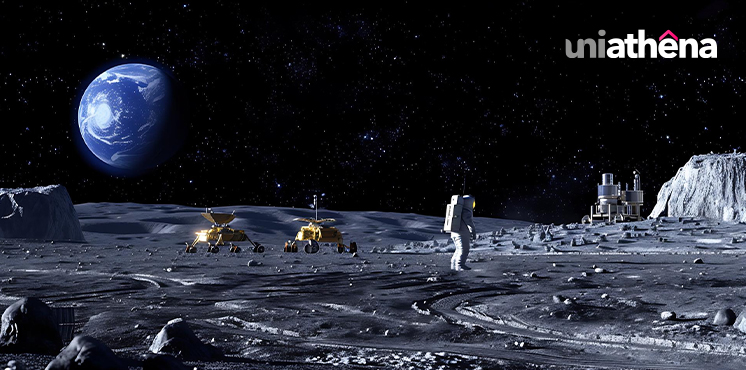
Human beings have looked at the shining hue of the Moon for centuries, curious about its mystery. Today, with increasing space travel to the moon and revived moon missions by NASA and private space firms, the fantasy of mining the Moon is becoming a real possibility. But as we make inquiries about the cycles of the Moon and embark on resource extraction, a vexing question emerges—Is space law ready for the next gold rush?
Why Mine the Moon?
The moon's terrain is not an empty field. Under the rugged surface are precious minerals on the moon—rare elements that would revolutionize industries on Earth. One of the most thrilling possibilities is HELIUM-3, an isotope seldom discovered on Earth but plentiful on the moon. The isotope can be used to power nuclear fusion reactors, yielding clean, virtually limitless energy for centuries.
Helium-3 mining alone can ignite a whole new industry for energy. Other minerals available on the Moon are rare earth elements, platinum, titanium, and silicon—essential materials for technology and building. With NASA's Artemis mission and other global initiatives gearing up, lunar mining is no longer science fiction—it's almost real.
How Would Moon Mining Work?
Technological innovation in robotics, 3D printing, and artificial intelligence is being researched to efficiently mine lunar resources. Equipment may be used to extract and process lunar minerals on the spot, eliminating the need for expensive shipment back to Earth.
Moreover, water ice that can be discovered at the poles of the Moon may be split into oxygen and hydrogen for rocket fuel, making the Moon a space travel refuelling station for more solar system and moon exploration. However, while technology continues to advance, the legal framework around lunar mining remains outdated and underdeveloped.
What Is the Law?
Currently, the international law space is governed by the Outer Space Treaty (1967), which states that no nation can claim ownership of celestial bodies, including the Moon. However, it’s vague when it comes to the legality of space mining. Can a private company own what it extracts? Can countries regulate or tax moon mining?
Some nations have passed domestic laws—such as the U.S. Commercial Space Launch Competitiveness Act (2015) and Luxembourg’s Space Resources Law—recognizing companies’ rights to lunar mining profits. NASA’s Artemis Accords also propose international guidelines, but critics argue they favor powerful spacefaring nations, leaving gaps in equitable access.
The question remains—can space regulations keep up with the commercial rush toward helium-3 mining ventures?
The Ethical and Legal Challenges Ahead
The lack of clear space rules creates potential conflicts. Who ensures the environmental protection of the Moon? How will disputes between nations or companies be resolved? And how will international law in space evolve to balance exploration, exploitation, and preservation?
Moreover, as humanity looks at the Earth from the Moon, we must ask: Will we treat the Moon better than we’ve treated Earth’s own resources?
Conclusion
With the current moon phase slowly transitioning, humanity stands on the cusp of a new era, not just of exploration but of extraction. The distance to the Moon may be shrinking thanks to advanced lunar landing missions, but the legal distance we need to cover to establish fair and sustainable space mining law remains vast.
As NASA, private companies, and other nations gear up for the next moon mission, the world must address one critical issue: Before we start mining the Moon’s riches, we must mine our collective wisdom to build a legal framework worthy of the future.
Source:
Explore Related Courses









COMMENTS(0)
Explore Related Courses
Our Popular Insights
Careers are shifting faster than ever, and staying relevant takes more than experience. Explore UniAthena’s most-read blogs for sharp insights, emerging skills, and practical pathways that help you move forward with clarity and confidence in a changing professional world.


What is the usage of Power BI?
Read More
5
mins read





How to Switch Career to Data Analytics?
Read More
6
mins read

What is the usage of Power BI?
Read more
5
mins read
How to Switch Career to Data Analytics?
Read more
6
mins read
Get in Touch

It’s Time to Start
Join NowMost Popular Online Specialization
- Master of International Business Administration
- Master of Business Administration
- MBA in General Management- FastTrack
- Master in Innovation and Entrepreneurship
- MBA-Family Business Management
- Master in Procurement and Contract Management
- Extended Diploma in Business Analytics (SCQF Level 11)
- Diploma in Supply Chain and Logistics Management (SCQF Level 11)
- Strategic Human Resource Management Practitioner
- Master in Data Science
- Master in Engineering Management
Trending Online
- Integrated Doctorate of Business Administration
- Postgraduate Certificate in Finance for Next Generation Managers
- Master of Business Administration- General Management (Fast Track)
- Postgraduate Certificate in Socio-Economic and Legal Framework
- Postgraduate Certificate in Business Sustainability
- Certified Manager
- Supply Chain Management Practitioner
- MBA - AI in Business
- MBA - Accounting & Finance
- Master in Supply Chain and Logistics Management
Top Universities Online Certificates
- Postgraduate Certificate in International Marketing Management
- Postgraduate Certificate In International Human Resource Management
- Postgraduate Certificate in Strategic Management
- Postgraduate Certificate in Procurement & Contracts Management
- Postgraduate Certificate in Business Analytics
- Postgraduate Certificate in Strategic Supply Chain & Logistics Management
- Postgraduate Certificate in Human Resource and Leadership
- Project Management Practitioner
- Postgraduate Certificate in Supply Chain Design & Implementation
- Postgraduate Certificate in Management Accounting and Finance
Accredited Online Degree Program
- MBA - Digital Transformation
- MBA - Family Business Management
- MBA - Marketing Management
- MBA in Quality Management
- MBA - Business Intelligence & Data Analytics
- MBA in Operations & Project Management
- MBA in Energy Management
- MBA In Construction & Safety Management
- Master in Organisational Leadership
- Master in Public Health
- Master in Construction Management
- Bachelor of Arts in Business Administration


 Install Now


UniAthena is an Ed-Tech, offering flexible, affordable learning solutions, including Free-Learning Upskilling Courses and Academic Programs in partnerships with accredited and globally renowned universities and professional qualification bodies.


Do you have any questions ?
Feel free to send us your questions or request a free consultation
Send a message
UK
Athena Global Education
Magdalen Centre,
Robert Robinson Avenue,
Oxford, OX4 4GA, UK
Phone : 01865 784299
MIDDLE EAST
Athena Global Education FZE
Block L-03, First Floor,
P O Box 519265, Sharjah Publishing City,
Free Zone, Sharjah, UAE
Phone : +971 55 879 5492
INDIA
Uniathena Private Limited
9A,Midas Tower
Phase 1
Hinjewadi Rajiv Gandhi Infotech Park
Pune-411057
Phone: +91 9145665544
All Copyrights Reserved @ Athena Global Education 2021-2026