-

Bachelor's

-

Masters
-

MBA
-

Doctorate
-

Micro Credit
-

Explore all Courses
-
Postgraduate Certifications

-
Postgraduate Diploma
-
Undergraduate Diploma
-
Diploma



Impostor Syndrome at Work: Causes, Signs and How to Overcome It

Author: urvi malusare
|8
MINS READ
| 0
| 5
Created On: 13 July, 2026
Share




Table of Contents (TOC):
- Key Takeaways
- Imposter Syndrome Meaning
- Imposter Syndrome Types
- Imposter Syndrome Examples
- Signs of Imposter Syndrome To Check For
- Causes of Imposter Syndrome
- Tips for Overcoming Imposter Syndrome
- Learn More With UniAthena
- FAQs
32% of professionals in the UK suffer from imposter syndrome. Many even avoid promotions or accepting new opportunities, stating they don’t think they are the right person for the job.
Imposter syndrome at work has become a common phenomenon in recent years, and unbeknownst to you, it might even be affecting your professional life.
In this article, let’s check out the signs of imposter syndrome and understand how to overcome it.
Key Takeaways:
- A huge sign of imposter syndrome is feeling like a fraud in your workplace and being in a constant state of anxiety over being ‘found out’.
- The five common imposter syndrome types include: the perfectionist, the soloist, the natural genius, the superhuman, and the expert.
- If you have a hard time accepting praise or compliments, if you get stuck on criticism, if you reduce your achievements to luck, if you don’t feel confident voicing your opinion, and if you struggle to accept higher-paying roles, these could be some signs of imposter syndrome in the workplace.
- A lot of the time, a person’s upbringing, unfamiliar surroundings and situations, personality traits, and social anxiety can be identified as the causes of imposter syndrome.
- Separate facts from feelings, create a hype folder for yourself, change your vocabulary, learn to be satisfied with 80% perfect work, and have a friend to check in with when looking to overcome imposter syndrome at work.
Imposter Syndrome Meaning
First, let's start by understanding what imposter syndrome in the workplace means.
A lot of people experience anxiety in the workplace. This anxiety usually stems from doubts in one’s skills and accomplishments. Those who feel self-doubt at work think that they are a fraud and that they will be ‘found out’.
This oftentimes leads to low self-esteem at work and declining promotions while overworking oneself.
Imposter Syndrome Types
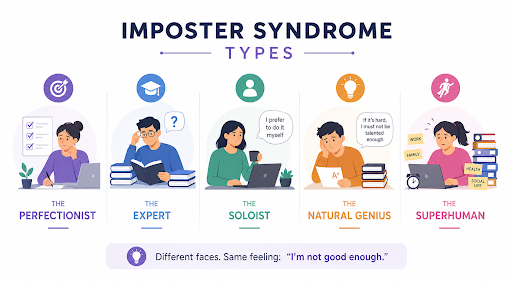
There are 5 common types of imposter syndrome: the perfectionist, the expert, the soloist, the natural genius, and the superhuman.
- The Perfectionist: This person spends way too much time on how something is done rather than the result. So even if they receive praise for their work, they don’t feel like they deserve it because the work is not perfect according to them.
- The Expert: Some professionals who have been deemed experts in their fields feel self-doubt at work when they lack knowledge about any minor detail. They don’t think themselves worthy of being known as experts.
- The Soloist: Some professionals do not perform well in teams. They think achieving something as a team cannot be counted as a personal achievement. This leads to them feeling the need to do everything themselves in order to feel accomplished.
- The Natural Genius: Those who grew up as natural geniuses or prodigies show characteristics of imposter syndrome when they fail to master anything in the first go.
- The Superhuman: These professionals only feel accomplished when they are juggling as many tasks as they can. Having free time on their hands feels like wasting time to them.
Imposter Syndrome Examples
Signs of Imposter Syndrome To Check For
If you think that you might have imposter syndrome, here is a checklist you can refer to to see if you fit the criteria:
You deeply believe your successes, promotions, or career milestones are entirely due to luck or timing rather than your hard work.
You carry a constant, underlying anxiety that at any moment, your boss, clients, or peers will suddenly realize you aren't as smart or capable as they think.
When someone compliments your work, your immediate internal reaction is to deflect it.
You can receive ten positive reviews, but you still spend days obsessing over a single piece of constructive criticism.
- You spend hours or days over-preparing for a simple meeting or presentation.
You stay silent during brainstorming sessions because you are terrified that your input will sound foolish.
You actively talk yourself out of applying for higher-paying roles.
You refuse to hand off tasks or ask for help when your plate is overflowing because you secretly worry that asking for support makes you look weak.
You have the degrees, the certifications, the happy clients, yet your internal confidence completely refuses to align with that external evidence.
If you check five or more boxes in this list, then you might be suffering from imposter syndrome at work.
Causes of Imposter Syndrome
To overcome your issue, first you need to understand the causes of imposter syndrome.
Family Upbringing
A lot of the time, imposter syndrome in the workplace could stem from your family upbringing. For example, if your parents put too much pressure on you regarding achievements as a child, that could lead to low self-esteem and performance anxiety.
Receiving constant criticism and not enough praise for your achievements in the family could also lead to self-doubt at work as an adult.
Unfamiliar Circumstances
Sometimes imposter syndrome could just be triggered by your anxiety regarding a new situation. Switching jobs or stepping into a role you don’t have much experience in could result in self-doubt.
Personality Traits
Certain personality types that chase perfectionism or are more likely to be emotionally sensitive struggle more with imposter syndrome at work. For example, to a perfectionist, getting a 99% score isn’t an achievement but a failure of getting 100%.
Social Anxiety
Social anxiety and imposter syndrome are deeply intertwined, feeding on the exact same core fear: the dread of negative evaluation. While general social anxiety can manifest as a fear of casual social interactions, in a professional setting, it leads to you hyper-fixating on your workplace performance.
Also Read: Productivity vs Efficiency: How to Work Smarter, Not Harder
Tips for Overcoming Imposter Syndrome
If you are showing any of the signs of imposter syndrome, here are some tips to help you overcome the feeling:
Facts Vs Feelings
The next time your brain whispers, "You don't know what you're doing, and everyone will find out," pause and write it down. Then, split a piece of paper into two columns: What I am Feeling vs. What the Objective Facts Are.
Stating out the real facts based on past data and comparing them with your current feelings will give you the perspective needed.
Hype Folder
Imposter syndrome suffers from selective amnesia; it entirely forgets your wins the moment a challenge appears. So create a folder with your achievements and wins to remind yourself that you have the ability to face the challenges.
Change Your Vocabulary
If you are bound to use phrases like “I think” or “I’m no expert but” before voicing your opinion, change this habit. Be direct, be assertive, and be confident in your thoughts and ideas.
80% Rule
If you constantly chase 100% perfectionism, you will get stuck in the imposter syndrome cycle. Instead, train yourself to be satisfied with your personal 80%. Because what you perceive as "average" work is often completely exceptional by industry standards.
Sanity Check
It’s important to have an external peer with whom you can talk about your feelings of imposter syndrome at work. Hearing a trusted colleague say, "You are entirely overthinking this; your work is solid," acts as an instant psychological circuit breaker.
Learn More With UniAthena
If you suffer from anxiety in the workplace, understanding the psychology behind it might help you better manage your thoughts and feelings.
Here are some free short courses at UniAthena that will help you:
- Basics of Psychology at Work
- Basics of Managerial Psychology
- Essentials of Communication Strategies & Sales Management
- Mastering Personnel Leadership & Management Planning
Imposter syndrome can lead to burnout at work. Not only will this negatively affect the work you are doing, but it will also have an impact on your mental health as well. The vicious cycle will just continue on. Unless you decide to put an end to it.
Changing the way you view your achievements and hyping yourself up every now and then will help you internalize the fact that you are exactly where you need to be. It will slowly but steadily diminish the feeling of an imposter and help you perform better in the workplace.
Also Read: Jobs for People With Anxiety
FAQs
Q1. How to deal with imposter syndrome?
A: It’s important to separate your feelings from the objective facts when dealing with imposter syndrome and self-doubt at work. Instead of normalizing the feeling of doubt, retrain your thoughts to challenge the creeping negative thoughts.
Q2. What does imposter syndrome feel like?
A: Having imposter syndrome feels like you are stuck in a cycle of self-doubt. No matter how many times you win or achieve praise, your mind gets stuck on the losses and criticisms.
Q3. What are examples of imposter syndrome?
A: Here are some examples of imposter syndrome at work:
- When you get promoted to a higher role instead of celebrating, you panic, thinking you have somehow tricked your company into thinking you deserve it.
- You worked hard on closing a deal, but when you get positive feedback, you struggle to accept the praise.
- You try to learn a new skill development course or skill and get frustrated when you don’t immediately master it.
- You constantly worry your colleagues only like your ‘curated persona’ and will not like you outside of work.
- You refuse to host a meeting because you don’t feel 100% prepared.
Our Popular Courses

$14000


Doctoral Degree in Business Administration
Universidad Catolica De Murcia (UCAM), Spain
Duration:
2 - 3 Years
$17500*
Integrated Doctorate of Business Administration
Guglielmo Marconi University, Italy
Universidad Catolica De Murcia (UCAM), Spain
Duration:
2.5 - 3.5 Years
$5600*
Master of Business Administration
Guglielmo Marconi University, Italy
Duration:
12 - 24 Months
$5600*
MBA in Operations & Project Management
Guglielmo Marconi University, Italy
Duration:
12 - 24 Months
$5600*
Master in Supply Chain and Logistics Management
Guglielmo Marconi University, Italy
Duration:
12 - 24 Months
$5950*
Master in Data Sciences
Guglielmo Marconi University, Italy
Duration:
12 - 24 Months
$5600*
Master in Engineering Management
Guglielmo Marconi University, Italy
Duration:
12 - 24 Months
$5600*
Master in Procurement and Contract Management
Guglielmo Marconi University, Italy
Duration:
12 - 24 Months
$5600*
Master in Public Health
Guglielmo Marconi University, Italy
Duration:
12 - 24 MonthsOur Popular Courses
COMMENTS(0)
Our Popular Courses
$14000
Doctoral Degree in Business Administration
Universidad Catolica De Murcia (UCAM), Spain
Duration:
2 - 3 Years
$17500*
Integrated Doctorate of Business Administration
Guglielmo Marconi University, Italy
Universidad Catolica De Murcia (UCAM), Spain
Duration:
2.5 - 3.5 Years
$5600*
Master of Business Administration
Guglielmo Marconi University, Italy
Duration:
12 - 24 Months
$5600*
MBA in Operations & Project Management
Guglielmo Marconi University, Italy
Duration:
12 - 24 Months
$5600*
Master in Supply Chain and Logistics Management
Guglielmo Marconi University, Italy
Duration:
12 - 24 Months
$5950*
Master in Data Sciences
Guglielmo Marconi University, Italy
Duration:
12 - 24 Months
$5600*
Master in Engineering Management
Guglielmo Marconi University, Italy
Duration:
12 - 24 Months
$5600*
Master in Procurement and Contract Management
Guglielmo Marconi University, Italy
Duration:
12 - 24 Months
$5600*
Master in Public Health
Guglielmo Marconi University, Italy
Duration:
12 - 24 MonthsOur Popular Courses
Our Popular Insights
Careers are shifting faster than ever, and staying relevant takes more than experience. Explore UniAthena’s most-read blogs for sharp insights, emerging skills, and practical pathways that help you move forward with clarity and confidence in a changing professional world.


🌟 Top Project Performer – June 2026 🌟
Read More
1
mins read


🌟 Top Project Performer – May 2026 🌟
Read More
1
mins read


🌟 Top Project Performer – April 2026 🌟
Read More
1
mins read

🌟 Top Project Performer – June 2026 🌟
Read more
1
mins read
🌟 Top Project Performer – May 2026 🌟
Read more
1
mins read
🌟 Top Project Performer – April 2026 🌟
Read more
1
mins read
Get in Touch

It’s Time to Start
Join NowMost Popular Online Specialization
- Master of International Business Administration
- Master of Business Administration
- MBA in General Management- FastTrack
- Master in Innovation and Entrepreneurship
- MBA-Family Business Management
- Master in Procurement and Contract Management
- Extended Diploma in Business Analytics (SCQF Level 11)
- Diploma in Supply Chain and Logistics Management (SCQF Level 11)
- Strategic Human Resource Management Practitioner
- Master in Data Science
- Master in Engineering Management
Trending Online
- Integrated Doctorate of Business Administration
- Postgraduate Certificate in Finance for Next Generation Managers
- Master of Business Administration- General Management (Fast Track)
- Postgraduate Certificate in Socio-Economic and Legal Framework
- Postgraduate Certificate in Business Sustainability
- Certified Manager
- Supply Chain Management Practitioner
- MBA - AI in Business
- MBA - Accounting & Finance
- Master in Supply Chain and Logistics Management
Top Universities Online Certificates
- Postgraduate Certificate in International Marketing Management
- Postgraduate Certificate In International Human Resource Management
- Postgraduate Certificate in Strategic Management
- Postgraduate Certificate in Procurement & Contracts Management
- Postgraduate Certificate in Business Analytics
- Postgraduate Certificate in Strategic Supply Chain & Logistics Management
- Postgraduate Certificate in Human Resource and Leadership
- Project Management Practitioner
- Postgraduate Certificate in Supply Chain Design & Implementation
- Postgraduate Certificate in Management Accounting and Finance
Accredited Online Degree Program
- MBA - Digital Transformation
- MBA - Family Business Management
- MBA - Marketing Management
- MBA in Quality Management
- MBA - Business Intelligence & Data Analytics
- MBA in Operations & Project Management
- MBA in Energy Management
- MBA In Construction & Safety Management
- Master in Organisational Leadership
- Master in Public Health
- Master in Construction Management
- Bachelor of Arts in Business Administration


 Install Now


UniAthena is an Ed-Tech, offering flexible, affordable learning solutions, including Free-Learning Upskilling Courses and Academic Programs in partnerships with accredited and globally renowned universities and professional qualification bodies.


Do you have any questions ?
Feel free to send us your questions or request a free consultation
Send a message
UK
Athena Global Education
Magdalen Centre,
Robert Robinson Avenue,
Oxford, OX4 4GA, UK
Phone : 01865 784299
MIDDLE EAST
Athena Global Education FZE
Block L-03, First Floor,
P O Box 519265, Sharjah Publishing City,
Free Zone, Sharjah, UAE
Phone : +971 55 879 5492
INDIA
Uniathena Private Limited
9A,Midas Tower
Phase 1
Hinjewadi Rajiv Gandhi Infotech Park
Pune-411057
Phone: +91 9145665544
All Copyrights Reserved @ Athena Global Education 2021-2026