-

Bachelor's

-

Masters
-

MBA
-

Doctorate
-

Micro Credit
-

Explore all Courses
-
Postgraduate Certifications

-
Postgraduate Diploma
-
Undergraduate Diploma
-
Diploma



How to Handle Salary Negotiation During an Interview

Author: aishwarya sancheti
|7
MINS READ
| 0
| 126
Created On: 21 April, 2026
Share




Table of Contents (TOC):
- Introduction
- Key Takeaways
- What is Salary Negotiation & Why Does It Matter
- When to Discuss Salary During the Interview Process
- Salary Discussions vs. Salary Negotiation
- How to Negotiate Salary: 7 Practical Tips
- How to Answer “What Are Your Salary Expectations?”
- How to Counter a Salary Offer Professionally
- How to Negotiate a Salary When Given a Range
- Salary Negotiation Do’s and Don’ts
- Build the Skills Behind Better Salary Conversations
- Conclusion
- FAQs
Introduction
You have earned the interview. Now it is time to make sure the offer reflects your value. Salary negotiation is one of the most important conversations in the hiring process, yet many candidates still approach it with uncertainty or avoid it altogether.
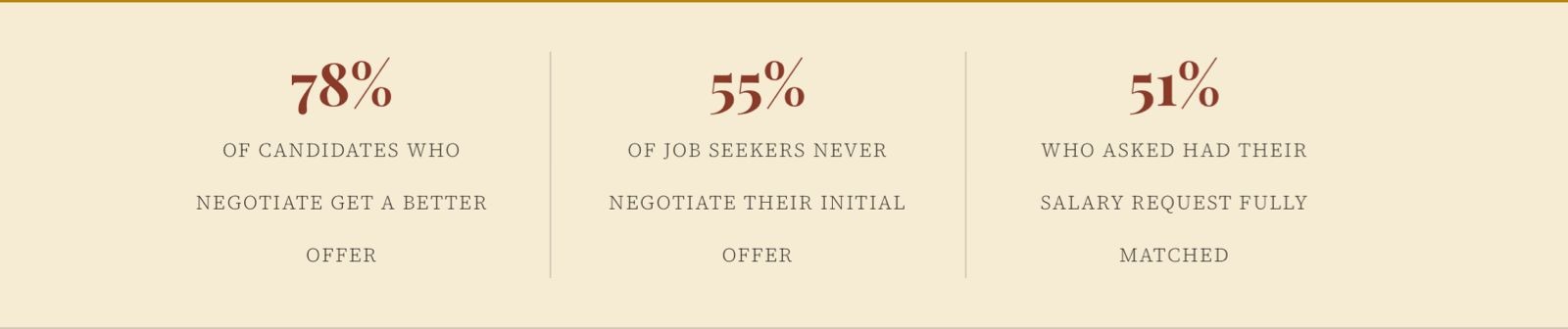
Recent survey data shows that many professionals still do not negotiate their starting salary. Salary conversations are also becoming more transparent: a 2026 Resume Genius hiring statistics roundup reports that over 40% of U.S. job postings now include salary ranges, a trend expected to grow as pay transparency laws expand.
This guide explains when to discuss salary, how to answer salary expectation questions, and how to negotiate an offer professionally without damaging the relationship.
Key Takeaways:
- Research your market rate before the conversation begins.
- Let the employer share their range first when possible.
- Avoid negotiating too early in the interview process.
- Give a salary range rather than a single number.
- Base your ask on market value, not personal expenses.
- Consider the full compensation package, not only base salary.
- Take time to review a formal offer before responding.
- Practice your delivery so you sound clear and confident.
What Is Salary Negotiation and Why Does It Matter?
Salary negotiation is the professional process of discussing and agreeing on a compensation package with a prospective or current employer. It is a standard part of hiring and, when handled professionally, is generally expected.
The impact of a starting salary can extend well beyond the first year. Raises, bonuses, and future offers are often influenced by your current compensation, which means accepting a lower offer at the start may affect your earnings over time. For that reason, salary negotiation is not simply about immediate gain; it is about establishing your value from the outset.
When to Discuss Salary During an Interview Process
First Interview: Focus on Fit
In the early stage, your main goal is to demonstrate that you are the right fit for the role. It is usually best not to initiate a salary discussion at this point. If the interviewer raises the topic, you can respond professionally without turning the conversation entirely toward compensation.
Second Interview or Later: Discuss Alignment
By the second interview or later stages, there is usually enough mutual interest to discuss salary expectations. If the topic has not yet come up, it is appropriate to ask whether the employer can share the salary range for the role.
After a Formal Offer: Negotiate
The strongest point to negotiate is after a formal offer has been made. At this stage, the employer has decided they want you, which gives you more leverage to discuss salary and the overall package.
Salary Discussion vs. Salary Negotiation
This distinction matters.
A salary discussion is an early-stage conversation about expectations and budget alignment. It helps both sides understand whether they are broadly in range.
A salary negotiation happens after an offer is made. This is the point where you evaluate the package and ask for improved terms if appropriate.
If you have ever asked yourself how do I negotiate salary or how do you negotiate salary without sounding difficult, the answer lies in preparation, timing, and professional delivery.
How to Negotiate Salary: 7 Practical Tips
1. Research Your Market Rate
Use salary databases such as Glassdoor, LinkedIn Salary, Payscale, Indeed, and relevant industry reports to understand typical compensation for your role, location, and experience level. Preparation gives you a stronger foundation for every conversation.
2. Let the Employer Share the Range First
When possible, ask the employer to share the approved budget or salary range before revealing your own expectation. This helps you avoid anchoring too low.
Example:
“Could you share the salary range budgeted for this position?”
3. Give a Range, Not a Single Figure
If you need to provide an expectation, offer a range rather than one fixed number. Your lower number should still be acceptable to you, and your upper number should reflect your target based on research.
4. Support Your Ask With Data
Keep the conversation focused on market benchmarks, your experience, and the value you bring. A negotiation grounded in evidence is more persuasive than one based on personal financial needs.
5. Look at the Full Compensation Package
Base salary matters, but it is not the only negotiable element. Consider bonuses, remote or hybrid flexibility, annual leave, learning budgets, equity, insurance, and review timelines.
6. Deliver Your Ask With Confidence
How you say it matters. A calm, direct, and professional tone helps communicate that your request is thoughtful and reasonable. Practicing out loud before the conversation can make a real difference.
7. Take Time Before You Respond
You do not need to accept or counter an offer immediately. It is entirely professional to ask for time to review the details before replying.
Example:
“Thank you for the offer. I’d appreciate a day or two to review the package before I respond.”
Also Read: 10 Job Interview Tips
How to Answer “What Are Your Salary Expectations?”
Knowing how to answer salary expectation questions professionally can help you stay prepared when employers ask for your expected pay early in the hiring process.
If You Want to Delay the Discussion
“I’d like to understand the full scope of the role and responsibilities before discussing a specific number. Could you share the salary range budgeted for the position?”
If You Need to Give a Range
“Based on my experience, skills, and market research, I’m currently targeting roles in the range of $X to $Y. I’m also open to discussing the full compensation package.”
If You Are Asked About Salary History
“I’d prefer to focus on the value I can bring to this role rather than my past compensation. Based on the market and my experience, I’m targeting a range of $X to $Y.”
In many jurisdictions, employers are restricted or prohibited from asking about salary history. Even where such questions are allowed, candidates can still redirect the discussion toward market value and role fit.
These are among the best answers for salary expectations because they keep the discussion focused on value, market range, and role fit rather than personal financial pressure.
How to Counter a Salary Offer Professionally and Ask for More Money
If the offer comes in lower than expected, respond with appreciation, reinforce your interest, and present a clear, evidence-based counter.
Example:
“Thank you very much for the offer. I’m genuinely excited about the opportunity and the chance to join the team. Before I make a final decision, I’d like to revisit the compensation. Based on my experience, qualifications, and market benchmarks, I was expecting something closer to $[target figure]. Is there flexibility to move closer to that range?”
This works because it keeps the tone positive, explains the rationale, and makes a clear request without sounding adversarial.
Also Read: 10 Essential Items to Bring for Every Successful Job Interview
How to Negotiate a Salary When Given a Range
When an employer shares a range, do not assume you should aim for the bottom. A range usually signals flexibility.
Ask yourself whether your skills, years of experience, and relevant achievements justify the midpoint or higher end of the range. If they do, make your case using specific examples such as measurable performance, revenue impact, project delivery, or process improvements.
Practical Formula
- Low point: the minimum you would accept
- Midpoint: the market rate for your profile
- High point: your ideal target based on your value
Your negotiation range should typically sit between the midpoint and the high point, rather than starting from your minimum.
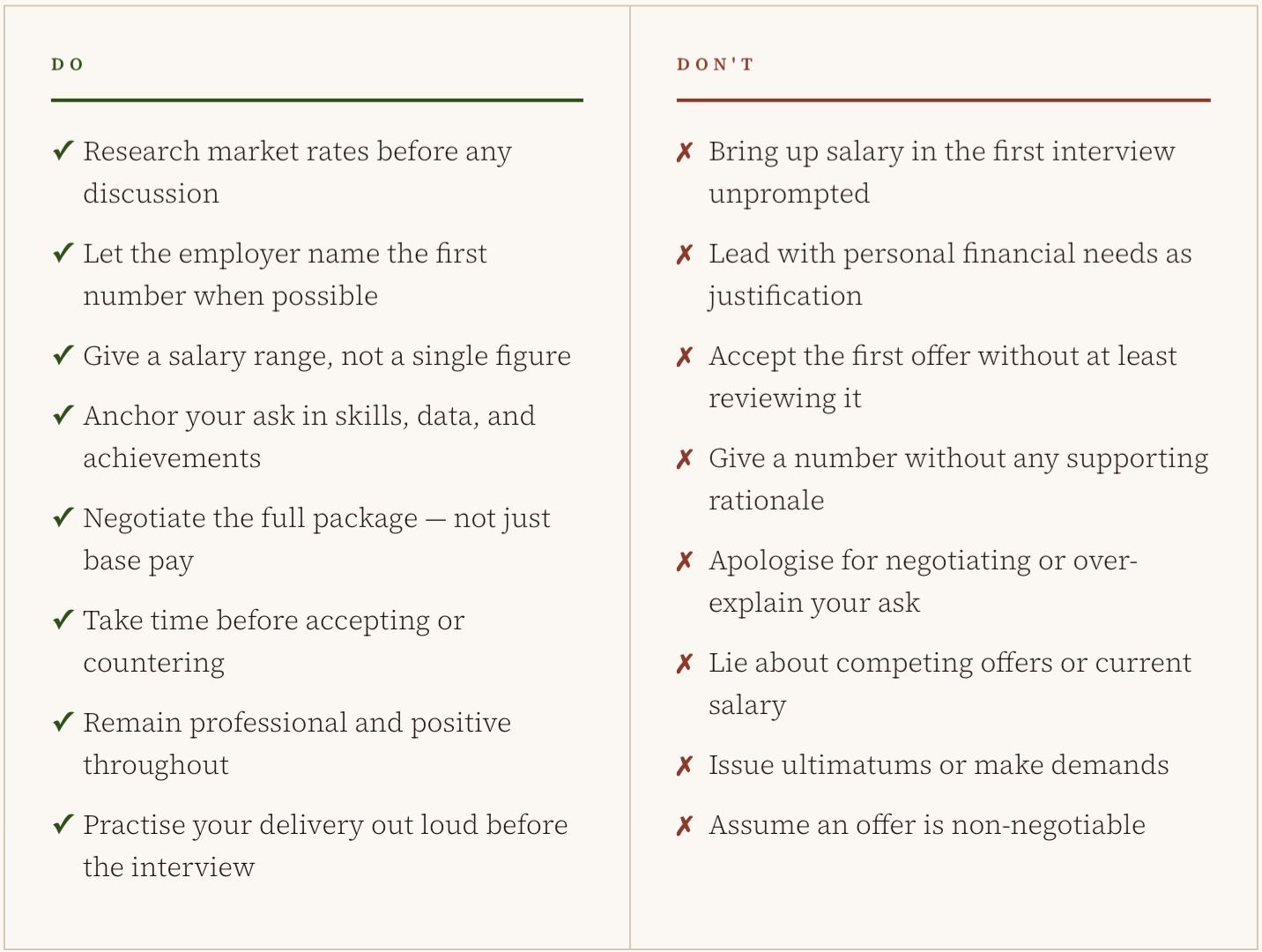
Salary Negotiation Do’s and Don’ts
Build the Skills Behind Better Salary Conversations
Strong salary negotiation is not only about numbers. It also depends on communication, confidence, and professional presence. UniAthena offers online courses that can help learners build these skills for interviews and career conversations.
- Diploma in Business Communication
- Mastering Management and Leadership Approaches
- Executive Diploma in Business Communication
Conclusion
Salary negotiation is not about being difficult. It is about understanding your market value, choosing the right moment, and discussing compensation with clarity and professionalism.
Candidates who prepare well are better positioned to evaluate offers, respond with confidence, and secure a package that reflects their skills and experience. When approached thoughtfully, salary negotiation does not damage the relationship with an employer; it demonstrates professionalism, self-awareness, and sound decision-making.
Also Read: High Demand Skills for the Next 10 Years
FAQs
Q1. Can I negotiate salary during the interview itself?
A: Yes, but early interviews should focus on fit, while formal negotiation is usually more effective after a written offer.
Q2. Will negotiating salary make me look greedy or difficult?
A: No. When handled professionally and supported by evidence, salary negotiation is generally seen as a normal part of the hiring process.
Q3. What if the employer says the salary is non-negotiable?
A: You can ask about other elements of the package, such as bonuses, flexibility, leave, learning support, or review timing.
Q4. How much more should I ask for?
A: A counter of 10–20% above the initial offer is often used as a starting point, depending on your experience, market value, and leverage.
Q5. How to Negotiate Salary With HR in an Interview?
A: Be clear, data-driven, and respectful. HR teams typically work within set compensation bands, so specific and well-supported requests are more effective.
Explore Related Courses










COMMENTS(0)
Explore Related Courses
Our Popular Insights
Careers are shifting faster than ever, and staying relevant takes more than experience. Explore UniAthena’s most-read blogs for sharp insights, emerging skills, and practical pathways that help you move forward with clarity and confidence in a changing professional world.


How to Switch Career to Data Analytics?
Read More
6
mins read






How to Switch Career to Data Analytics?
Read more
6
mins read

Get in Touch

It’s Time to Start
Join NowMost Popular Online Specialization
- Master of International Business Administration
- Master of Business Administration
- MBA in General Management- FastTrack
- Master in Innovation and Entrepreneurship
- MBA-Family Business Management
- Master in Procurement and Contract Management
- Extended Diploma in Business Analytics (SCQF Level 11)
- Diploma in Supply Chain and Logistics Management (SCQF Level 11)
- Strategic Human Resource Management Practitioner
- Master in Data Science
- Master in Engineering Management
Trending Online
- Integrated Doctorate of Business Administration
- Postgraduate Certificate in Finance for Next Generation Managers
- Master of Business Administration- General Management (Fast Track)
- Postgraduate Certificate in Socio-Economic and Legal Framework
- Postgraduate Certificate in Business Sustainability
- Certified Manager
- Supply Chain Management Practitioner
- MBA - AI in Business
- MBA - Accounting & Finance
- Master in Supply Chain and Logistics Management
Top Universities Online Certificates
- Postgraduate Certificate in International Marketing Management
- Postgraduate Certificate In International Human Resource Management
- Postgraduate Certificate in Strategic Management
- Postgraduate Certificate in Procurement & Contracts Management
- Postgraduate Certificate in Business Analytics
- Postgraduate Certificate in Strategic Supply Chain & Logistics Management
- Postgraduate Certificate in Human Resource and Leadership
- Project Management Practitioner
- Postgraduate Certificate in Supply Chain Design & Implementation
- Postgraduate Certificate in Management Accounting and Finance
Accredited Online Degree Program
- MBA - Digital Transformation
- MBA - Family Business Management
- MBA - Marketing Management
- MBA in Quality Management
- MBA - Business Intelligence & Data Analytics
- MBA in Operations & Project Management
- MBA in Energy Management
- MBA In Construction & Safety Management
- Master in Organisational Leadership
- Master in Public Health
- Master in Construction Management
- Bachelor of Arts in Business Administration


 Install Now


UniAthena is an Ed-Tech, offering flexible, affordable learning solutions, including Free-Learning Upskilling Courses and Academic Programs in partnerships with accredited and globally renowned universities and professional qualification bodies.


Do you have any questions ?
Feel free to send us your questions or request a free consultation
Send a message
UK
Athena Global Education
Magdalen Centre,
Robert Robinson Avenue,
Oxford, OX4 4GA, UK
Phone : 01865 784299
MIDDLE EAST
Athena Global Education FZE
Block L-03, First Floor,
P O Box 519265, Sharjah Publishing City,
Free Zone, Sharjah, UAE
Phone : +971 55 879 5492
INDIA
Uniathena Private Limited
9A,Midas Tower
Phase 1
Hinjewadi Rajiv Gandhi Infotech Park
Pune-411057
Phone: +91 9145665544
All Copyrights Reserved @ Athena Global Education 2021-2026