-

Bachelor's

-

Masters
-

MBA
-

Doctorate
-

Micro Credit
-

Explore all Courses
-
Postgraduate Certifications

-
Postgraduate Diploma
-
Undergraduate Diploma
-
Diploma



E-Government: The Story of Power, Process, and Public Trust
Author: ruchika sharma
|3
MINS READ
| 0
| 157
Created On: 12 February, 2026
Share




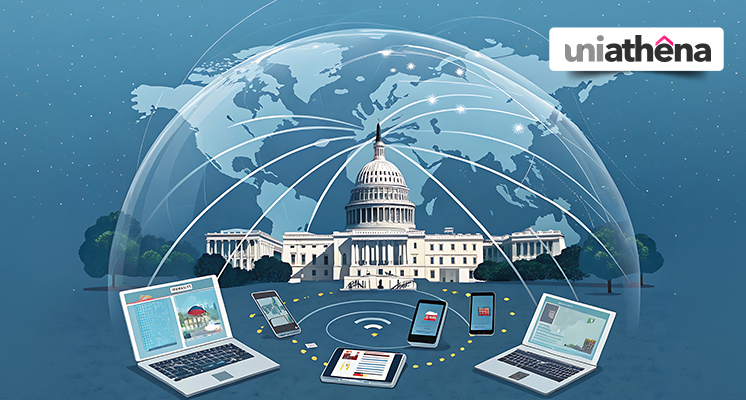
The concept of E-Government is often understood as websites, apps, or online forms. However, it is far deeper than just software or servers. It is more about digital tools that are being used to transform government work and serve citizens with efficiency, transparency, and participation at the core.
Understanding E-Government and Electronic Governance
Electronic governance is defined as the use of Information and Communication Technologies by government bodies to deliver public services, exchange information, and improve administrative efficiency by strengthening citizen participation. In short, e-government and e-governance are about improved governance enabled by technology, not just digitizing paperwork.
While the terms E-Government and E-Governance are often used interchangeably, e-government focuses primarily on service delivery and administrative functions, whereas e-governance includes broader aspects such as policy-making, citizen engagement, and governance processes. Therefore, e-government is a part of the wider concept of electronic governance.
Why E-Government Is More Than Technology
Technology alone cannot fix the issues of governance; the success of e-government depends upon:
- Process Engineering: Transforming inefficient systems needs to be done before digitization; putting deficient processes online will only lead to digital inefficiency.
- Transparency and Accountability: With Digital systems in place, leads to the creation of traceable records, thereby reducing corruption and enhancing trust.
- Citizen-Centric Approach: The services under E-governance are designed to cater to the needs of citizens and not just departmental convenience, thereby enabling public feedback and grievance redressal.
- Institutional Change: Training of the staff, Policy reforms, and Organizational restructuring are essential, thereby leading to key institutional change.
Key Components of E-Government
E-Government operates through several essential components:
- Digital Infrastructure: Includes internet connectivity, servers, and data centres.
- Service Portals: Online platforms through which citizens access public services.
- Data Management and Security: Ensuring data privacy and strong cybersecurity measures to build citizen confidence.
- Legal Framework: Establishing data protection regulations and Information Technology laws to support digital governance.
Major Interactions Types under E-Government
Challenges of E-Government
E-Governance is not merely about technology because several structural challenges exist:
- Digital Divide: The gap between citizens who can effectively use digital services and those who cannot creates barriers to successful implementation.
- Cybersecurity Threats: Risks such as phishing, ransomware, and nation-state attacks undermine public trust and compromise sensitive data.
- Resistance to Change: Bureaucratic inertia, fear of transparency, and limited digital literacy among staff and citizens can hinder adoption.
- Legal and Policy Limitations: Inadequate frameworks for digital signatures, data protection, and cybercrime regulation present additional obstacles.
Real Impact: Governance Transformation
It is important to emphasise that e-government is not merely a technological initiative but a governance reform enabled by technology. The ultimate objective is not simply to digitize government processes but to enhance the quality of governance itself.
Successful e-government initiatives make public services accessible 24/7, ensure proactive service delivery, and encourage participatory governance. This transformation builds trust between citizens and the state. It shifts governance from paper-based bureaucracy to a responsive, digital administration.
When strategy, people, policies, and technology work together, e-government becomes a powerful driver of efficiency, transparency, and democratic engagement.
Sources:
https://www.sydle.com/blog/e-government-what-is-it-6398ad2d40644b0c1fed1072
https://www.tandfonline.com/doi/full/10.1080/23311975.2024.2340579
Explore Related Courses













COMMENTS(0)
Explore Related Courses
Our Popular Insights
Careers are shifting faster than ever, and staying relevant takes more than experience. Explore UniAthena’s most-read blogs for sharp insights, emerging skills, and practical pathways that help you move forward with clarity and confidence in a changing professional world.


How to Switch Career to Data Analytics?
Read More
6
mins read




How to Switch Career to Data Analytics?
Read more
6
mins read

Get in Touch

It’s Time to Start
Join NowMost Popular Online Specialization
- Master of International Business Administration
- Master of Business Administration
- MBA in General Management- FastTrack
- Master in Innovation and Entrepreneurship
- MBA-Family Business Management
- Master in Procurement and Contract Management
- Extended Diploma in Business Analytics (SCQF Level 11)
- Diploma in Supply Chain and Logistics Management (SCQF Level 11)
- Strategic Human Resource Management Practitioner
- Master in Data Science
- Master in Engineering Management
Trending Online
- Integrated Doctorate of Business Administration
- Postgraduate Certificate in Finance for Next Generation Managers
- Master of Business Administration- General Management (Fast Track)
- Postgraduate Certificate in Socio-Economic and Legal Framework
- Postgraduate Certificate in Business Sustainability
- Certified Manager
- Supply Chain Management Practitioner
- MBA - AI in Business
- MBA - Accounting & Finance
- Master in Supply Chain and Logistics Management
Top Universities Online Certificates
- Postgraduate Certificate in International Marketing Management
- Postgraduate Certificate In International Human Resource Management
- Postgraduate Certificate in Strategic Management
- Postgraduate Certificate in Procurement & Contracts Management
- Postgraduate Certificate in Business Analytics
- Postgraduate Certificate in Strategic Supply Chain & Logistics Management
- Postgraduate Certificate in Human Resource and Leadership
- Project Management Practitioner
- Postgraduate Certificate in Supply Chain Design & Implementation
- Postgraduate Certificate in Management Accounting and Finance
Accredited Online Degree Program
- MBA - Digital Transformation
- MBA - Family Business Management
- MBA - Marketing Management
- MBA in Quality Management
- MBA - Business Intelligence & Data Analytics
- MBA in Operations & Project Management
- MBA in Energy Management
- MBA In Construction & Safety Management
- Master in Organisational Leadership
- Master in Public Health
- Master in Construction Management
- Bachelor of Arts in Business Administration


 Install Now


UniAthena is an Ed-Tech, offering flexible, affordable learning solutions, including Free-Learning Upskilling Courses and Academic Programs in partnerships with accredited and globally renowned universities and professional qualification bodies.


Do you have any questions ?
Feel free to send us your questions or request a free consultation
Send a message
UK
Athena Global Education
Magdalen Centre,
Robert Robinson Avenue,
Oxford, OX4 4GA, UK
Phone : 01865 784299
MIDDLE EAST
Athena Global Education FZE
Block L-03, First Floor,
P O Box 519265, Sharjah Publishing City,
Free Zone, Sharjah, UAE
Phone : +971 55 879 5492
INDIA
Uniathena Private Limited
9A,Midas Tower
Phase 1
Hinjewadi Rajiv Gandhi Infotech Park
Pune-411057
Phone: +91 9145665544
All Copyrights Reserved @ Athena Global Education 2021-2026