-

Bachelor's

-

Masters
-

MBA
-

Doctorate
-

Micro Credit
-

Explore all Courses
-
Postgraduate Certifications

-
Postgraduate Diploma
-
Undergraduate Diploma
-
Diploma



A Beginner’s Guide to Financial Management

Author: ankita shrikrishna jawalkar
|3
MINS READ
| 0
| 198
Created On: 11 December, 2025
Share




What is Financial Management?
Financial Management is a core component of overall business management, not just a fundraising activity. It is concerned with all financial activities involving planning, raising, allocating, and controlling funds. The scope of financial management is very wide. Financial management holds the key to all activities in a business. Finance may be regarded as a science because it represents a structured body of knowledge related to payment systems and financial behavior.
Just as production and sales are key functions of a business, financial management (FM) is an independent and specialized function that integrates closely with other activities. In many organizations, accounting and finance are combined, and finance is often treated as part of the accounting function. But bookkeeping, which mainly keeps track of transactions and creates financial statements like profit and loss accounts, balance sheets, and cash/funds flow statements, is only one aspect of financial management.
“Finance is the management of monetary activities of a business. It includes determining what has to be paid for and when, raising the money on the best terms available, and diverting the available funds to the best uses” —-Paul G. Husings.
Goals of Financial Management
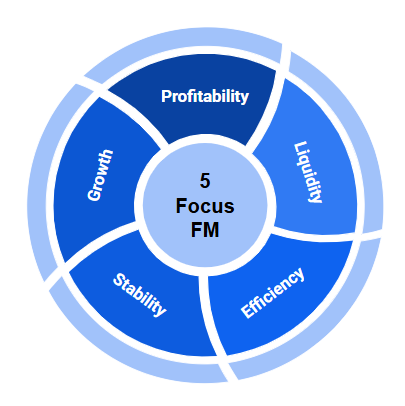
Financial management aims to ensure that an organization uses its financial resources wisely and strategically.
Its key goals include:
- Profitability: Ensuring that the business generates sufficient profits by optimizing revenue, managing expenses, and making sound investment decisions.
- Liquidity: Maintaining adequate cash or easily convertible assets to meet short-term obligations without operational disruption.
- Efficiency: Using financial and physical resources as effectively as possible to support daily operations and reduce waste.
- Stability: Ensuring long-term financial health by managing risks effectively, balancing the capital structure, and avoiding excessive debt.
- Growth: Supporting sustainable expansion through strategic investments, reinvestment of profits, and long-term financial planning for continued progress.
Techniques of Financial Management
- Ratio Analysis: A Major method of analyzing the financial performance of an entity through relationships between key figures from financial statements.
- Capital Budgeting: Evaluating possible projects in which investment can be made to determine which will provide the highest returns.
- Working Capital Management: Ensuring that the firm efficiently manages short-term assets and liabilities to maintain smooth operations.
- Capital Structure: Determining the optimal mix of debt and equity to finance the firm's operations.
- ROI Maximization: Focusing on strategies that maximize returns on investment for shareholders.
Also Read: What Is Financial Reporting & Why Is It Important?
Supporting Financial Techniques
- Cash Flow Management: Managing inflows and outflows is duly monitored to sustain sufficient liquidity.
- Investment Appraisal: Evaluating projects based on their payback period, IRR, and net present value.
- Cost Control: Reducing costs that are not required, hence enhancing efficiency.
- Risk Management: To identify, assess, and mitigate various financial risks and secure the firm against them.
Also Read: The Future of Finance: How AI is Shaping Financial Decisions
Challenges of Financial Management
- Cash Availability: Ensuring that the company has adequate cash or liquid assets for short-term obligations.
- Raising Capital: Securing funds from investors, lenders, or other sources at minimal cost.
- Resource Planning: Planning and allocating resources efficiently to meet financial needs and achieve organizational goals.
- Cost Efficiency: Controlling unnecessary expenses while maintaining operational effectiveness.
- Threat Mitigation: Identifying and managing risks to protect financial stability.
- Debt-Equity Balance: Optimizing the mix of debt and equity to maximize returns while maintaining financial stability.
- Legal Compliance: Following legal requirements, accounting standards, and regulations to ensure integrity.
- Economic Adaptation: Adjusting financial strategies in response to ongoing market and economic changes.
- Long-term Financing: Planning and structuring long-term capital to support sustainable growth.
- Future Projections: Estimating revenues, costs, and financial needs to inform decisions.
Also Read: How To Become a Financial Analyst?
Conclusion
Financial management forms the backbone of every business operation, ensuring that resources are planned, allocated, and controlled wisely. Without effective financial management, organizations risk inefficiency, instability, and reduced profitability.
By mastering core techniques—such as budgeting, cost control, risk management, and capital planning—businesses can navigate uncertainty and make informed decisions. Ultimately, strong financial management provides the foundation for long-term growth, operational resilience, and sustainable success.
Explore Related Courses










.jpg)





COMMENTS(0)
Explore Related Courses
Our Popular Insights
Careers are shifting faster than ever, and staying relevant takes more than experience. Explore UniAthena’s most-read blogs for sharp insights, emerging skills, and practical pathways that help you move forward with clarity and confidence in a changing professional world.


🌟 Top Project Performer – June 2026 🌟
Read More
1
mins read



🌟 Top Project Performer – May 2026 🌟
Read More
1
mins read


🌟 Top Project Performer – April 2026 🌟
Read More
1
mins read

🌟 Top Project Performer – June 2026 🌟
Read more
1
mins read
🌟 Top Project Performer – May 2026 🌟
Read more
1
mins read

🌟 Top Project Performer – April 2026 🌟
Read more
1
mins read
Get in Touch

It’s Time to Start
Join NowMost Popular Online Specialization
- Master of International Business Administration
- Master of Business Administration
- MBA in General Management- FastTrack
- Master in Innovation and Entrepreneurship
- MBA-Family Business Management
- Master in Procurement and Contract Management
- Extended Diploma in Business Analytics (SCQF Level 11)
- Diploma in Supply Chain and Logistics Management (SCQF Level 11)
- Strategic Human Resource Management Practitioner
- Master in Data Science
- Master in Engineering Management
Trending Online
- Integrated Doctorate of Business Administration
- Postgraduate Certificate in Finance for Next Generation Managers
- Master of Business Administration- General Management (Fast Track)
- Postgraduate Certificate in Socio-Economic and Legal Framework
- Postgraduate Certificate in Business Sustainability
- Certified Manager
- Supply Chain Management Practitioner
- MBA - AI in Business
- MBA - Accounting & Finance
- Master in Supply Chain and Logistics Management
Top Universities Online Certificates
- Postgraduate Certificate in International Marketing Management
- Postgraduate Certificate In International Human Resource Management
- Postgraduate Certificate in Strategic Management
- Postgraduate Certificate in Procurement & Contracts Management
- Postgraduate Certificate in Business Analytics
- Postgraduate Certificate in Strategic Supply Chain & Logistics Management
- Postgraduate Certificate in Human Resource and Leadership
- Project Management Practitioner
- Postgraduate Certificate in Supply Chain Design & Implementation
- Postgraduate Certificate in Management Accounting and Finance
Accredited Online Degree Program
- MBA - Digital Transformation
- MBA - Family Business Management
- MBA - Marketing Management
- MBA in Quality Management
- MBA - Business Intelligence & Data Analytics
- MBA in Operations & Project Management
- MBA in Energy Management
- MBA In Construction & Safety Management
- Master in Organisational Leadership
- Master in Public Health
- Master in Construction Management
- Bachelor of Arts in Business Administration


 Install Now


UniAthena is an Ed-Tech, offering flexible, affordable learning solutions, including Free-Learning Upskilling Courses and Academic Programs in partnerships with accredited and globally renowned universities and professional qualification bodies.


Do you have any questions ?
Feel free to send us your questions or request a free consultation
Send a message
UK
Athena Global Education
Magdalen Centre,
Robert Robinson Avenue,
Oxford, OX4 4GA, UK
Phone : 01865 784299
MIDDLE EAST
Athena Global Education FZE
Block L-03, First Floor,
P O Box 519265, Sharjah Publishing City,
Free Zone, Sharjah, UAE
Phone : +971 55 879 5492
INDIA
Uniathena Private Limited
9A,Midas Tower
Phase 1
Hinjewadi Rajiv Gandhi Infotech Park
Pune-411057
Phone: +91 9145665544
All Copyrights Reserved @ Athena Global Education 2021-2026