-

Bachelor's

-

Masters
-

MBA
-

Doctorate
-

Micro Credit
-

Explore all Courses
-
Postgraduate Certifications

-
Postgraduate Diploma
-
Undergraduate Diploma
-
Diploma



AI in Healthcare: Opportunities and Ethical Challenges
Author: urvi malusare
|6
MINS READ
| 0
| 40
Created On: 24 June, 2026
Share




Table of Contents (TOC):
- Key Takeaways
- Artificial Intelligence in Healthcare
- How Is AI Solving Healthcare Challenges and Seizing Opportunities?
- What Are the Ethical Issues of Artificial Intelligence?
- Conclusion
- FAQs
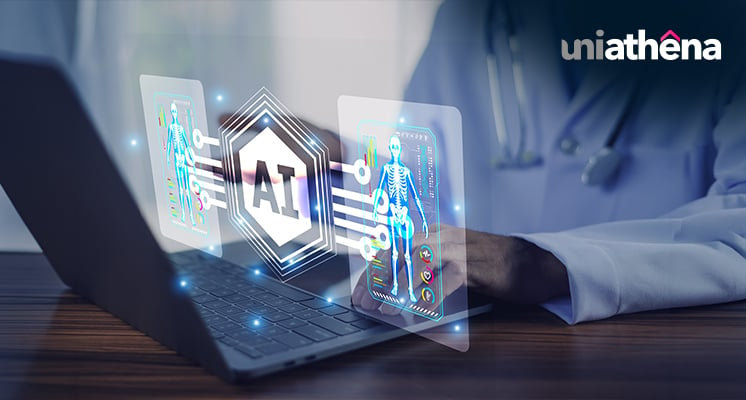
In a radiology department buzzing with staff and patients, an AI algorithm flags something in a scan that human eyes missed. This little anomaly turns out to be an early sign of cancer that can now be detected and treated before it becomes life-threatening. That’s what AI in healthcare looks like.
Key Takeaways:
- From flagging early signs of tumors to accelerating drug discovery and clinical efficiency, AI in healthcare can be revolutionary.
- Healthcare challenges like oversight in medical imaging, time-consuming paperwork, delayed diagnosis, and errors in keeping records can be improved, along with operational efficiency, by introducing AI in healthcare.
- The use of AI in healthcare can not always produce accurate results. A wrong diagnosis could be extremely dangerous for the patients. This also leads to the ethical dilemma of a lack of accountability for the results AI produces.
Artificial Intelligence in Healthcare
Artificial intelligence in healthcare goes beyond managing paperwork and records. It is reshaping medicine as we speak. AI is on the frontlines, becoming a part of healthcare systems, contributing to predictive diagnosis, offering personalized medicine, and supporting healthcare automation.
Artificial intelligence has the ability to bring forth medical innovation. From detecting tumors to accelerating drug discovery, it can be used in multiple areas of healthcare.
But with the increased use of AI in healthcare, there arise questions like who will be accountable for an inaccurate diagnosis? Introduction of AI technology in healthcare is not a bad move, as long as it does not affect the safety and trust of the patients.
How Is AI Solving Healthcare Challenges and Seizing Opportunities?
If you are interested in building AI models for healthcare and are wondering what AI use in healthcare could look like, these are some of the possibilities:
Challenge #1: The daily load of medical imaging (X-rays, MRIs, and CT scans) leave radiologists and oncologists fatigued. This could lead to oversight.
Opportunity for AI: Artificial intelligence’s computer vision can act as a second pair of eyes. AI models designed for pattern recognition and scanning can flag anomalies that human specialists miss.
Challenge #2: Today’s doctors spend just as much time managing paperwork as talking to patients. Tracking records, typing clinical notes, and managing records are leading to professional burnout among physicians and reducing the time they spend on patient care.
Opportunity for AI: Voice-enabled AI tools can be used in the examination room to record and input the conversation between the doctor and the patient into records. Automated systems could manage patient records in order without human dependency.
Challenge #3: Medical care is primarily reactive. Patients seek out care only when they are experiencing symptoms. This is not always ideal, as damage that’s already been done cannot be reversed by medicine.
Opportunity for AI: Artificial intelligence in healthcare can help make the process preventive. It can identify high-risk demographics and help set up check-up camps for the public to scan for early signs of illnesses. AI tech can also be used to make wearable devices to monitor health metrics and notify the person of any sudden changes.
Challenge #4: Healthcare management and administration professionals are usually overwhelmed by paperwork, including medical bills, insurance claims, authorizations, and more. Minor human errors like misspellings, incomplete forms, or writing the wrong billing code could end up costing the hospital money.
Opportunity for AI: An autonomous AI management system can streamline paperwork and record-keeping and reduce minor errors. It can not only save a lot of time but also prevent any fraudulent claims.
What Are the Ethical Issues of Artificial Intelligence?
While some applications of AI in healthcare help solve existing issues, there is still the matter of ethical issues when using artificial intelligence in healthcare.
Threat to Safety
One of the biggest challenges of AI in healthcare is that AI cannot be fully relied upon when it comes to human safety. The more it becomes common to use artificial intelligence in healthcare, the risk of healthcare professionals relying on AI output that their own professional judgement will increase.
This poses a huge threat to safety. False medical data or inaccuracies produced by AI can end up confusing professionals. This could lead to an incorrect diagnosis and inappropriate treatment decisions.
Patient Privacy
AI models need to be fed real patient data and medical records in order for the system to learn. If an AI system is compromised by cybercriminals, sensitive patient information could be exposed. This violates a lot of patient privacy and confidentiality laws across the world.
Informed Consent
When treating a patient, the medical practitioner needs to get informed consent from the patient. The patient must be aware of who or what is treating them, and they must agree with the procedure.
The ethical issues of artificial intelligence in healthcare arise when patients are unaware of the use of AI in the process of treatment. It can be challenging to explain to every single patient what information will be fed to AI and how it will be used.
Healthcare Data and Ownership
Just because a patient shares their healthcare information with a hospital and agrees to being treated by them, does not mean they agree to their data being used to train AI models. The question of who owns an individual’s healthcare data and the right to use it for research or training is an ethical dilemma when it comes to the application of artificial intelligence in healthcare.
Data Bias and Fairness
Additionally, if the data that the AI model is trained on is biased, the results will also be biased. So, unless the data used to train the AI model comes from across populations and demographics, it will lack fairness.
Lack of Accountability
There is an evident lack of transparency in a lot of these advanced deep learning networks. So if an AI model makes the wrong assumptions or diagnoses a patient incorrectly, there is no way of figuring out what went wrong where.
In fact, even the engineers who build these platforms cannot be held accountable for errors, as they themselves are unaware of the logic behind an AI connecting dots and reaching a conclusion. This lack of accountability presents itself as one of the main limitations of AI in healthcare.
Conclusion
By 2030, we can predict a larger role of AI in healthcare. There are plenty of opportunities in the field where AI can improve processes, reduce errors, and increase accuracy. We can see AI being adopted in healthcare for predictive diagnostics, creating personalized medicine, healthcare automation, and medical innovation. But none of this must be at the cost of ignoring the ethical challenges.
Also Read: Preventive Health Is Changing Fast. Here’s What Comes Next
FAQs
Q1. How is AI used in healthcare?
A: AI is being used in healthcare to improve treatment accuracy. It helps scan X-rays and other medical imaging to detect anomalies that human eyes might miss. It is also used in healthcare management to handle paperwork and improve efficiency.
Q2. What is the future of AI in healthcare?
A: AI in healthcare in the future can be used for remote monitoring of patients' health. It can also assess population health trends and create alerts regarding health emergencies. It can also be used in developing new therapeutic drugs or medical devices.
Q3. Can AI check MRIs?
A: Yes, earlier this year, an AI model was developed at the University of Michigan which can check an MRI and give an accurate diagnosis. Currently, the accuracy rate is at 97.5%, but the researchers at the university are working on improving it further.
Explore Related Courses








COMMENTS(0)
Explore Related Courses
Our Popular Insights
Careers are shifting faster than ever, and staying relevant takes more than experience. Explore UniAthena’s most-read blogs for sharp insights, emerging skills, and practical pathways that help you move forward with clarity and confidence in a changing professional world.


How to Switch Career to Data Analytics?
Read More
6
mins read





How to Switch Career to Data Analytics?
Read more
6
mins read

Get in Touch

It’s Time to Start
Join NowMost Popular Online Specialization
- Master of International Business Administration
- Master of Business Administration
- MBA in General Management- FastTrack
- Master in Innovation and Entrepreneurship
- MBA-Family Business Management
- Master in Procurement and Contract Management
- Extended Diploma in Business Analytics (SCQF Level 11)
- Diploma in Supply Chain and Logistics Management (SCQF Level 11)
- Strategic Human Resource Management Practitioner
- Master in Data Science
- Master in Engineering Management
Trending Online
- Integrated Doctorate of Business Administration
- Postgraduate Certificate in Finance for Next Generation Managers
- Master of Business Administration- General Management (Fast Track)
- Postgraduate Certificate in Socio-Economic and Legal Framework
- Postgraduate Certificate in Business Sustainability
- Certified Manager
- Supply Chain Management Practitioner
- MBA - AI in Business
- MBA - Accounting & Finance
- Master in Supply Chain and Logistics Management
Top Universities Online Certificates
- Postgraduate Certificate in International Marketing Management
- Postgraduate Certificate In International Human Resource Management
- Postgraduate Certificate in Strategic Management
- Postgraduate Certificate in Procurement & Contracts Management
- Postgraduate Certificate in Business Analytics
- Postgraduate Certificate in Strategic Supply Chain & Logistics Management
- Postgraduate Certificate in Human Resource and Leadership
- Project Management Practitioner
- Postgraduate Certificate in Supply Chain Design & Implementation
- Postgraduate Certificate in Management Accounting and Finance
Accredited Online Degree Program
- MBA - Digital Transformation
- MBA - Family Business Management
- MBA - Marketing Management
- MBA in Quality Management
- MBA - Business Intelligence & Data Analytics
- MBA in Operations & Project Management
- MBA in Energy Management
- MBA In Construction & Safety Management
- Master in Organisational Leadership
- Master in Public Health
- Master in Construction Management
- Bachelor of Arts in Business Administration


 Install Now


UniAthena is an Ed-Tech, offering flexible, affordable learning solutions, including Free-Learning Upskilling Courses and Academic Programs in partnerships with accredited and globally renowned universities and professional qualification bodies.


Do you have any questions ?
Feel free to send us your questions or request a free consultation
Send a message
UK
Athena Global Education
Magdalen Centre,
Robert Robinson Avenue,
Oxford, OX4 4GA, UK
Phone : 01865 784299
MIDDLE EAST
Athena Global Education FZE
Block L-03, First Floor,
P O Box 519265, Sharjah Publishing City,
Free Zone, Sharjah, UAE
Phone : +971 55 879 5492
INDIA
Uniathena Private Limited
9A,Midas Tower
Phase 1
Hinjewadi Rajiv Gandhi Infotech Park
Pune-411057
Phone: +91 9145665544
All Copyrights Reserved @ Athena Global Education 2021-2026