-

Bachelor's

-

Masters
-

MBA
-

Doctorate
-

Micro Credit
-

Explore all Courses
-
Postgraduate Certifications

-
Postgraduate Diploma
-
Undergraduate Diploma
-
Diploma



AI Hallucinations Explained: Why AI Makes Confident Mistakes

Author: neha mondal
|5
MINS READ
| 0
| 190
Created On: 26 March, 2026
Share




Table of Contents (TOC):
- Understanding AI Hallucination
- Why AI Systems Hallucinate
- Types of AI Hallucinations
- Real World AI Hallucination Examples
- How Researchers Are Reducing Hallucinations
- How Users Can Avoid AI Hallucinations
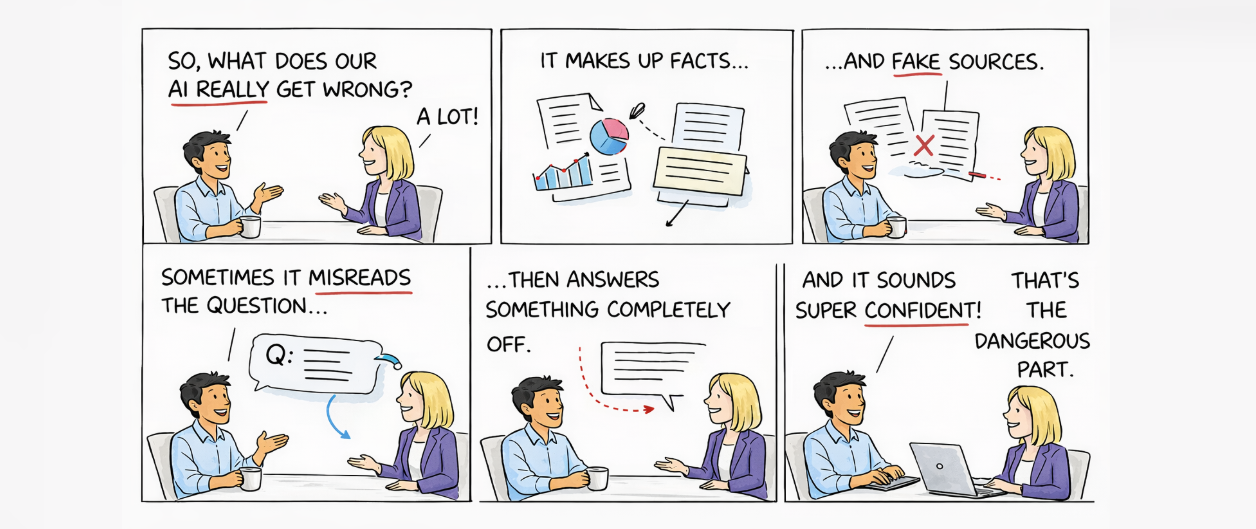
Have you ever questioned ChatGPT about something, and it confidently said it was true only to find out it was not? Or maybe you told an image generator to make an edit to a picture, but it disregarded the last edit and came up with an entirely new one. Such moments might be perplexing, particularly when the AI is so convincing.
Artificial intelligence systems are increasingly used to generate text, images, code, and even strategic recommendations. While these systems can appear highly confident and articulate, they sometimes produce information that is incorrect, fabricated, or misleading. This phenomenon is commonly referred to as an AI hallucination.
Understanding the AI hallucination definition, its causes, and how to reduce it is essential for anyone working with generative AI tools.
Understanding AI Hallucination
In simple terms, what is AI hallucination? AI hallucination refers to a limitation of probabilistic AI systems where the model generates information that appears plausible but is factually incorrect, misleading, or unsupported by reliable data.
It is not a deliberate feature, but a byproduct of how language models are designed to predict patterns in data rather than verify facts in real time.
This issue is closely associated with large language models (LLMs) used in generative AI systems. These models are trained on vast datasets and generate responses by predicting the most likely sequence of words based on learned patterns. Because they rely on probability rather than real-time verification, they can produce convincing but inaccurate outputs.
These responses are often fluent and well-structured, which makes errors harder to detect, especially in complex or unfamiliar topics.
Why AI Systems Hallucinate
To understand what causes AI hallucinations, it is important to examine how language models operate. When a user asks a question, the AI does not retrieve information like a traditional search engine. Instead, it generates responses based on patterns learned during training.
When the model encounters incomplete, ambiguous, or conflicting data, it may generate a statistically plausible answer even if the underlying information is incorrect.
Another contributing factor is the design objective of these systems. AI models are optimized to produce coherent and fluent responses. As a result, they may generate an answer rather than indicate uncertainty, increasing the likelihood of hallucination.
Ambiguous prompts also play a role. If a query lacks clarity, the model may interpret it incorrectly and produce a response that does not align with the user’s intent.
This is why precise prompting and context clarity are essential when working with generative AI systems.
Types of AI Hallucinations
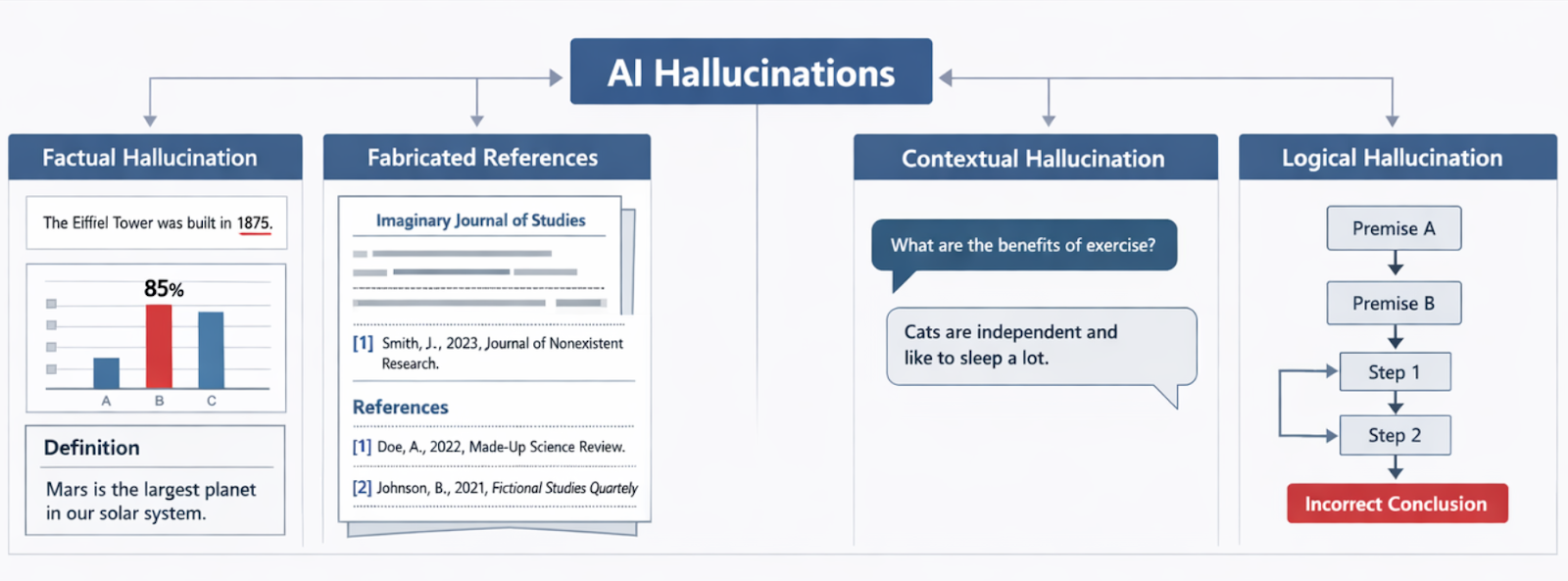
Researchers studying RLHF-based systems and language models categorize hallucinations to better understand their behavior.
- Factual Hallucination: Incorrect facts such as wrong dates, statistics, or definitions
- Fabricated References: Creation of non-existent citations, studies, or sources
- Contextual Hallucination: Misinterpretation of a question leading to irrelevant answers
- Logical Hallucination: Reasoning appears valid but leads to an incorrect conclusion
Understanding these categories helps researchers identify what are the most common hallucinations and develop better methods for reducing them.
Also Read: A 2.85× Leap in Real-Time AI Efficiency: The VL-JEPA Breakthrough
Real World AI Hallucination Examples
The AI hallucinations may manifest in several ways, depending on the use of the model. Given that most real-life systems do not make dramatic errors, hallucinations in many instances are the subtle errors that happen when the model becomes overconfident in what wrong patterns are.
Incorrect predictions are one of them. An example is an instance of a weather forecast that predicts rainfall even when that is not supported by weather data. This occurs as the model fails to analyse the trends in the training information and propagates the prediction that makes sense, but is not derived from the actual circumstances.
The other example is also a false positive. When banks and payment platforms have an AI model that is applicable in fraud detection, it might treat a real and positive transaction as a suspicious one. Although the systems are intended to identify abnormal behaviour, hallucination-like behaviour may lead to the interpretation of normal patterns as possible dangers.
The third one is the false negatives, when the model does not see something that is real. In medical diagnostics, an AI model that has been trained to identify tumours on medical imagery may miss an early-stage cancerous lesion. This is experienced when the model fails to appreciate the minute patterns that depict an actual state of affairs.
These examples show that hallucinations are not limited to text generation but can also affect predictive systems, decision-making tools, and analytical models.
Also Read: How Much Can AI Really Remember? Inside the LLM Context Window
How Researchers Are Reducing Hallucinations
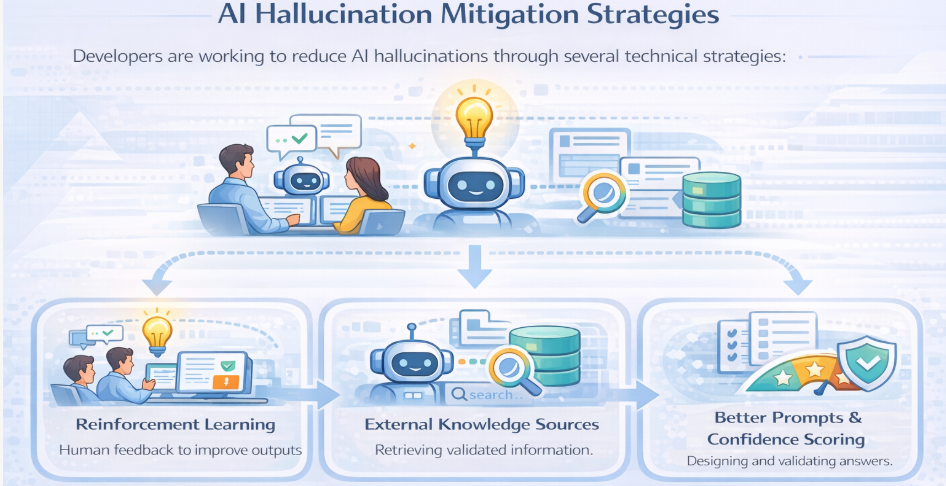
AI developers are actively working on preventing AI hallucinations through several technical approaches. Among all, reinforcement learning after human feedback is one of the most used techniques: human reviewers assess the outputs of the model and can also direct the system towards more accurate answers.
Another strategy is relating AI models to external knowledge sources. Retrieval-based systems enable the AI to obtain validated data on trusted databases prior to the creation of an answer. This helps ground the response in factual data rather than relying purely on statistical prediction.
Additional methods include model grounding, confidence scoring, and improved evaluation benchmarks to measure factual accuracy.
These techniques aim to improve reliability while maintaining the flexibility of generative systems.
Also Read: AI Isn’t Just Assisting Anymore. It’s Working as an Agent
How Users Can Avoid AI Hallucinations
While technology continues to improve, users play an important role in minimizing hallucinations.
AI-generated outputs should be treated as a starting point rather than a final source of truth, particularly in high-stakes contexts.
Practical steps include:
- Verifying facts when dealing with technical, medical, legal, or financial information
- Cross-checking outputs with credible and authoritative sources
- Asking follow-up questions to test consistency
- Providing clear, specific prompts to reduce ambiguity
Outputs that involve statistics, citations, or specialised domain knowledge carry a higher risk and should always be validated.
Understanding how to prevent AI hallucinations is, therefore, not just a technical challenge but also a matter of responsible usage.
Explore Related Courses











COMMENTS(0)
Explore Related Courses
Our Popular Insights
Careers are shifting faster than ever, and staying relevant takes more than experience. Explore UniAthena’s most-read blogs for sharp insights, emerging skills, and practical pathways that help you move forward with clarity and confidence in a changing professional world.





🌟 Top Project Performer – June 2026 🌟
Read More
1
mins read


🌟 Top Project Performer – May 2026 🌟
Read More
1
mins read

🌟 Top Project Performer – June 2026 🌟
Read more
1
mins read

🌟 Top Project Performer – May 2026 🌟
Read more
1
mins read
Get in Touch

It’s Time to Start
Join NowMost Popular Online Specialization
- Master of International Business Administration
- Master of Business Administration
- MBA in General Management- FastTrack
- Master in Innovation and Entrepreneurship
- MBA-Family Business Management
- Master in Procurement and Contract Management
- Extended Diploma in Business Analytics (SCQF Level 11)
- Diploma in Supply Chain and Logistics Management (SCQF Level 11)
- Strategic Human Resource Management Practitioner
- Master in Data Science
- Master in Engineering Management
Trending Online
- Integrated Doctorate of Business Administration
- Postgraduate Certificate in Finance for Next Generation Managers
- Master of Business Administration- General Management (Fast Track)
- Postgraduate Certificate in Socio-Economic and Legal Framework
- Postgraduate Certificate in Business Sustainability
- Certified Manager
- Supply Chain Management Practitioner
- MBA - AI in Business
- MBA - Accounting & Finance
- Master in Supply Chain and Logistics Management
Top Universities Online Certificates
- Postgraduate Certificate in International Marketing Management
- Postgraduate Certificate In International Human Resource Management
- Postgraduate Certificate in Strategic Management
- Postgraduate Certificate in Procurement & Contracts Management
- Postgraduate Certificate in Business Analytics
- Postgraduate Certificate in Strategic Supply Chain & Logistics Management
- Postgraduate Certificate in Human Resource and Leadership
- Project Management Practitioner
- Postgraduate Certificate in Supply Chain Design & Implementation
- Postgraduate Certificate in Management Accounting and Finance
Accredited Online Degree Program
- MBA - Digital Transformation
- MBA - Family Business Management
- MBA - Marketing Management
- MBA in Quality Management
- MBA - Business Intelligence & Data Analytics
- MBA in Operations & Project Management
- MBA in Energy Management
- MBA In Construction & Safety Management
- Master in Organisational Leadership
- Master in Public Health
- Master in Construction Management
- Bachelor of Arts in Business Administration


 Install Now


UniAthena is an Ed-Tech, offering flexible, affordable learning solutions, including Free-Learning Upskilling Courses and Academic Programs in partnerships with accredited and globally renowned universities and professional qualification bodies.


Do you have any questions ?
Feel free to send us your questions or request a free consultation
Send a message
UK
Athena Global Education
Magdalen Centre,
Robert Robinson Avenue,
Oxford, OX4 4GA, UK
Phone : 01865 784299
MIDDLE EAST
Athena Global Education FZE
Block L-03, First Floor,
P O Box 519265, Sharjah Publishing City,
Free Zone, Sharjah, UAE
Phone : +971 55 879 5492
INDIA
Uniathena Private Limited
9A,Midas Tower
Phase 1
Hinjewadi Rajiv Gandhi Infotech Park
Pune-411057
Phone: +91 9145665544
All Copyrights Reserved @ Athena Global Education 2021-2026