-

Bachelor's

-

Masters
-

MBA
-

Doctorate
-

Micro Credit
-

Explore all Courses
-
Postgraduate Certifications

-
Postgraduate Diploma
-
Undergraduate Diploma
-
Diploma



What is Change Management?
Author: maharajan p
|7
MINS READ
| 0
| 97
Created On: 15 April, 2026
Share




Table of Contents (TOC):
- Introduction
- Key Takeaways
- What is Change Management?
- Where is Change Management Applied?
- Core Frameworks Used in Change Management
- Job Roles that Value Change Management Skills
- What You Need to Learn in Change Management
- Conclusion
- FAQs
Introduction
Every organization reaches a point where something stops working. A process feels outdated. A system slows teams down. Results don’t match the effort anymore.
At that moment, there’s uncertainty. Do you fix what exists? Do you replace it? Or do you leave things as they are and hope it works out?
Most teams struggle here, not because change is impossible, but because they don’t know how to approach it. Decisions feel risky. People push back. Progress slows. This is where the importance of change management becomes clear.
It provides a way to think through change. To plan it. And to guide people through it, without breaking what already works.
Key Takeaways:
- Change management applies across technology, operations, culture, and strategy. Its value lies in applying the principles of change management consistently, especially during software rollouts, restructuring, and process improvement.
- Frameworks like Kotter, ADKAR, and Lewin provide structure, not shortcuts. They help identify risks, guide adoption, and embed change, but success depends on how well they are applied to real situations.
- Effective change managers combine leadership, communication, project execution, and data analysis. These skills are often developed through practice and change management training online, where learners apply theory to real scenarios.
What is Change Management? Importance of it
Change management is the process of helping people and organizations adjust to new ways of working. It’s about making transitions smoother and ensuring changes actually work.
For example, when a company launches new software, change management includes training employees, communicating clearly, addressing concerns, and tracking adoption. The goal is simple: the change should benefit both the organization and the people using it.
Why is change management important?
- Reduces resistance – People are naturally hesitant to change. Proper change management helps them understand why the change matters and how it affects them.
- Ensures faster adoption – With guidance and support, employees adopt new processes or tools quicker. This keeps projects on schedule.
- Minimizes disruption – Change can disrupt workflows. A structured approach reduces mistakes, confusion, and downtime.
In short, change management makes change work for both the organization and the people.
Where is Change Management Applied?
Change management is used whenever people and organizations need to adapt to new ways of working. It shows up in many areas:
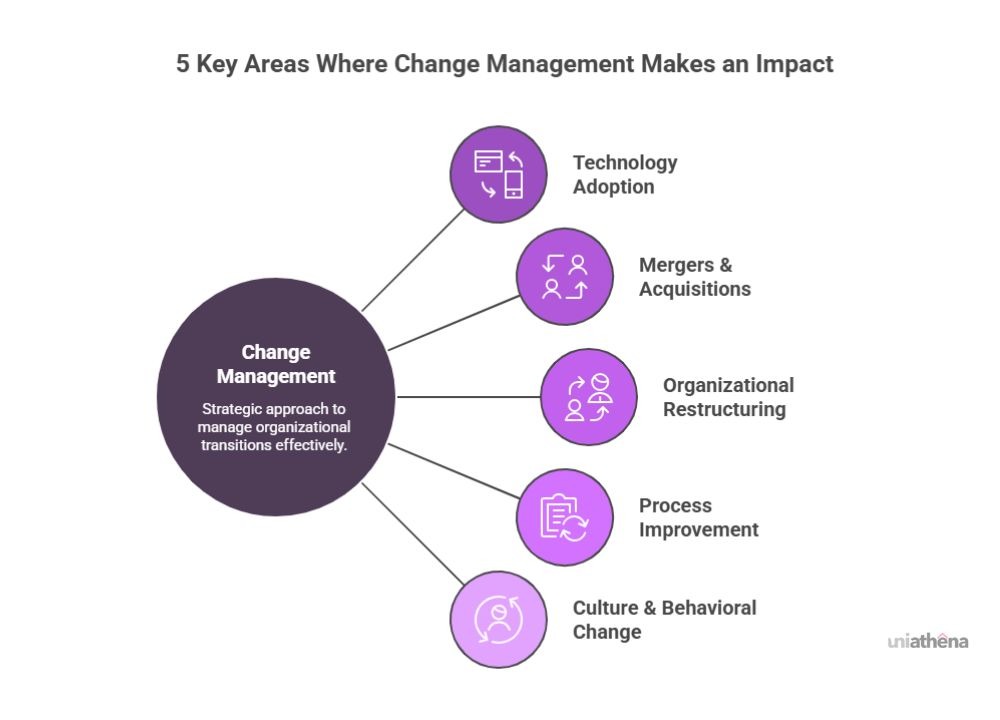
- Technology changes – Adopting new software, automation tools, or IT systems. Change management helps employees learn and use these tools effectively.
- Mergers and acquisitions – Aligning teams, systems, and culture during company integrations.
- Organizational restructuring – Shifting roles, reporting lines, or team structures.
- Process improvements – Updating workflows, policies, or operational procedures.
- Culture and behavioral change – Moving toward agile work, customer-centric practices, or innovative mindsets.
- Healthcare and compliance updates – Introducing new digital systems or meeting regulatory requirements.
- Education and learning systems – Implementing new learning platforms or administrative tools.
- Customer experience shifts – Training staff for new service models or digital support channels.
In short, any situation where people need to change how they work can benefit from change management. It makes transitions smoother, faster, and more successful.
Core Frameworks Used in Change Management
Change management frameworks provide a clear path for implementing change. They help organizations guide people and processes through transitions. The three most common frameworks are:
1. Kotter’s 8-Step Model
This model focuses on both people and processes to make change stick.
Example: A company adopting a new project management tool might:
- Show why the change is urgent using real workflow data.
- Build a team to lead the change.
- Set clear goals and a strategy.
- Communicate the purpose and benefits.
- Train employees and remove obstacles.
- Track and celebrate early wins.
- Expand the change across teams.
- Make it part of the company culture.
Each step addresses a key point in adoption, from resistance to embedding new behaviors.
2. ADKAR Model
ADKAR is people-focused. It tracks change adoption through five stages: Awareness, Desire, Knowledge, Ability, and Reinforcement.
Example: When rolling out a new CRM system:
- Awareness: Employees know why the CRM is needed.
- Desire: They want to use it because it makes their work easier.
- Knowledge: They learn how to use the system.
- Ability: They apply it in daily tasks.
- Reinforcement: Success is tracked, and continued support ensures adoption.
3. Lewin’s Change Model
A simple three-step model: Unfreeze → Change → Refreeze.
Example: Updating reporting processes:
- Unfreeze – Show why the old process no longer works.
- Change – Introduce new templates and train staff.
- Refreeze – Make the new process standard with ongoing support.
Job Roles that Value Change Management Skills
Change management skills include communication, leadership, problem-solving, planning, and the ability to guide teams through transitions. They help professionals reduce resistance, ensure adoption, and make change successful.
Roles that value these skills:
- Project Managers – Lead projects that involve process updates, technology rollouts, or team restructuring.
- HR Professionals – Support organizational change, employee training, and culture shifts.
- Operations Managers – Implement new workflows or operational improvements smoothly.
- Business Analysts – Bridge the gap between teams and stakeholders during change initiatives.
- Consultants – Advise companies on strategy, process transformation, and adoption planning.
- IT Managers – Guide technology implementation and ensure employees adopt new systems.
- Leaders and Executives – Drive strategic initiatives and create buy-in for company-wide changes.
What You Need to Learn in Change Management
Learning change management goes beyond understanding frameworks. To apply change in real organizations, you need a mix of technical knowledge, analytical thinking, and people skills.
Here’s what that actually means in practice.
1. Leadership and Influence
Change rarely succeeds without strong leadership. You need to learn how to guide people through uncertainty, align teams around a shared goal, and maintain momentum when resistance shows up.
This includes decision-making, accountability, and influencing stakeholders who may not report directly to you.
If you want to strengthen your leadership capabilities in change management, you can explore programs such as:
- Basics of Leadership & Human Behavior in Change Management: introduces the foundations of leadership behavior during change.
- Essentials of Strategic Change Management & Leadership: focuses on strategic leadership approaches to managing organizational transitions.
- Mastering Leadership for Change Management: designed for developing deeper leadership capability to guide complex transformation initiatives.
2. Business Communication
Change fails more often due to poor communication than poor strategy. You must learn how to explain change clearly, tailor messages to different audiences, and handle concerns without creating confusion. This involves written communication, presentations, and structured conversations with teams and leadership.
3. Stakeholder and Impact Analysis
Effective change management requires knowing who is affected, how they are affected, and what level of support they need.
You need to learn how to map stakeholders, assess readiness, and prioritize engagement efforts based on risk and influence.
4. Project and Process Management
Most change initiatives run alongside projects. That means you need working knowledge of planning, timelines, dependencies, and execution control.
Understanding how change activities align with project milestones helps ensure adoption happens on time, not after delivery.
Check out our program: Executive Diploma in Project Management
5. Data Analysis and Measurement
Change is not complete until it is adopted. You need to learn how to measure adoption, track performance, and analyze outcomes using data. This includes defining metrics, interpreting results, and using insights to adjust strategies when things are not working as expected.
Check out our program: Essentials of Data Analytics
Conclusion
Change management is not just a concept. It is a practical skill used to guide people, processes, and organizations through transitions. When applied correctly, it reduces resistance, improves adoption, and ensures changes deliver real outcomes.
To work effectively in this field, you need more than theory. You need skills in leadership, communication, project execution, and data-driven decision-making.
FAQs
Q1. Is change management only for large organizations?
A: No. Change management applies to organizations of all sizes, including startups and small teams, whenever people need to adapt to new ways of working.
Q2. Is change management the same as project management?
A: No. Project management focuses on delivering tasks and timelines. Change management focuses on helping people adopt and sustain those changes.
Q3. Which change management framework should beginners start with?
A: The ADKAR model is often a good starting point because it focuses on individual adoption and is easy to apply in real situations.
Q4. Why do change initiatives fail even with good planning?
A: Most failures happen due to poor communication, lack of leadership support, or unaddressed resistance, not because the strategy itself was wrong.
Q5. Do you need technical skills to work in change management?
A: Yes. You need skills in stakeholder analysis, communication planning, project coordination, and data measurement to manage change effectively.
Explore Related Courses










.jpg)
.jpg)
COMMENTS(0)
Explore Related Courses
Our Popular Insights
Careers are shifting faster than ever, and staying relevant takes more than experience. Explore UniAthena’s most-read blogs for sharp insights, emerging skills, and practical pathways that help you move forward with clarity and confidence in a changing professional world.

What Is Grok AI?
Read More
9
mins read
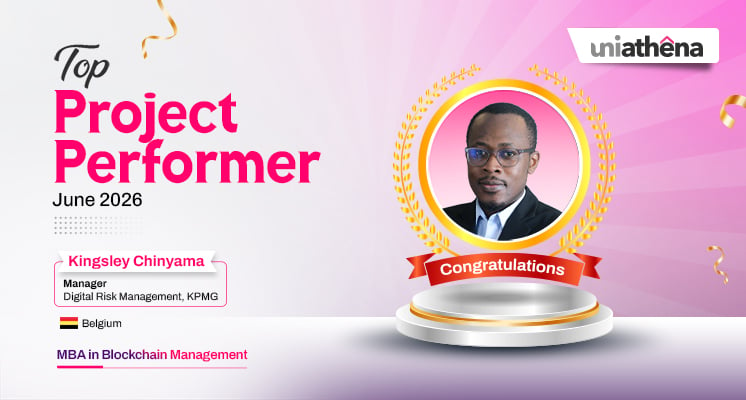
🌟 Top Project Performer – June 2026 🌟
Read More
1
mins read


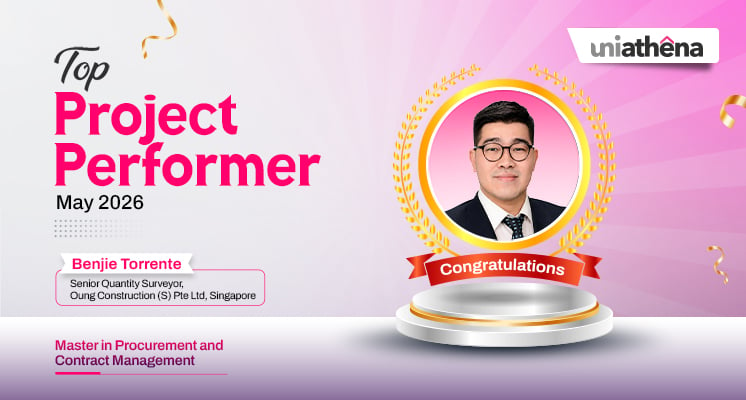
🌟 Top Project Performer – May 2026 🌟
Read More
1
mins read

Top Cybersecurity Courses in Ghana
Read More
7
mins read
Best AI Tools for Content Creation
Read More
8
mins read
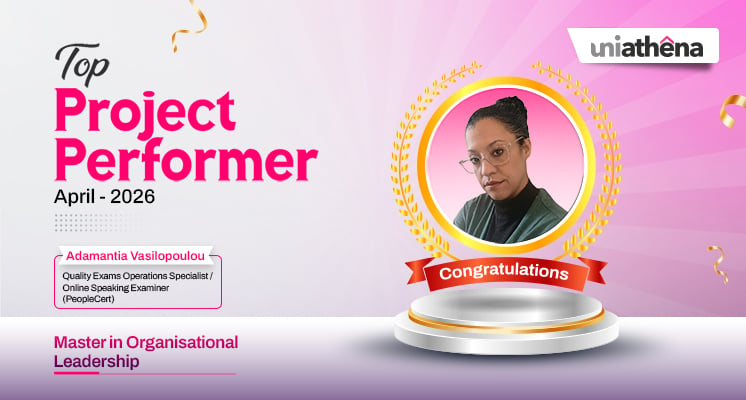
🌟 Top Project Performer – April 2026 🌟
Read More
1
mins read
What Is Grok AI?
Read more
9
mins read
🌟 Top Project Performer – June 2026 🌟
Read more
1
mins read
🌟 Top Project Performer – May 2026 🌟
Read more
1
mins read
Top Cybersecurity Courses in Ghana
Read more
7
mins read
Best AI Tools for Content Creation
Read more
8
mins read
🌟 Top Project Performer – April 2026 🌟
Read more
1
mins read
Get in Touch

It’s Time to Start
Join NowMost Popular Online Specialization
- Master of International Business Administration
- Master of Business Administration
- MBA in General Management- FastTrack
- Master in Innovation and Entrepreneurship
- MBA-Family Business Management
- Master in Procurement and Contract Management
- Extended Diploma in Business Analytics (SCQF Level 11)
- Diploma in Supply Chain and Logistics Management (SCQF Level 11)
- Strategic Human Resource Management Practitioner
- Master in Data Science
- Master in Engineering Management
Trending Online
- Integrated Doctorate of Business Administration
- Postgraduate Certificate in Finance for Next Generation Managers
- Master of Business Administration- General Management (Fast Track)
- Postgraduate Certificate in Socio-Economic and Legal Framework
- Postgraduate Certificate in Business Sustainability
- Certified Manager
- Supply Chain Management Practitioner
- MBA - AI in Business
- MBA - Accounting & Finance
- Master in Supply Chain and Logistics Management
Top Universities Online Certificates
- Postgraduate Certificate in International Marketing Management
- Postgraduate Certificate In International Human Resource Management
- Postgraduate Certificate in Strategic Management
- Postgraduate Certificate in Procurement & Contracts Management
- Postgraduate Certificate in Business Analytics
- Postgraduate Certificate in Strategic Supply Chain & Logistics Management
- Postgraduate Certificate in Human Resource and Leadership
- Project Management Practitioner
- Postgraduate Certificate in Supply Chain Design & Implementation
- Postgraduate Certificate in Management Accounting and Finance
Accredited Online Degree Program
- MBA - Digital Transformation
- MBA - Family Business Management
- MBA - Marketing Management
- MBA in Quality Management
- MBA - Business Intelligence & Data Analytics
- MBA in Operations & Project Management
- MBA in Energy Management
- MBA In Construction & Safety Management
- Master in Organisational Leadership
- Master in Public Health
- Master in Construction Management
- Bachelor of Arts in Business Administration


 Install Now


UniAthena is an Ed-Tech, offering flexible, affordable learning solutions, including Free-Learning Upskilling Courses and Academic Programs in partnerships with accredited and globally renowned universities and professional qualification bodies.


Do you have any questions ?
Feel free to send us your questions or request a free consultation
Send a message
UK
Athena Global Education
Magdalen Centre,
Robert Robinson Avenue,
Oxford, OX4 4GA, UK
Phone : 01865 784299
MIDDLE EAST
Athena Global Education FZE
Block L-03, First Floor,
P O Box 519265, Sharjah Publishing City,
Free Zone, Sharjah, UAE
Phone : +971 55 879 5492
INDIA
Uniathena Private Limited
9A,Midas Tower
Phase 1
Hinjewadi Rajiv Gandhi Infotech Park
Pune-411057
Phone: +91 9145665544
All Copyrights Reserved @ Athena Global Education 2021-2026