-

Bachelor's

-

Masters
-

MBA
-

Doctorate
-

Micro Credit
-

Explore all Courses
-
Postgraduate Certifications

-
Postgraduate Diploma
-
Undergraduate Diploma
-
Diploma



Can Senior Project Managers Benefit from a DBA in Project Management?

Author: aishwarya sancheti
|9
MINS READ
| 0
| 9
Created On: 09 July, 2026
Share




Table of Contents:
- Introduction
- Key Takeaways
- The Modern Project Manager Is Already Operating Like an Executive
- What Is a DBA in Project Management?
- Why Senior Project Managers Are Reconsidering Executive Education
- From Project Manager to C-Level: The Doctorate Advantage
- What Does a Project Manager Do at the Senior Level?
- Can You Be a Project Manager With a Business Degree?
- The Leadership Skills That Separate Executives From Managers
- Is a Doctorate in Business Administration Worth It for Experienced Professionals?
- Why Online Doctoral Programs Are Becoming More Relevant
- The Future of Career Growth for Senior Project Managers
- Conclusion
- FAQs
Introduction
There comes a point in every senior project manager’s career when execution can be more than a challenge but an influence.
You already know how to deliver multimillion-dollar programs, manage cross-functional teams, navigate stakeholders, mitigate risk, and keep operations moving under pressure. But moving from delivery leadership to enterprise leadership requires a different shift altogether. Boards are now looking for leaders who understand business transformation, strategic growth, governance, organizational change, digital disruption, and executive decision-making at scale.
That is exactly why conversations around a DBA in Project Management are growing among experienced professionals. Not because senior project managers suddenly need another qualification. But because the role itself has evolved.
Key Takeaways:
- Senior project managers are now expected to drive business strategy, transformation, and enterprise growth, not just project delivery.
- A DBA in Project Management helps professionals transition from operational leadership to executive-level decision-making.
- Modern project leadership requires expertise in governance, innovation, digital transformation, and strategic business alignment.
- Career growth for project managers increasingly depends on executive influence, strategic thinking, and organizational leadership skills.
- Online doctoral programs are becoming more relevant for experienced professionals seeking flexible, research-driven executive education.
- The future of project management leadership will be shaped by AI, enterprise modernization, sustainability, and large-scale business transformation.
The Modern Project Manager Is Already Operating Like an Executive
The traditional perception of project management is outdated. Today’s senior project managers are deeply involved in:
- Business strategy execution
- Organizational transformation
- Financial oversight
- Digital adoption initiatives
- Vendor governance
- Change management
- Cross-border operations
- Risk and compliance leadership
According to the Project Management Institute (PMI), organizations that prioritize project management as a strategic competency waste 28 times less money than organizations with low project management maturity. That statistic alone explains why project leadership has become a boardroom conversation.
The modern enterprise now is increasingly depending on project leaders to drive measurable business outcomes and not just operational delivery.
And this shift is changing the expectations attached to senior project manager responsibilities. Execution is now assumed. Plus, strategic thinking is what differentiates leaders.
What Is a DBA in Project Management?
A DBA in Project Management is a professional doctorate designed for experienced managers and executives who want to combine advanced business leadership with applied research and strategic decision-making. Unlike a traditional PhD, which is heavily academic and theory-driven, a Doctor of Business Administration focuses on solving real organizational challenges. That distinction matters.
Senior professionals are not looking to pause their careers for academic exploration. They are looking to:
- Strengthen executive leadership capabilities
- Understand enterprise-level business strategy
- Improve organizational decision-making
- Lead transformation initiatives more effectively
- Develop research-backed business insight
- Position themselves for C-suite and advisory roles
In practical terms, a doctorate in project management online often bridges the gap between operational leadership and enterprise leadership. And for many professionals, that transition becomes the defining stage of their career.
Why Senior Project Managers Are Reconsidering Executive Education
There is a growing reason that experienced professionals are turning toward project management executive education. The ceiling has changed. In many industries, promotion into senior leadership no longer depends solely on years of experience. Organizations increasingly value leaders who can connect operations with business strategy.
A senior project manager may successfully deliver programs worth millions. But executive leadership demands additional capabilities like Enterprise thinking, Global business awareness, Financial and commercial understanding, and Strategic governance. Adding to it are Data-driven decision-making, Organizational leadership, Innovation management, and Stakeholder diplomacy.
This is particularly visible in industries undergoing aggressive transformation - technology, infrastructure, healthcare, finance, consulting, manufacturing, and logistics.
According to PMI’s Talent Gap report, the global economy will require millions of new project-oriented roles by the end of the decade, particularly in leadership-intensive sectors.
However, technical project expertise alone is no longer sufficient for long-term advancement. The leaders advancing fastest are the ones who can influence organizational direction. That is where the benefits of Doctor of Business Administration programs become highly relevant.
From Project Manager to C-Level: The Doctorate Advantage
One of the most overlooked realities in the product manager career path and broader project leadership ecosystem is this: The higher you move, the less your role is about managing projects. And the more it becomes about managing business impact.
Senior professionals eventually begin handling questions such as:
- Should the organization invest in this transformation initiative?
- What operational risks affect long-term growth?
- How should enterprise resources be allocated?
- Which innovation programs deserve executive sponsorship?
- What delivery frameworks support scalability?
- How do digital initiatives align with business profitability?
These are not project coordination questions. They are executive leadership questions.
A DBA in Project Management helps experienced professionals develop the strategic lens required to answer them. That is why many leaders pursue project management doctoral programs later in their careers, not to become academics, but to become more effective business leaders.
What Does a Project Manager Do at the Senior Level?
At the entry or mid-management level, project management is often associated with execution. At the senior level, the role changes significantly.
A senior project manager today may oversee:
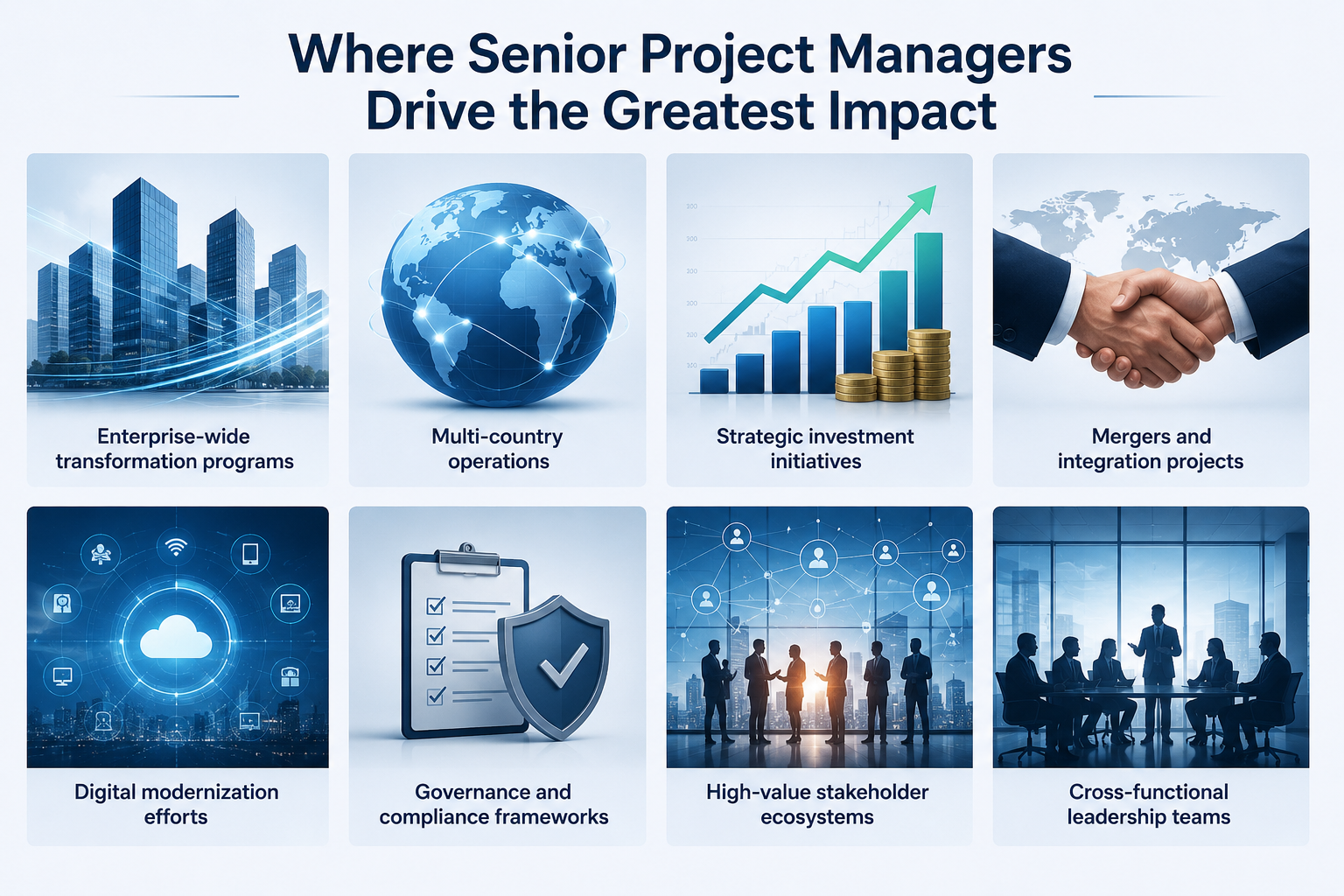
In many organizations, senior project managers operate as de facto business leaders.
The title may remain operational. But the expectations are increasingly executive. This is one reason career growth for project managers now depends heavily on leadership positioning rather than technical capability alone.
Can You Be a Project Manager With a Business Degree?
Absolutely. In fact, many successful project leaders come from business, operations, finance, engineering, technology, and consulting backgrounds.
The question is no longer whether a business degree can lead to project management. The more important question is: How far can strategic business expertise take a project management professional?
As organizations become more interconnected, project leaders are expected to understand:
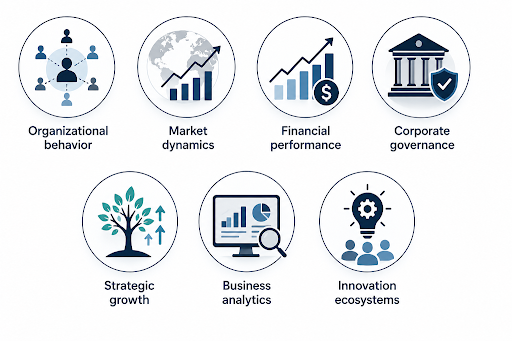
And so professionals are increasingly exploring advanced qualifications such as a DBA in Project Management rather than relying solely on technical certifications. The future of project leadership is becoming deeply business-centric.
The Leadership Skills That Separate Executives From Managers
One reason many experienced professionals reach a plateau is that operational excellence does not automatically create executive influence.
The transition requires a different category of leadership. The most valuable project management leadership skills today include:
This is where advanced executive education often creates measurable value. Not because senior professionals lack experience. But because they need frameworks that help convert experience into enterprise leadership capability.
Is a Doctorate in Business Administration Worth It for Experienced Professionals?
For early-career professionals, the answer may depend on timing.
For senior leaders, the question is usually different.
Will it strengthen strategic credibility? In many cases, yes.
A DBA is increasingly seen as a leadership qualification rather than a purely academic credential. Particularly for professionals aiming toward:
- C-suite roles
- Consulting leadership
- Transformation leadership
- Strategy positions
- Board advisory opportunities
- Enterprise operations leadership
- Academic-industry hybrid careers
The value is often less about the title itself and more about the intellectual transition it enables. Senior professionals already possess practical experience. A doctorate in project management often helps structure that experience into strategic insight. And in leadership environments where credibility, vision, and analytical depth matter, that distinction becomes important.
Why Online Doctoral Programs Are Becoming More Relevant
One major reason professionals explore a doctorate in project management online is flexibility. Experienced leaders are rarely in a position to step away from full-time responsibilities.
Modern executive education models increasingly accommodate: Working professionals, Global executives, Hybrid leadership roles, International teams, and Flexible research structures.
This shift has made advanced executive education significantly more practical for senior professionals who want to continue leading while advancing academically.
DBA in Project Management by UniAthena in partnership with Guglielmo Marconi University (GMU), Italy, is structured for experienced professionals balancing leadership responsibilities alongside doctoral-level learning.
This 3-year, 180 ECTS program is designed with a flexible online learning model and focuses on applied business research, strategic project leadership, organizational transformation, and executive decision-making, areas increasingly shaping enterprise project environments.
Professionals exploring project management doctoral programs today are not necessarily looking for academic theory alone. They are looking for education that connects directly to real business complexity, leadership influence, and long-term executive growth.
The Future of Career Growth for Senior Project Managers
The next decade will likely redefine project leadership entirely. Organizations are becoming more transformation-driven, technology-led, and globally interconnected. Which means project leaders will increasingly influence:
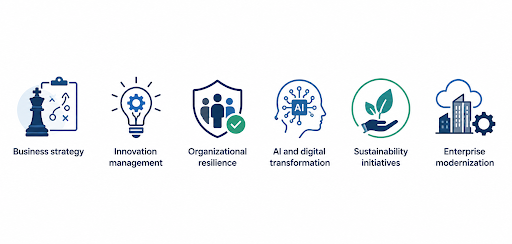
The project manager of the future will not simply coordinate execution but shape organizational direction. And professionals who understand both operational delivery and executive strategy will hold a distinct advantage. That is the larger conversation behind the growing interest in project management doctoral programs.
Not academic prestige. Strategic relevance.
Conclusion
The professionals who make the jump from Senior PM to VP, COO, or Chief Transformation Officer don't usually have more certifications than their peers. They have a fundamentally different level of strategic thinking and the credentials that prove it.
Career growth for project managers at the senior level is rarely about learning new tools. It's about expanding the intellectual and organizational authority you bring to the table. That's exactly what doctoral-level education in business administration is designed to develop.
If you're genuinely asking whether a DBA in project management is the right next step, you're probably already past the point where a certification would move the needle. The question is no longer "Can I do this work?" It's "Am I positioned to lead it at the highest level?"
FAQs
Q1.Can you be a project manager with a business degree?
A: Yes, and most successful PMs begin with a business undergraduate or MBA. The DBA is a step taken once you've built significant experience and want to lead at a higher organizational level, not a prerequisite for entry.
Q2. What does a project manager do at the senior level that's different?
A: Senior PMs operate at the intersection of strategy and execution. They govern portfolios, align delivery to business objectives, manage executive relationships, and often function as internal consultants to C-level leadership. The role is more advisory, less operational.
Q3. Are there doctorates in project management programs available online?
A: Yes. Several accredited institutions now offer DBA programs with a project management concentration fully online or in a hybrid format, designed specifically for working professionals who cannot interrupt their careers.
Q4. What's the difference between project management executive education and a DBA?
A: Executive education programs (think 3–5-day intensives or short certificate programs) offer curated exposure to leadership concepts. A DBA is a full terminal credential - a multi-year investment that transforms your thinking, not just your toolkit.
Q5. What are the real benefits of a Doctor of Business Administration for a PM?
A: Applied research capability, executive credibility, strategic leadership depth, expanded professional network at the doctoral level, and a clear differentiator in competitive C-suite hiring processes.
Our Popular Courses

$14000


Doctoral Degree in Business Administration
Universidad Catolica De Murcia (UCAM), Spain
Duration:
2 - 3 Years
$17500*
Integrated Doctorate of Business Administration
Guglielmo Marconi University, Italy
Universidad Catolica De Murcia (UCAM), Spain
Duration:
2.5 - 3.5 Years
$5600*
Master of Business Administration
Guglielmo Marconi University, Italy
Duration:
12 - 24 Months
$5600*
MBA in Operations & Project Management
Guglielmo Marconi University, Italy
Duration:
12 - 24 Months
$5600*
Master in Supply Chain and Logistics Management
Guglielmo Marconi University, Italy
Duration:
12 - 24 Months
$5950*
Master in Data Sciences
Guglielmo Marconi University, Italy
Duration:
12 - 24 Months
$5600*
Master in Engineering Management
Guglielmo Marconi University, Italy
Duration:
12 - 24 Months
$5600*
Master in Procurement and Contract Management
Guglielmo Marconi University, Italy
Duration:
12 - 24 Months
$5600*
Master in Public Health
Guglielmo Marconi University, Italy
Duration:
12 - 24 MonthsOur Popular Courses
COMMENTS(0)
Our Popular Courses
$14000
Doctoral Degree in Business Administration
Universidad Catolica De Murcia (UCAM), Spain
Duration:
2 - 3 Years
$17500*
Integrated Doctorate of Business Administration
Guglielmo Marconi University, Italy
Universidad Catolica De Murcia (UCAM), Spain
Duration:
2.5 - 3.5 Years
$5600*
Master of Business Administration
Guglielmo Marconi University, Italy
Duration:
12 - 24 Months
$5600*
MBA in Operations & Project Management
Guglielmo Marconi University, Italy
Duration:
12 - 24 Months
$5600*
Master in Supply Chain and Logistics Management
Guglielmo Marconi University, Italy
Duration:
12 - 24 Months
$5950*
Master in Data Sciences
Guglielmo Marconi University, Italy
Duration:
12 - 24 Months
$5600*
Master in Engineering Management
Guglielmo Marconi University, Italy
Duration:
12 - 24 Months
$5600*
Master in Procurement and Contract Management
Guglielmo Marconi University, Italy
Duration:
12 - 24 Months
$5600*
Master in Public Health
Guglielmo Marconi University, Italy
Duration:
12 - 24 MonthsOur Popular Courses
Our Popular Insights
Careers are shifting faster than ever, and staying relevant takes more than experience. Explore UniAthena’s most-read blogs for sharp insights, emerging skills, and practical pathways that help you move forward with clarity and confidence in a changing professional world.
What Is Grok AI?
Read More
9
mins read

🌟 Top Project Performer – June 2026 🌟
Read More
1
mins read


Top Cybersecurity Courses in Ghana
Read More
7
mins read
🌟 Top Project Performer – May 2026 🌟
Read More
1
mins read
Best AI Tools for Content Creation
Read More
8
mins read

🌟 Top Project Performer – April 2026 🌟
Read More
1
mins read
What Is Grok AI?
Read more
9
mins read
🌟 Top Project Performer – June 2026 🌟
Read more
1
mins read
Top Cybersecurity Courses in Ghana
Read more
7
mins read
🌟 Top Project Performer – May 2026 🌟
Read more
1
mins read
Best AI Tools for Content Creation
Read more
8
mins read
🌟 Top Project Performer – April 2026 🌟
Read more
1
mins read
Get in Touch

It’s Time to Start
Join NowMost Popular Online Specialization
- Master of International Business Administration
- Master of Business Administration
- MBA in General Management- FastTrack
- Master in Innovation and Entrepreneurship
- MBA-Family Business Management
- Master in Procurement and Contract Management
- Extended Diploma in Business Analytics (SCQF Level 11)
- Diploma in Supply Chain and Logistics Management (SCQF Level 11)
- Strategic Human Resource Management Practitioner
- Master in Data Science
- Master in Engineering Management
Trending Online
- Integrated Doctorate of Business Administration
- Postgraduate Certificate in Finance for Next Generation Managers
- Master of Business Administration- General Management (Fast Track)
- Postgraduate Certificate in Socio-Economic and Legal Framework
- Postgraduate Certificate in Business Sustainability
- Certified Manager
- Supply Chain Management Practitioner
- MBA - AI in Business
- MBA - Accounting & Finance
- Master in Supply Chain and Logistics Management
Top Universities Online Certificates
- Postgraduate Certificate in International Marketing Management
- Postgraduate Certificate In International Human Resource Management
- Postgraduate Certificate in Strategic Management
- Postgraduate Certificate in Procurement & Contracts Management
- Postgraduate Certificate in Business Analytics
- Postgraduate Certificate in Strategic Supply Chain & Logistics Management
- Postgraduate Certificate in Human Resource and Leadership
- Project Management Practitioner
- Postgraduate Certificate in Supply Chain Design & Implementation
- Postgraduate Certificate in Management Accounting and Finance
Accredited Online Degree Program
- MBA - Digital Transformation
- MBA - Family Business Management
- MBA - Marketing Management
- MBA in Quality Management
- MBA - Business Intelligence & Data Analytics
- MBA in Operations & Project Management
- MBA in Energy Management
- MBA In Construction & Safety Management
- Master in Organisational Leadership
- Master in Public Health
- Master in Construction Management
- Bachelor of Arts in Business Administration


 Install Now


UniAthena is an Ed-Tech, offering flexible, affordable learning solutions, including Free-Learning Upskilling Courses and Academic Programs in partnerships with accredited and globally renowned universities and professional qualification bodies.


Do you have any questions ?
Feel free to send us your questions or request a free consultation
Send a message
UK
Athena Global Education
Magdalen Centre,
Robert Robinson Avenue,
Oxford, OX4 4GA, UK
Phone : 01865 784299
MIDDLE EAST
Athena Global Education FZE
Block L-03, First Floor,
P O Box 519265, Sharjah Publishing City,
Free Zone, Sharjah, UAE
Phone : +971 55 879 5492
INDIA
Uniathena Private Limited
9A,Midas Tower
Phase 1
Hinjewadi Rajiv Gandhi Infotech Park
Pune-411057
Phone: +91 9145665544
All Copyrights Reserved @ Athena Global Education 2021-2026