-

Bachelor's

-

Masters
-

MBA
-

Doctorate
-

Micro Credit
-

Explore all Courses
-
Postgraduate Certifications

-
Postgraduate Diploma
-
Undergraduate Diploma
-
Diploma



Blockchain in Supply Chain Management
Author: maria rashid
|5
MINS READ
| 0
| 196
Created On: 19 September, 2025
Share




Table of Content (TOC):
- What is Blockchain?
- What is Supply Chain Management?
- Key Elements of Supply Chain
- Blockchain Capabilities in Supply Chains
- Blockchain for Supply Chain Benefits and Challenges
- AI with Blockchain in Supply Chains
- Final Thoughts
The advancement of supply chain management has been remarkable over time, as it has adapted to the demands of the globalized world. Whereas traditional supply chain management systems still face many challenges and risks, despite the advancing technology. Some of these risks are complexities in logistics, fraud, lack of transparency, and improper communication.
In this blog, we will discuss how blockchain technology can be utilized to detect and mitigate the risks and difficulties present in traditional supply chain management systems, as well as how it can be integrated within these systems to create advanced and innovative supply chains.
What is Blockchain?
Blockchain technology is a distributed or decentralized digital ledger that is utilized to record data and transactions across various computers forming a network, so that no individual is the owner of the records and cannot alter records without the consensus of the network. This type of mechanism ensures that there is 100% transparency, security, and immutability of data and records.
The blocks are a collection of records that are linked or chained together using cryptography.
The supply chain sector, where accountability, security, traceability, and transparency are critical, is a good fit for blockchain technology because of its transparent and safe nature.
What is Supply Chain Management?
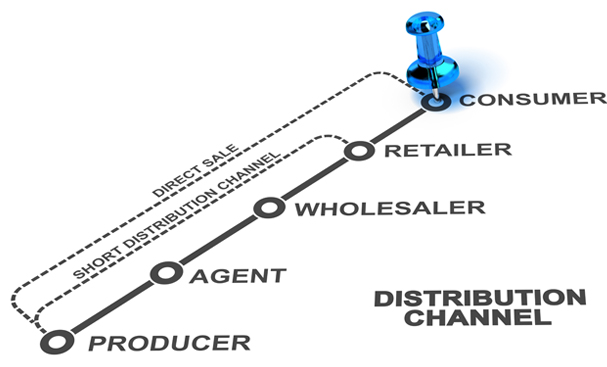
Supply chain management is the overall process that is responsible for the production of goods and services and their distribution, from the procurement of raw materials to the final delivery to the customers. It coordinates every process that is undertaken to manufacture and deliver products to the customers. It centrally controls and links the production, shipment, and distribution of products.
Key Elements of Supply Chain
- Procurement - It is the choice of the suppliers who supply the raw materials that are required for production. The main focus is on quality, cost-effectiveness, and reliable delivery timelines.
- Manufacturing - This is the production of finished goods. The main focus is on converting raw materials into products ready for delivery.
- Logistics & Distribution - This is the physical flow of products through various modes of transportation and warehousing. The aim is efficient and timely delivery to customers.
- Inventory Management - This involves storing the right quantity of inventory in the warehouses without over- and under-stocking. The aim is to prevent delays in the supply chain.
- Planning of Demand- This involves forecasting market demand to produce the right quantity of products. The goal is to avoid stockout and overproduction.
- Customer Service - Supply chain management ensures customer satisfaction by maintaining relationships and meeting customer expectations.
Despite the advancements made in supply chain management systems, the flow of goods and information can be low sometimes. Therefore, the integration of blockchain technology into supply chain management is crucial for efficient and innovative improvements.
Also Read: Digital Tools and Strategies for Navigating Supply Chain Disruptions in Project Management

Blockchain Capabilities in Supply Chains
The fusion of blockchain technology with supply chain management has resulted in various benefits, allowing businesses to develop more efficient, secure, and agile supply chain ecosystems.
Here are some of the key capabilities of blockchain in supply chain management:
Enhanced Transparency:
The main challenge of traditional supply chains is the lack of visibility into the flow of goods and information. But blockchain technology stores the records and data into an immutable ledger, which allows stakeholders to track the progress of shipments, verify transactions, and get real-time insights about the flow of goods.
Development of Smart Contracts:
These contracts are self-executing contracts with the terms of agreements already written in the code, which automatically execute actions if the predetermined terms are met without the need of any intermediary, therefore enhancing efficiency and reducing the risks of disputes and human error.
Improved Supply Chain Security:
The security and privacy of sensitive supply chain data are the primary concerns of traditional supply chains. Blockchain technology ensures that no unauthorized party can access or tamper with the sensitive data by providing a secure and tamper-proof way of recording transactions. The cryptographic technology in blockchain makes it nearly impossible for bad actors to tamper with or damage any stored data.
Upgrading Logistics and Shipping Functions:
Blockchain plays a revolutionary role in improving the logistics and shipping functions. These functions are simplified and innovated by providing a single, distributed ledger of all supply chain transactions. All shipments are tracked by authorized stakeholders in real-time, and delays are identified and addressed promptly.
Also Read: Career in Supply Chain Management: A Path to Promising Opportunities
Blockchain for Supply Chain Benefits and Challenges
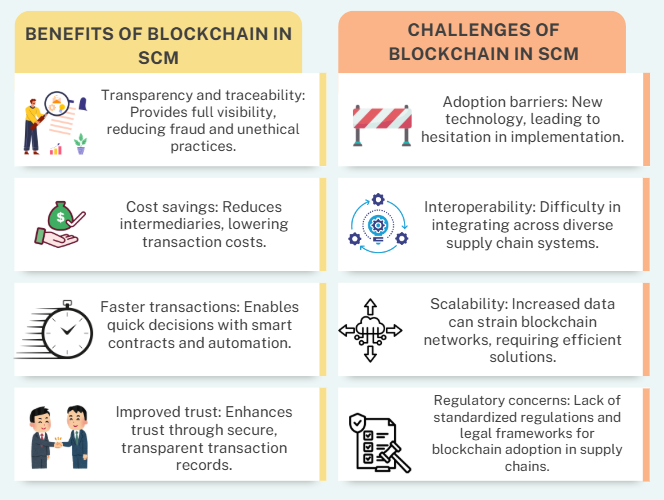
Integrating blockchain for SCM comes with several key benefits, as well as some challenges that businesses must consider:
AI with Blockchain in Supply Chains
As businesses are moving towards digitalization, various new opportunities are revealed through the integration of blockchain technology with Artificial Intelligence (AI). AI with blockchain can enhance supply chains by providing predictive analysis, demand forecasting, reducing waste, and optimizing inventory levels. Supply chain managers can use machine learning algorithms to identify data patterns and make smarter decisions.
Furthermore, blockchain and other technologies like Internet of Things (IOT) can be used in supply chain management to develop autonomous and connected supply chains. The combination of smarter technologies and supply chain management offers a powerful solution for smarter, more efficient supply chain management.
Also Read: 7 Reasons to Learn Blockchain Basics
Final Thoughts
Blockchain has huge potential in supply chain management by enhancing transparency, efficiency, and security of supply chains with the help of innovations like smart contracts or AI-driven solutions. As supply chains grow more digital and connected, blockchain will play a critical role in driving operational excellence and innovation across industries.
References:
https://www.investopedia.com/terms/b/blockchain.asp
https://www.investopedia.com/terms/s/scm.asp
https://www.oracle.com/in/blockchain/what-is-blockchain/blockchain-for-supply-chain/
Explore Related Courses












COMMENTS(0)
Explore Related Courses
Our Popular Insights
Careers are shifting faster than ever, and staying relevant takes more than experience. Explore UniAthena’s most-read blogs for sharp insights, emerging skills, and practical pathways that help you move forward with clarity and confidence in a changing professional world.

🌟 Students of the Month | May – June 2026 🌟
Read More
1
mins read







🌟 Students of the Month | May – June 2026 🌟
Read more
1
mins read
Get in Touch

It’s Time to Start
Join NowMost Popular Online Specialization
- Master of International Business Administration
- Master of Business Administration
- MBA in General Management- FastTrack
- Master in Innovation and Entrepreneurship
- MBA-Family Business Management
- Master in Procurement and Contract Management
- Extended Diploma in Business Analytics (SCQF Level 11)
- Diploma in Supply Chain and Logistics Management (SCQF Level 11)
- Strategic Human Resource Management Practitioner
- Master in Data Science
- Master in Engineering Management
Trending Online
- Integrated Doctorate of Business Administration
- Postgraduate Certificate in Finance for Next Generation Managers
- Master of Business Administration- General Management (Fast Track)
- Postgraduate Certificate in Socio-Economic and Legal Framework
- Postgraduate Certificate in Business Sustainability
- Certified Manager
- Supply Chain Management Practitioner
- MBA - AI in Business
- MBA - Accounting & Finance
- Master in Supply Chain and Logistics Management
Top Universities Online Certificates
- Postgraduate Certificate in International Marketing Management
- Postgraduate Certificate In International Human Resource Management
- Postgraduate Certificate in Strategic Management
- Postgraduate Certificate in Procurement & Contracts Management
- Postgraduate Certificate in Business Analytics
- Postgraduate Certificate in Strategic Supply Chain & Logistics Management
- Postgraduate Certificate in Human Resource and Leadership
- Project Management Practitioner
- Postgraduate Certificate in Supply Chain Design & Implementation
- Postgraduate Certificate in Management Accounting and Finance
Accredited Online Degree Program
- MBA - Digital Transformation
- MBA - Family Business Management
- MBA - Marketing Management
- MBA in Quality Management
- MBA - Business Intelligence & Data Analytics
- MBA in Operations & Project Management
- MBA in Energy Management
- MBA In Construction & Safety Management
- Master in Organisational Leadership
- Master in Public Health
- Master in Construction Management
- Bachelor of Arts in Business Administration


 Install Now


UniAthena is an Ed-Tech, offering flexible, affordable learning solutions, including Free-Learning Upskilling Courses and Academic Programs in partnerships with accredited and globally renowned universities and professional qualification bodies.


Do you have any questions ?
Feel free to send us your questions or request a free consultation
Send a message
UK
Athena Global Education
Magdalen Centre,
Robert Robinson Avenue,
Oxford, OX4 4GA, UK
Phone : 01865 784299
MIDDLE EAST
Athena Global Education FZE
Block L-03, First Floor,
P O Box 519265, Sharjah Publishing City,
Free Zone, Sharjah, UAE
Phone : +971 55 879 5492
INDIA
Uniathena Private Limited
9A,Midas Tower
Phase 1
Hinjewadi Rajiv Gandhi Infotech Park
Pune-411057
Phone: +91 9145665544
All Copyrights Reserved @ Athena Global Education 2021-2026