-

Bachelor's

-

Masters
-

MBA
-

Doctorate
-

Micro Credit
-

Explore all Courses
-
Postgraduate Certifications

-
Postgraduate Diploma
-
Undergraduate Diploma
-
Diploma



The Power of Trust: How Great Leaders Inspire Accountability Without Micromanagement

Author: ruchika nangia
|5
MINS READ
| 0
| 127
Created On: 07 April, 2025
Share




What is Micromanagement?
Micromanagement is a management approach marked by an overabundance of oversight and control regarding a team and its individual members. Employees subjected to micromanagement often find themselves with minimal freedom in their work processes and limited opportunities to participate in decision-making.
Some Damaging Effects of Micromanagement
- A deficiency of trust from management diminishes both confidence and engagement among employees.
- Excessively stringent supervision stifles employees, leading to low motivation.
- Micromanagement hinders collaboration, resulting in employee isolation.
- Rigid directives cause employees to be reluctant in exercising independent thought.
- Continuous monitoring leads employees to doubt their own competencies.
- Persistent stress stemming from micromanagement contributes to burnout for both managers and staff.
- In an environment characterized by micromanagement, both leaders and employees experience reduced engagement and productivity due to a diminished sense of purpose.
The Solution: The Power of Trust in Leadership
A high-trust organization is one in which employees feel safe to take risks, have freedom of expression, and be creative. When trust is inculcated in an organization, completing difficult tasks can become effortless because people are more likely to collaborate and communicate with each other more effectively enhancing productivity. As a result, outcomes tend to be more successful.
According to a study in Harvard Business Review, people at high-trust companies report 74% less stress, 106% more energy at work, 50% higher productivity, 13% fewer sick days, 76% more engagement, 29% more satisfaction with their lives, and 40% less burnout than people at low-trust companies.
What Trust-Based Leadership Looks Like
Trust-based leadership is a management style that empowers employees, fosters collaboration, and enhances productivity by creating a work environment built on mutual respect and confidence.
Effective Delegation:
Leaders who hold trust as a foundation believe in delegating tasks based on the abilities of their employees. Team members are encouraged to take responsibility and promote skill development that would allow them to focus on strategic decision making. This approach improves the confidence and efficiency within the team.
Encouraging Ownership:
Trust-based leaders prefer working in an environment that allows them to make decisions on problems and take initiative. Such leaders empower their teams by delegating tasks according to individual strengths and skills, which cultivate a greater sense of ownership and commitment to achieving their goals.
Setting Clear Expectations Coupled with Autonomy:
Leaders establish clear goals while still allowing space for some flexibility in achieving the said goals. Employees tend to perform better when they have a clear understanding of what is expected from them, yet have the freedom to use their skills and creativity in accomplishing tasks.
Support As Opposed to Control:
Instead of constant monitoring, trust-based leaders act as mentors and supporters. Leadership based on trust offers better guidance, eliminates barriers and inculcates a growth mindset. This kind of environment nurtures innovation, builds confidence, and leads to sustainable progress.
How Trust Builds Accountability
Empowers Responsibility:
When employees feel trusted, they take ownership of the tasks assigned and responsibility for the decisions they take. This feeling of authority or control over their work, builds greater commitment and dependability.
Enhances Engagement and Motivation:
Trust brings about a sense of self-motivation and resourcefulness among employees. This engagement in their work often results in better performance and greater accountability.
Fosters Open Communication and Problem-Solving:
In a trust-based culture, employees have the freedom to express their opinions or concerns and collaborate on solutions. When communication is open, it promotes accountability and brings about a mindset focused on problem-solving.
Satya Nadella’s Leadership at Microsoft
Satya Nadella became the CEO of Microsoft in 2014 initiating a significant transformation in the culture of the company. The movement shifted the emphasis from competing internally to a collaborative and trust-based environment. He let his people initiate things in their own ideas rather than controlling innovation. He urged them to try new things without fear and learn from failure.
Nadella shifted from a rigid top-down management style to one that granted employees freedom to make decisions. He maintained a "growth mindset," challenging employees to continue learning and have control over their work. Under Nadella, Microsoft was more agile and innovative. This resulted in major innovations in cloud computing AI, and other emerging technologies. His trust-based leadership not only boosted employee engagement, but also enabled Microsoft to rank among the most valuable companies in the world.
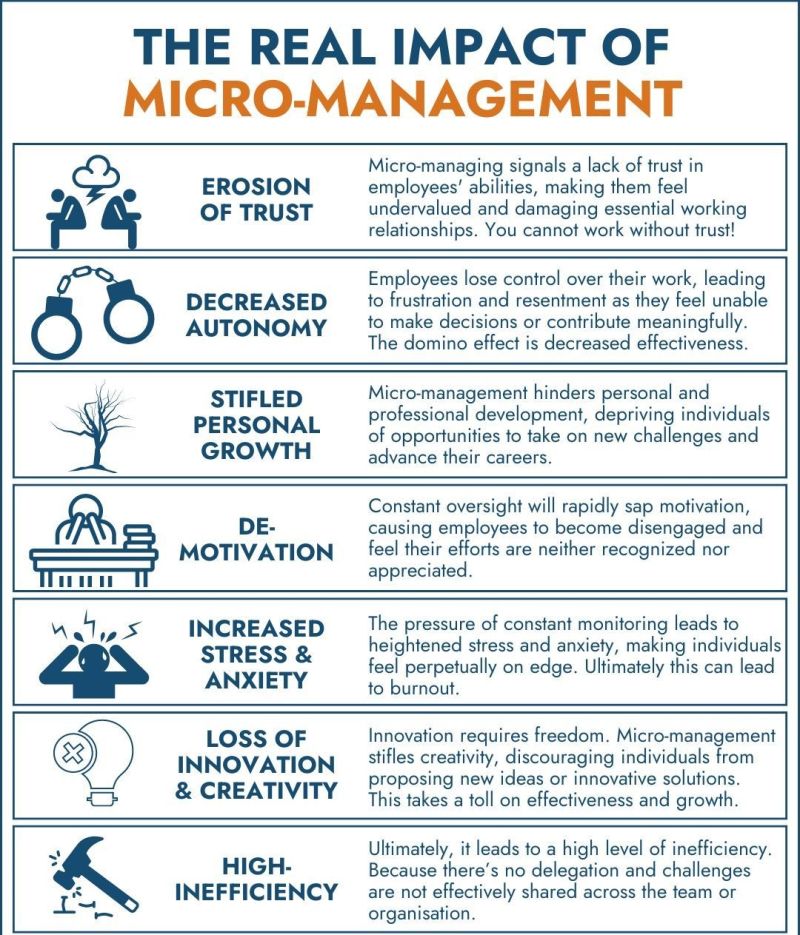
Image Source: How to Deal with a Micro Manager
How Can Managers Inspire Accountability Without Micromanagement?
Set Clear Expectations & Goals:
Set clear goals instead of directing people at every step. When you lay out what you want to achieve, it helps employees stay focused, thus giving them room to figure out how to reach the goals.
Encourage Autonomy & Decision-Making:
Let your team take ownership. When you give them the freedom to make decisions, it gives them confidence and makes them feel more responsible.
Provide Constructive Feedback Regularly:
Mentor and support your employees without having to control their jobs. Give them regular helpful feedback to help them improvise and feel more accountable for their work.
Foster a Culture of Psychological Safety:
Nurture a workplace environment that authorizes employees to take up risks and learn from their mistakes. A culture that has trust as a foundation, stimulates both responsibility and innovation.
Recognize and Reward Accountability:
Acknowledge employees who exhibit ownership and initiative. Celebrating accountability strengthens positive behaviours and improves employee engagement in the long run.
Conclusion
Great leaders cultivate accountability by way of building trust and do not exercise control. By establishing clear goals, empowering their teams, and encouraging a culture of independence, they develop an environment where individuals naturally take up responsibility. While micromanagement may result in immediate compliance, it is trust that fosters long lasting dedication and drives innovation.
As a leader, ask yourself: Do I trust my team enough to let them grow? If the answer is yes, you’re on the path to building a high-performing, self-motivated team that thrives without excessive oversight.
Explore Related Courses














COMMENTS(0)
Explore Related Courses
Our Popular Insights
Careers are shifting faster than ever, and staying relevant takes more than experience. Explore UniAthena’s most-read blogs for sharp insights, emerging skills, and practical pathways that help you move forward with clarity and confidence in a changing professional world.

What is the usage of Power BI?
Read More
5
mins read





How to Switch Career to Data Analytics?
Read More
6
mins read

What is the usage of Power BI?
Read more
5
mins read
How to Switch Career to Data Analytics?
Read more
6
mins read

Get in Touch

It’s Time to Start
Join NowMost Popular Online Specialization
- Master of International Business Administration
- Master of Business Administration
- MBA in General Management- FastTrack
- Master in Innovation and Entrepreneurship
- MBA-Family Business Management
- Master in Procurement and Contract Management
- Extended Diploma in Business Analytics (SCQF Level 11)
- Diploma in Supply Chain and Logistics Management (SCQF Level 11)
- Strategic Human Resource Management Practitioner
- Master in Data Science
- Master in Engineering Management
Trending Online
- Integrated Doctorate of Business Administration
- Postgraduate Certificate in Finance for Next Generation Managers
- Master of Business Administration- General Management (Fast Track)
- Postgraduate Certificate in Socio-Economic and Legal Framework
- Postgraduate Certificate in Business Sustainability
- Certified Manager
- Supply Chain Management Practitioner
- MBA - AI in Business
- MBA - Accounting & Finance
- Master in Supply Chain and Logistics Management
Top Universities Online Certificates
- Postgraduate Certificate in International Marketing Management
- Postgraduate Certificate In International Human Resource Management
- Postgraduate Certificate in Strategic Management
- Postgraduate Certificate in Procurement & Contracts Management
- Postgraduate Certificate in Business Analytics
- Postgraduate Certificate in Strategic Supply Chain & Logistics Management
- Postgraduate Certificate in Human Resource and Leadership
- Project Management Practitioner
- Postgraduate Certificate in Supply Chain Design & Implementation
- Postgraduate Certificate in Management Accounting and Finance
Accredited Online Degree Program
- MBA - Digital Transformation
- MBA - Family Business Management
- MBA - Marketing Management
- MBA in Quality Management
- MBA - Business Intelligence & Data Analytics
- MBA in Operations & Project Management
- MBA in Energy Management
- MBA In Construction & Safety Management
- Master in Organisational Leadership
- Master in Public Health
- Master in Construction Management
- Bachelor of Arts in Business Administration


 Install Now


UniAthena is an Ed-Tech, offering flexible, affordable learning solutions, including Free-Learning Upskilling Courses and Academic Programs in partnerships with accredited and globally renowned universities and professional qualification bodies.


Do you have any questions ?
Feel free to send us your questions or request a free consultation
Send a message
UK
Athena Global Education
Magdalen Centre,
Robert Robinson Avenue,
Oxford, OX4 4GA, UK
Phone : 01865 784299
MIDDLE EAST
Athena Global Education FZE
Block L-03, First Floor,
P O Box 519265, Sharjah Publishing City,
Free Zone, Sharjah, UAE
Phone : +971 55 879 5492
INDIA
Uniathena Private Limited
9A,Midas Tower
Phase 1
Hinjewadi Rajiv Gandhi Infotech Park
Pune-411057
Phone: +91 9145665544
All Copyrights Reserved @ Athena Global Education 2021-2026