-

Bachelor's

-

Masters
-

MBA
-

Doctorate
-

Micro Credit
-

Explore all Courses
-
Postgraduate Certifications

-
Postgraduate Diploma
-
Undergraduate Diploma
-
Diploma



The Splinternet in 2026: How AI Applications Are Designed for Multi-Region Systems

Author: pallavi patnaik
|8
MINS READ
| 0
| 7
Created On: 12 June, 2026
Share




Table of Contents (TOC):
- Introduction
- Key Takeaways
- What Is the Splinternet?
- Why AI Infrastructure Is Becoming Region-Specific
- Distributed AI Systems: The New Backbone
- Data Sovereignty in AI: The Silent Redesign
- AI Governance Frameworks by Region
- Multi-Agent AI Systems: Built for Fragmentation
- Real-World Examples from 2026
- The Honest Limitations of AI in a Fragmented Internet
- The Future of the Artificial Intelligence Web
- Conclusion
- FAQs
Introduction
You deployed your AI application globally. Same model. Same cloud. Same pipeline. Then one morning, your European users triggered a compliance audit, your Indian government contract stalled over data localisation, and a key API went dark at a regional border you didn't know existed.
Welcome to the Splinternet - the accelerating fragmentation of the global internet into region-controlled digital territories. In 2026, it has become one of the most consequential forces reshaping artificial intelligence development worldwide.
Companies are not rebuilding their AI Infrastructure because their models underperform. They're rebuilding because the world around those models has been legally and politically fractured. This blog breaks down exactly how and what smart teams are doing about it.
Key Takeaways
- The Splinternet is pushing companies to rebuild AI Infrastructure region by region.
- Distributed AI Systems are replacing centralized models to meet compliance and market demands.
- Data sovereignty in AI requires data processing and storage within national borders.
- AI governance frameworks across major regions are becoming increasingly fragmented.
- Multi-agent systems in artificial intelligence are emerging as the most scalable solution for managing compliance, localization, and security across the fragmented web.
What Is the Splinternet?
The Splinternet describes the breakdown of the unified global internet into separate, region-controlled digital ecosystems, each governed by its own infrastructure rules, content laws, cybersecurity standards, and AI regulations.
In practice for AI teams, digital fragmentation means:
- A recommendation model may be legally non-deployable in Germany without explainability documentation.
- An AI assistant built on a US cloud may be blocked in China without a domestic server arrangement.
- A healthcare AI in India may need to store all inference logs within Indian data centres.
This is technological decoupling at the infrastructure level, driven by three shared national concerns: security over foreign-controlled AI, economic competition over AI dominance, and cultural sovereignty over algorithmic decisions.
(Note: While the extent of fragmentation varies by sector, industry, and region, the broader trend is clear. Governments are exercising greater control over data flows, digital infrastructure, and AI governance. For organisations building AI systems, the challenge is no longer whether regional requirements exist, but how to operate effectively across an increasingly diverse set of digital environments )
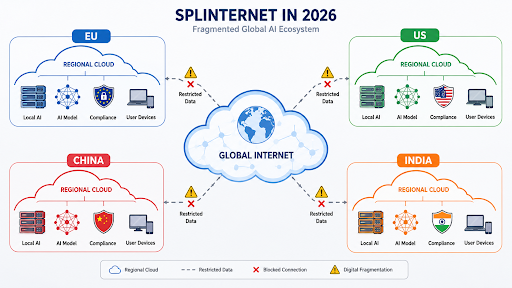
Fig: Simple overview of the Splinternet and regional AI separation
Why AI Infrastructure Is Becoming Region-Specific
The centralised "build once, deploy everywhere" model is broken. In 2026, companies face:
- Regulatory Shutdowns: The EU AI Act classifies high-risk AI systems requiring full conformity assessments before deployment. Non-compliance can result in significant restrictions, penalties, or limitations on deployment.
- Data Localisation Mandates: Several countries, including India, Indonesia, Russia, and some Gulf nations, have introduced data localisation or sovereignty requirements that can affect how citizen data is stored, processed, and transferred across borders.
- Algorithmic Supervision: China requires content-surfacing AI systems to be registered, audited, and government-reviewable.
- Compute Export Controls: US restrictions on advanced AI chips force localised compute strategies in affected regions.
The result: AI Infrastructure is no longer one engineering problem. It is a portfolio of regional problems that must be solved simultaneously.
Distributed AI Systems: The New Backbone
Distributed AI Systems deploy multiple regional AI nodes connected through a shared intelligence layer - regional minds that share learning but govern themselves independently.
Key advantages include faster local processing, independent compliance per region, isolated failure containment, and models fine-tuned on local language and cultural context, which consistently outperform globally generalised models in specific markets.
Artificial Intelligence Capabilities are only valuable if they can reach users. In a Splinternet world, that requires being built for the region, not just deployed to it.
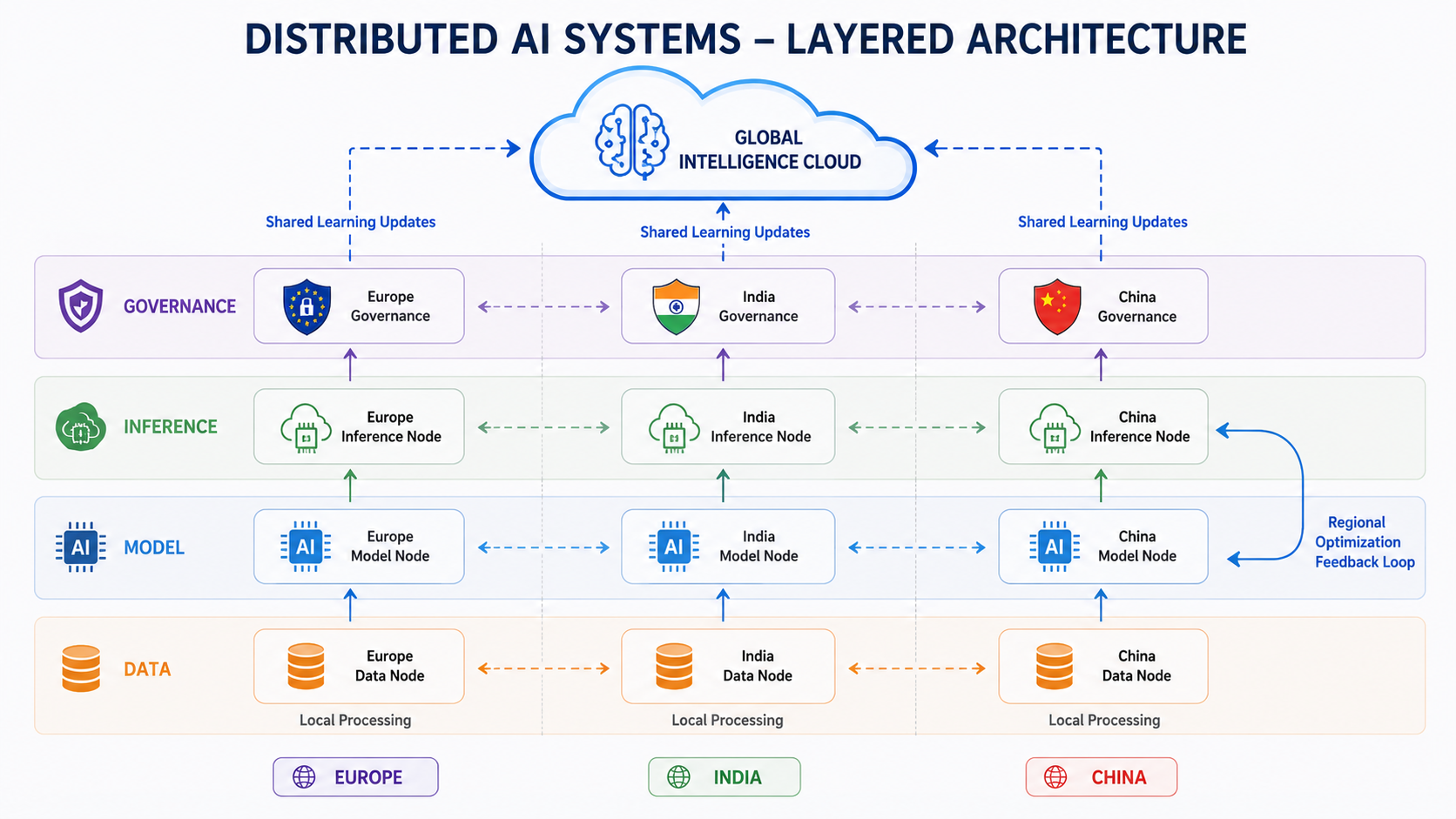
Fig: Distributed AI systems using regional processing with shared intelligence
Data Sovereignty in AI: The Silent Redesign
Data sovereignty in AI means data generated within a country and AI decisions made about its citizens must be stored and processed under that country's legal jurisdiction. The engineering implications are significant:
- Training Pipelines shift to federated learning - models train locally, sharing only anonymised gradient updates, never raw data.
- Inference Infrastructure must be duplicated across geographies, multiplying operational costs.
- Model Versioning diverges by region - the model serving France and the one serving Indonesia may share base weights but behave differently in practice
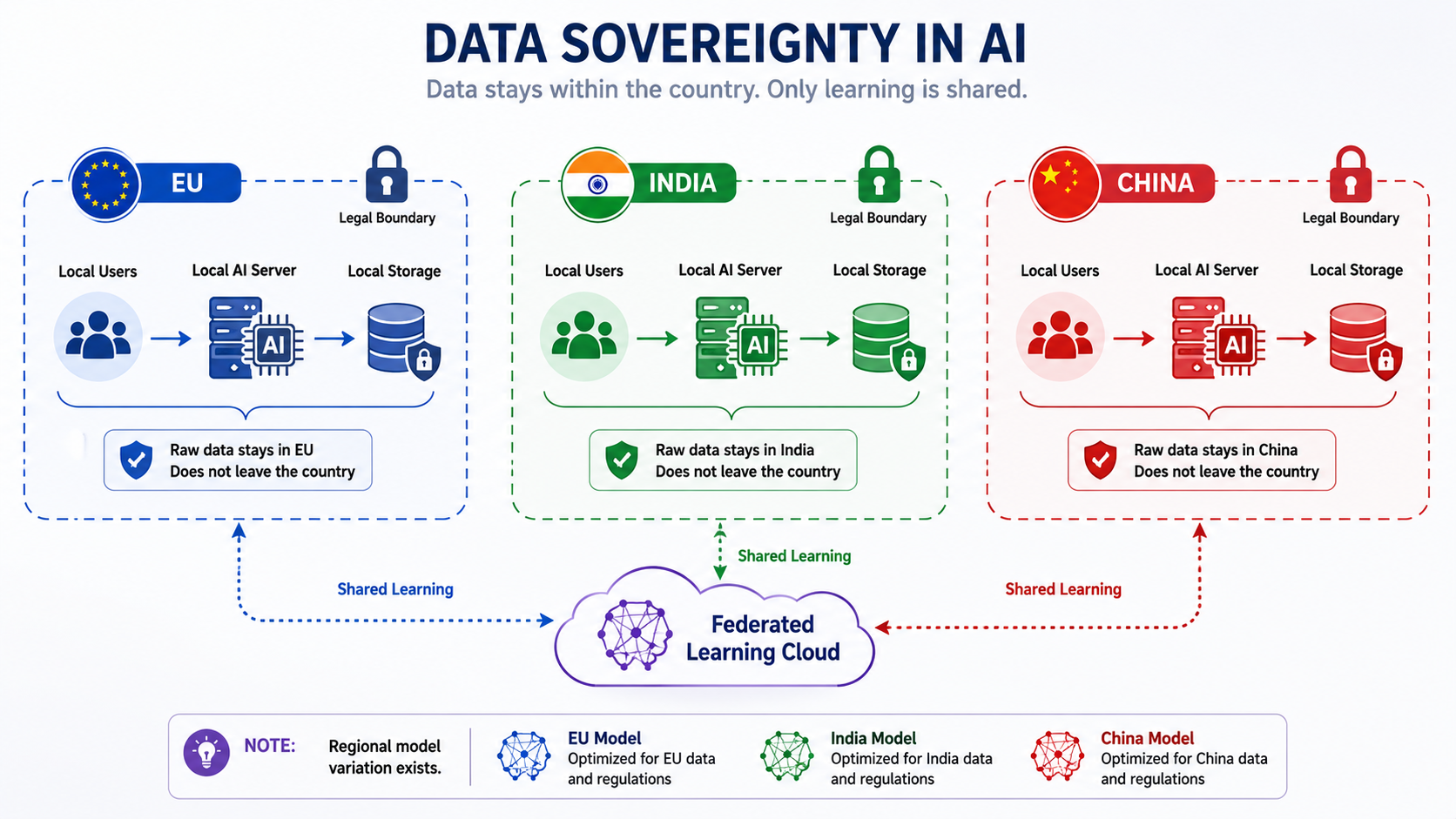
Fig: Data sovereignty keeping AI data and processing within national borders
AI Governance Frameworks by Region
AI governance frameworks are diverging, not converging, and the incompatibilities are real.
EU - Risk-First: The AI Act classifies systems into risk tiers. High-risk categories, including hiring, credit, and law enforcement, require conformity assessments, CE marking, and post-market monitoring. A feature freely deployable in the US may be legally high-risk in Europe.
US - Innovation-Led: No comprehensive federal laws on artificial intelligence yet. Sector-specific rules and state-level laws in California, Illinois, and Texas create patchwork compliance - a mini-Splinternet within the country itself.
China - State-Integrated: Algorithm recommendation rules and deep synthesis regulations require AI systems to be auditable by government authorities and aligned with state priorities. Operating in this environment requires organisations to address not only technical localisation requirements but also specific governance, compliance, and regulatory obligations.
India - Sovereignty-Forward: The IndiaAI mission and DPDP Act signal a long-term push toward domestic AI technology infrastructure. The challenge for companies is not restriction but investment - building local compute and storage that meets sovereignty expectations.
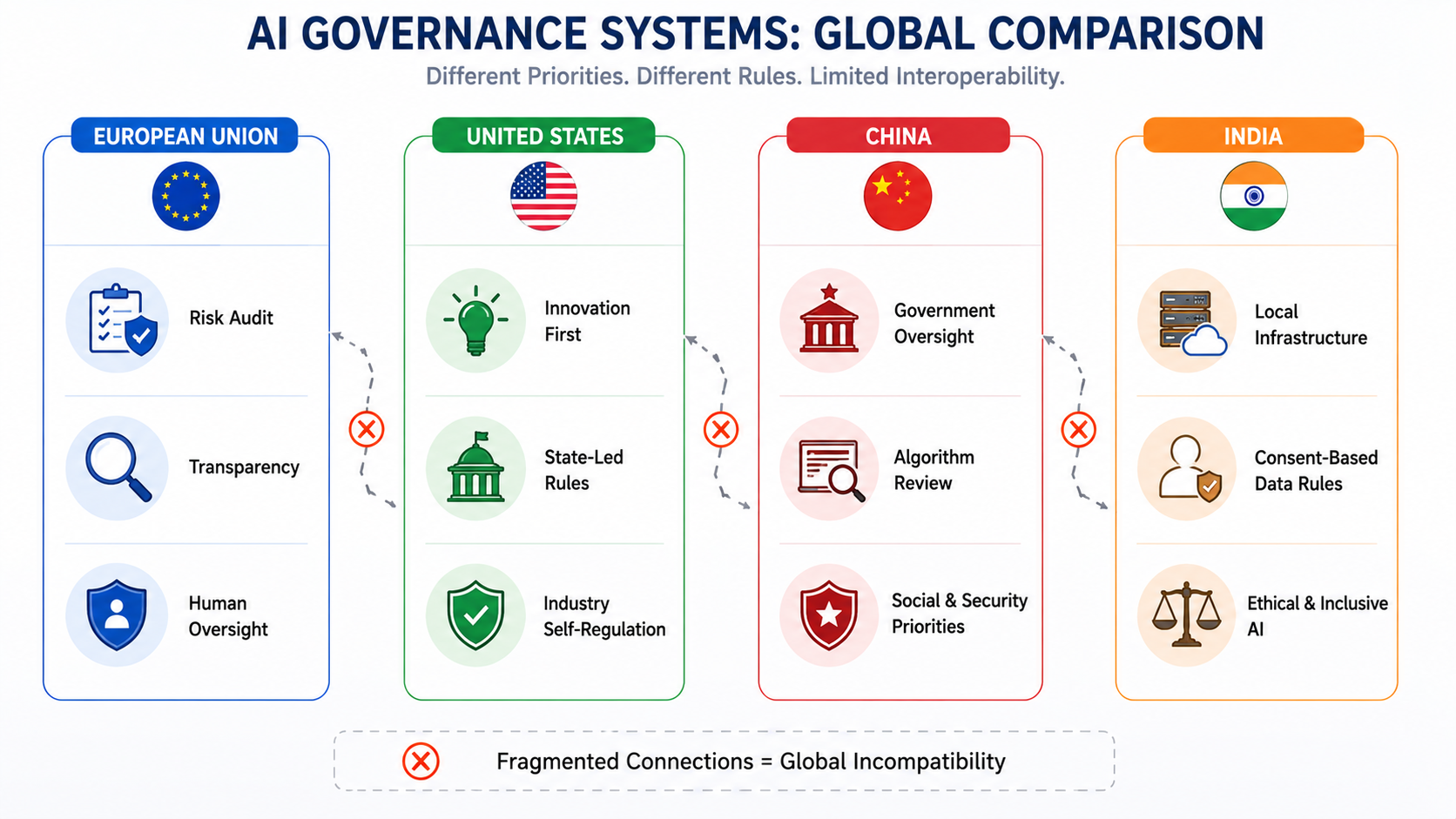
Fig: Simplified comparison of regional AI governance frameworks
Multi-Agent AI Systems: Built for Fragmentation
Managing compliance, localisation, security, and governance across regional deployments simultaneously cannot be scaled by human teams alone. This is where multi-agent systems in artificial intelligence are emerging as one possible approach.
Each agent in artificial intelligence owns a specific operational domain:
- Compliance Agent monitors regulatory changes and flags non-compliant configurations automatically.
- Localisation Agent handles language, cultural context, and region-specific content standards, going well beyond translation.
- Data Governance Agent enforces data sovereignty rules in real time, maintaining regional audit trails.
- Security Agent manages region-specific threat detection and incident reporting obligations.
- Optimisation Agent monitors regional model performance and triggers retraining when quality degrades.
These intelligent agents working in coordination are what make the growth of artificial intelligence at a global scale operationally sustainable in a fragmented world.
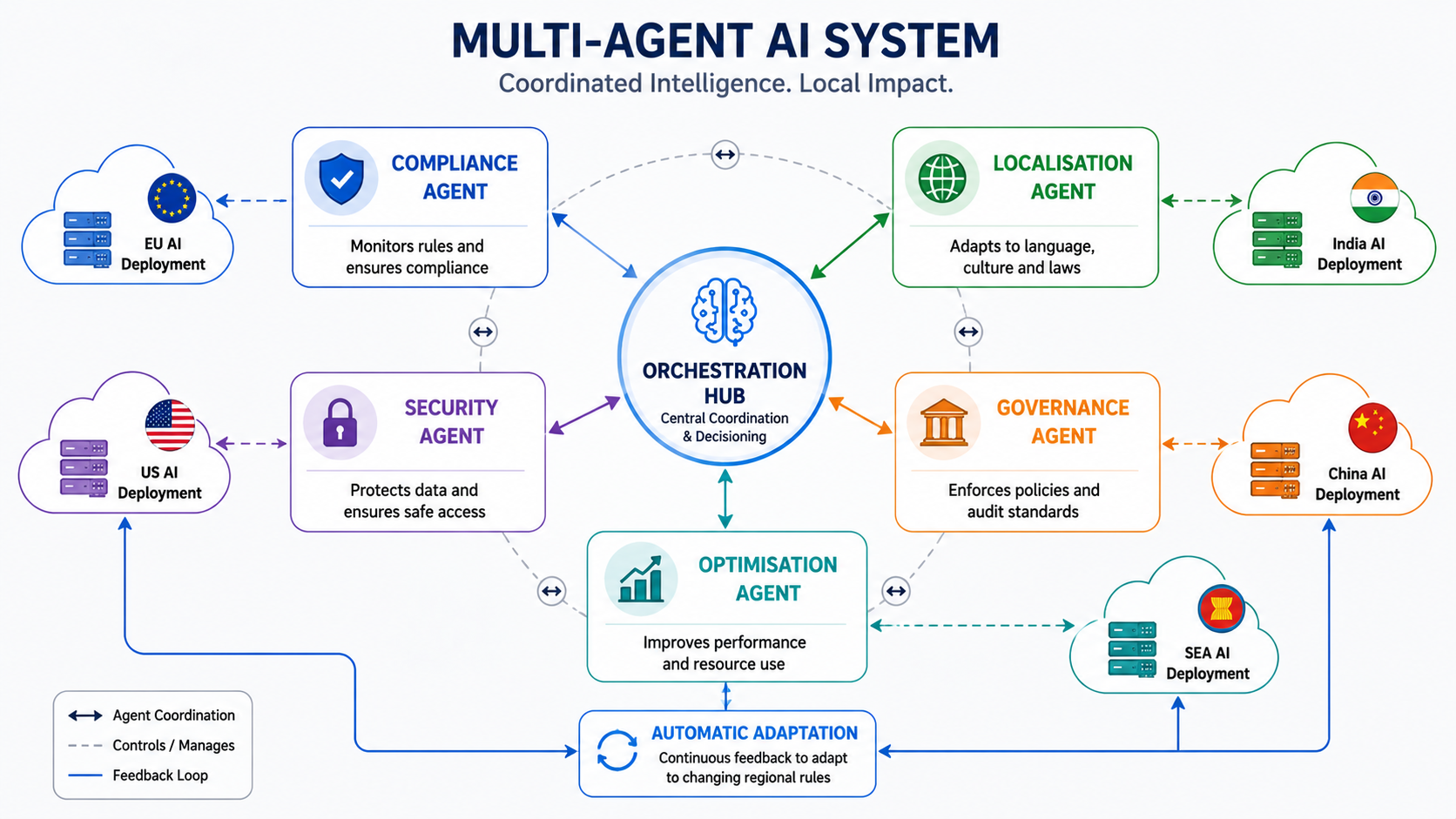
Fig: Multi-agent AI systems managing regional AI operations
Real-World Examples from 2026
Microsoft has expanded its sovereign cloud programme to 30+ countries, with AI Infrastructure running entirely within national borders and regional model variants audited locally.
Meta now operates regionally separate content moderation AI systems in the EU, US, and Asia-Pacific, each trained on region-specific data to simultaneously satisfy incompatible regulatory environments.
TikTok runs formally separate recommendation systems by regulatory zone, with shared architecture but entirely regional training data, logic, and audit trails.
NVIDIA is partnering with governments in the Middle East, South Asia, and Southeast Asia to establish domestic AI compute ecosystems, addressing export control risks and regional sovereignty demands.
Mistral (EU), Sarvam (India), and Sea AI Lab (Southeast Asia) are building regionally grounded foundation models as sovereign alternatives to US-dominated AI, designed as infrastructure decisions for entire regions.
The Honest Limitations of AI in a Fragmented Internet
The Splinternet also introduces genuine limitations of AI that deserve acknowledgement:
- Reduced Training Diversity: Data localisation shrinks training datasets, producing models that are more locally compliant but potentially less capable.
- Capability Inequality: Regions with strong domestic AI infrastructure will develop stronger artificial intelligence capabilities than those without, risking a two-tier global AI system.
- Research Fragmentation: Export controls and competitive national strategies are reducing the cross-border collaboration that historically drove AI breakthroughs.
- Version Drift: Regional variants of the same product may deliver materially different quality, not by design but as an emergent consequence of divergence.
The Future of the Artificial Intelligence Web
The artificial intelligence web of 2030 is likely to be a collection of regional ecosystems, partially interconnected by federated protocols and partially isolated by sovereign design.
Key trends already taking shape in AI system architecture:
- Federated Learning Becomes Diplomatic: Cross-border AI collaboration will happen at the gradient level, not the data level.
- Region-Awareness Becomes First-Class: Future AI platforms will ship with regional compliance profiles built into the core architecture, not added as an afterthought.
- Sovereign Foundation Models Proliferate: The EU, India, and ASEAN are expected to own and operate their own large models, accelerating both capability development and regulatory divergence.
- Intelligent Agents Become Infrastructure: The ability to build effective agent architectures for regional adaptation will become a core competitive differentiator.
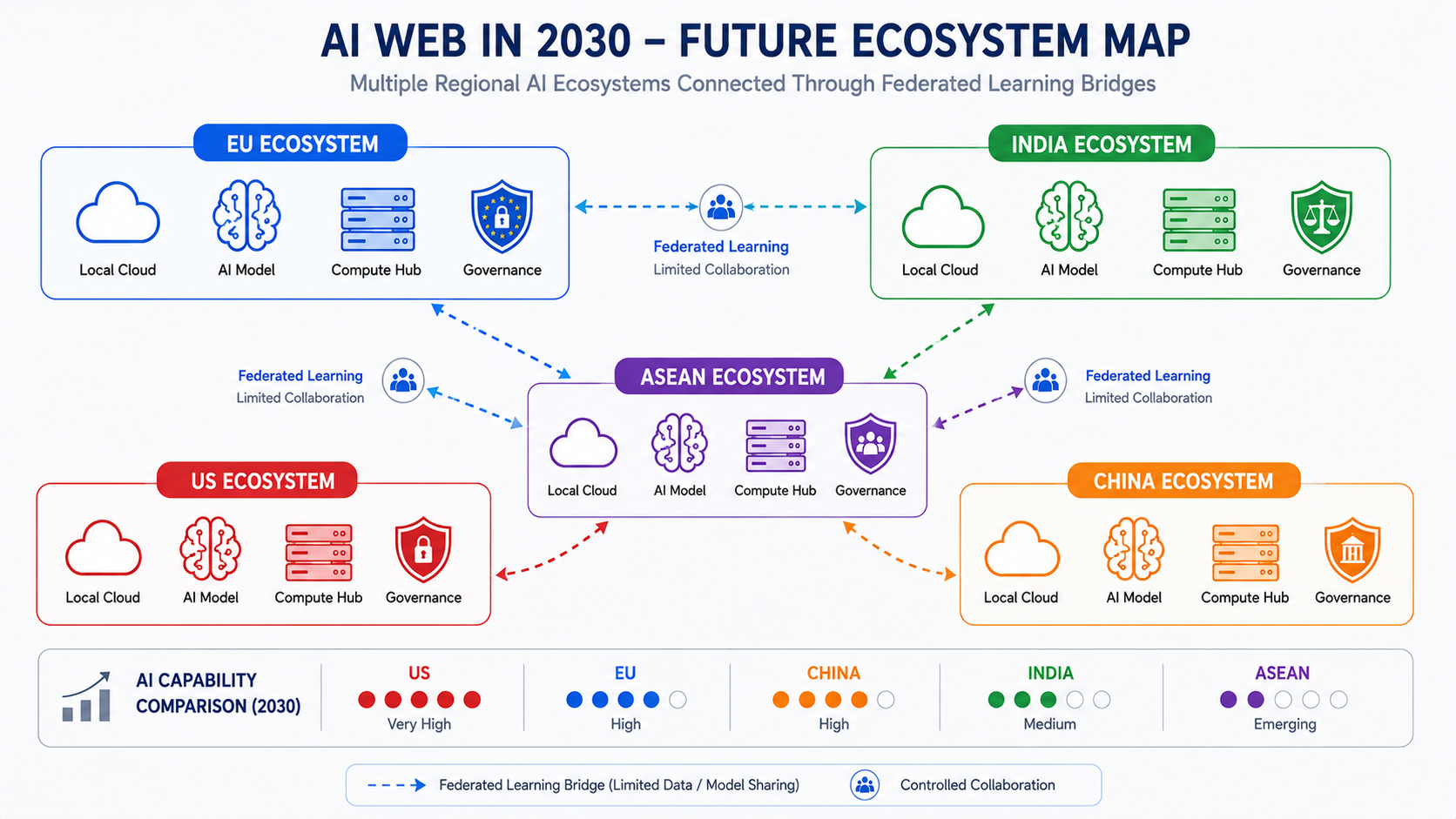
Fig: Future regional AI ecosystems connected through limited collaboration
Conclusion
The Splinternet is not a warning. It is a current condition. In 2026, AI Infrastructure, data sovereignty in AI, AI governance frameworks, and multi-agent systems in artificial intelligence are no longer specialist topics. They are foundational competencies for anyone building AI with global ambitions.
The companies winning in this environment share one trait: they stopped treating regional compliance as a constraint on their real work and started treating it as part of the design brief from day one.
The artificial intelligence web is fragmenting. The teams that build for that fragmentation, not against it, are the ones who will still be operating in every market when the dust settles.
FAQs
Q1. What is the Splinternet and why does it matter for AI?
A: The Splinternet divides the internet into region-specific digital ecosystems, forcing AI applications to follow local regulations, infrastructure rules, and data policies.
Q2. How are Distributed AI Systems different from centralized AI?
A: Distributed AI Systems use regional AI nodes for local compliance and data handling, unlike centralized AI models that operate from one global system.
Q3. Why is data sovereignty a major challenge for AI development?
A: Data sovereignty restricts cross-border data movement, making AI training, storage, and compliance significantly more complex and expensive.
Q4. How do multi-agent systems help manage regional AI challenges?
A: Multi-agent systems use specialized intelligent agents to independently handle compliance, security, localization, and governance across different regions.
Q5. Can the limitations of AI caused by digital fragmentation be solved?
A: Some challenges may improve with technologies like federated learning, but balancing AI performance with regional sovereignty remains a long-term challenge.
Our Popular Courses

$14000


Doctoral Degree in Business Administration
Universidad Catolica De Murcia (UCAM), Spain
Duration:
2 - 3 Years
$17500*
Integrated Doctorate of Business Administration
Guglielmo Marconi University, Italy
Universidad Catolica De Murcia (UCAM), Spain
Duration:
2.5 - 3.5 Years
$5600*
Master of Business Administration
Guglielmo Marconi University, Italy
Duration:
12 - 24 Months
$5600*
MBA in Operations & Project Management
Guglielmo Marconi University, Italy
Duration:
12 - 24 Months
$5600*
Master in Supply Chain and Logistics Management
Guglielmo Marconi University, Italy
Duration:
12 - 24 Months
$5950*
Master in Data Sciences
Guglielmo Marconi University, Italy
Duration:
12 - 24 Months
$5600*
Master in Engineering Management
Guglielmo Marconi University, Italy
Duration:
12 - 24 Months
$5600*
Master in Procurement and Contract Management
Guglielmo Marconi University, Italy
Duration:
12 - 24 Months
$5600*
Master in Public Health
Guglielmo Marconi University, Italy
Duration:
12 - 24 MonthsOur Popular Courses
COMMENTS(0)
Our Popular Courses
$14000
Doctoral Degree in Business Administration
Universidad Catolica De Murcia (UCAM), Spain
Duration:
2 - 3 Years
$17500*
Integrated Doctorate of Business Administration
Guglielmo Marconi University, Italy
Universidad Catolica De Murcia (UCAM), Spain
Duration:
2.5 - 3.5 Years
$5600*
Master of Business Administration
Guglielmo Marconi University, Italy
Duration:
12 - 24 Months
$5600*
MBA in Operations & Project Management
Guglielmo Marconi University, Italy
Duration:
12 - 24 Months
$5600*
Master in Supply Chain and Logistics Management
Guglielmo Marconi University, Italy
Duration:
12 - 24 Months
$5950*
Master in Data Sciences
Guglielmo Marconi University, Italy
Duration:
12 - 24 Months
$5600*
Master in Engineering Management
Guglielmo Marconi University, Italy
Duration:
12 - 24 Months
$5600*
Master in Procurement and Contract Management
Guglielmo Marconi University, Italy
Duration:
12 - 24 Months
$5600*
Master in Public Health
Guglielmo Marconi University, Italy
Duration:
12 - 24 MonthsOur Popular Courses
Our Popular Insights
Careers are shifting faster than ever, and staying relevant takes more than experience. Explore UniAthena’s most-read blogs for sharp insights, emerging skills, and practical pathways that help you move forward with clarity and confidence in a changing professional world.



🌟 Top Project Performer – April 2026 🌟
Read More
1
mins read


How to Use AI for Interview Preparation?
Read More
9
mins read


Why AI and Python Skills Matter in India?
Read More
6
mins read

High-Paying Jobs in Canada
Read More
7
mins read

🌟 Top Project Performer – April 2026 🌟
Read more
1
mins read
How to Use AI for Interview Preparation?
Read more
9
mins read
Why AI and Python Skills Matter in India?
Read more
6
mins read
High-Paying Jobs in Canada
Read more
7
mins read
Get in Touch

It’s Time to Start
Join NowMost Popular Online Specialization
- Master of International Business Administration
- Master of Business Administration
- MBA in General Management- FastTrack
- Master in Innovation and Entrepreneurship
- MBA-Family Business Management
- Master in Procurement and Contract Management
- Extended Diploma in Business Analytics (SCQF Level 11)
- Diploma in Supply Chain and Logistics Management (SCQF Level 11)
- Strategic Human Resource Management Practitioner
- Master in Data Science
- Master in Engineering Management
Trending Online
- Integrated Doctorate of Business Administration
- Postgraduate Certificate in Finance for Next Generation Managers
- Master of Business Administration- General Management (Fast Track)
- Postgraduate Certificate in Socio-Economic and Legal Framework
- Postgraduate Certificate in Business Sustainability
- Certified Manager
- Supply Chain Management Practitioner
- MBA - AI in Business
- MBA - Accounting & Finance
- Master in Supply Chain and Logistics Management
Top Universities Online Certificates
- Postgraduate Certificate in International Marketing Management
- Postgraduate Certificate In International Human Resource Management
- Postgraduate Certificate in Strategic Management
- Postgraduate Certificate in Procurement & Contracts Management
- Postgraduate Certificate in Business Analytics
- Postgraduate Certificate in Strategic Supply Chain & Logistics Management
- Postgraduate Certificate in Human Resource and Leadership
- Project Management Practitioner
- Postgraduate Certificate in Supply Chain Design & Implementation
- Postgraduate Certificate in Management Accounting and Finance
Accredited Online Degree Program
- MBA - Digital Transformation
- MBA - Family Business Management
- MBA - Marketing Management
- MBA in Quality Management
- MBA - Business Intelligence & Data Analytics
- MBA in Operations & Project Management
- MBA in Energy Management
- MBA In Construction & Safety Management
- Master in Organisational Leadership
- Master in Public Health
- Master in Construction Management
- Bachelor of Arts in Business Administration


 Install Now


UniAthena is an Ed-Tech, offering flexible, affordable learning solutions, including Free-Learning Upskilling Courses and Academic Programs in partnerships with accredited and globally renowned universities and professional qualification bodies.


Do you have any questions ?
Feel free to send us your questions or request a free consultation
Send a message
UK
Athena Global Education
Magdalen Centre,
Robert Robinson Avenue,
Oxford, OX4 4GA, UK
Phone : 01865 784299
MIDDLE EAST
Athena Global Education FZE
Block L-03, First Floor,
P O Box 519265, Sharjah Publishing City,
Free Zone, Sharjah, UAE
Phone : +971 55 879 5492
INDIA
Uniathena Private Limited
9A,Midas Tower
Phase 1
Hinjewadi Rajiv Gandhi Infotech Park
Pune-411057
Phone: +91 9145665544
All Copyrights Reserved @ Athena Global Education 2021-2026