-

Bachelor's

-

Masters
-

MBA
-

Doctorate
-

Micro Credit
-

Explore all Courses
-
Postgraduate Certifications

-
Postgraduate Diploma
-
Undergraduate Diploma
-
Diploma



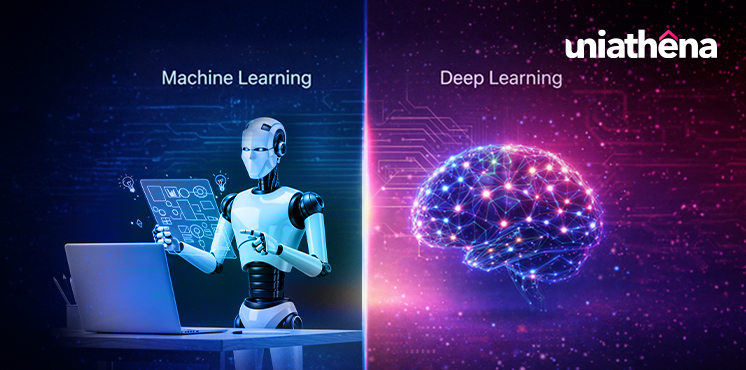
Difference Between Machine Learning and Deep Learning
Author: aishwarya sancheti
|6
MINS READ
| 0
| 59
Created On: 23 March, 2026
Share




Table of Contents (TOC):
- Introduction
- Key Takeaways
- What is Machine Learning?
- What is Deep Learning?
- The Core Difference Between Machine Learning and Deep Learning
- Types of Machine Learning
- Types of Deep Learning
- How Does Deep Learning Work?
- Applications of Machine Learning
- Applications of Deep Learning
- History of Machine Learning and Deep Learning
- Is ChatGPT Deep Learning?
- Scope of Machine Learning in the Future
- How to Learn Machine Learning from Scratch
- Conclusion
- FAQs
Introduction
AI is everywhere and it’s not subtle about it.
When Netflix suggests a movie.
When Google predicts and completes your search query.
When ChatGPT delivers an instant response.
It might seem surprising at first, yet it reflects significant innovation.
But then comes the real question, the one that makes people pause mid-scroll:
What’s the actual difference between machine learning and deep learning?
Are they the same thing? Is one more advanced? Is deep learning just a fancy marketing term? You’ve probably heard both thrown around in podcasts, LinkedIn posts, job descriptions, and tech headlines. Sometimes they sound interchangeable. Sometimes they sound like competitors. No wonder it feels confusing.
Here’s the simple truth: they’re connected but they’re not identical. Think of machine learning as the bigger umbrella, and deep learning as the more intense, data-hungry overachiever living under it. One learns from patterns. The other builds layered neural networks that mimic how the human brain processes information.
And once you see the difference clearly, everything else about AI starts to make sense.
So if you’ve ever nodded along in a conversation about AI while secretly thinking, “Wait… what?” - don’t worry. You’re about to get clarity.
Key Takeaways:
- Machine learning teaches computers using structured data and algorithms.
- Deep learning is a subset of machine learning built on neural networks.
- Deep learning needs more data and computing power.
- Machine learning works well with smaller datasets.
- ChatGPT is based on deep learning.
- The scope of machine learning in the future is massive.
What is Machine Learning?
If you’ve ever wondered what is machine learning, here’s the simplest answer:
Machine learning (ML) is a way to teach computers to learn from data without being explicitly programmed. Instead of writing rules like:
“If email contains ‘win money’ → mark as spam”
You feed examples of spam and non-spam emails. The system finds patterns on its own.
That’s machine learning.
Machine Learning Algorithms
Some common machine learning algorithms include:
- Linear Regression
- Logistic Regression
- Decision Trees
- Random Forest
- Support Vector Machines
- K-Nearest Neighbors
These algorithms work well with structured data like spreadsheets, numbers, and labeled datasets.
What is Deep Learning?
Deep learning is a subset of machine learning that uses neural networks inspired by the human brain. Instead of manually selecting features from data, deep learning models automatically learn complex patterns.
If machine learning is teaching a child with flashcards, deep learning is building a brain-like system that learns from experience.
What Is Neural Network in Deep Learning?
A neural network is made of layers:
- Input layer
- Hidden layers
- Output layer
The more hidden layers, the “deeper” the network. That’s why it’s called deep learning.
The Core Difference Between Machine Learning and Deep Learning
Deep learning differs from machine learning mainly in complexity and scale. Machine learning relies more on human input. Deep learning relies more on data and layered neural networks.
Think of machine learning as smart.
Think of deep learning as powerful.
Types of Machine Learning
Types of Deep Learning
How Does Deep Learning Work?
Here’s the simple flow:
1. Feed massive data into a neural network.
2. Each layer processes information.
3. The system adjusts weights using backpropagation.
4. Errors reduce over time.
5. Predictions improve.
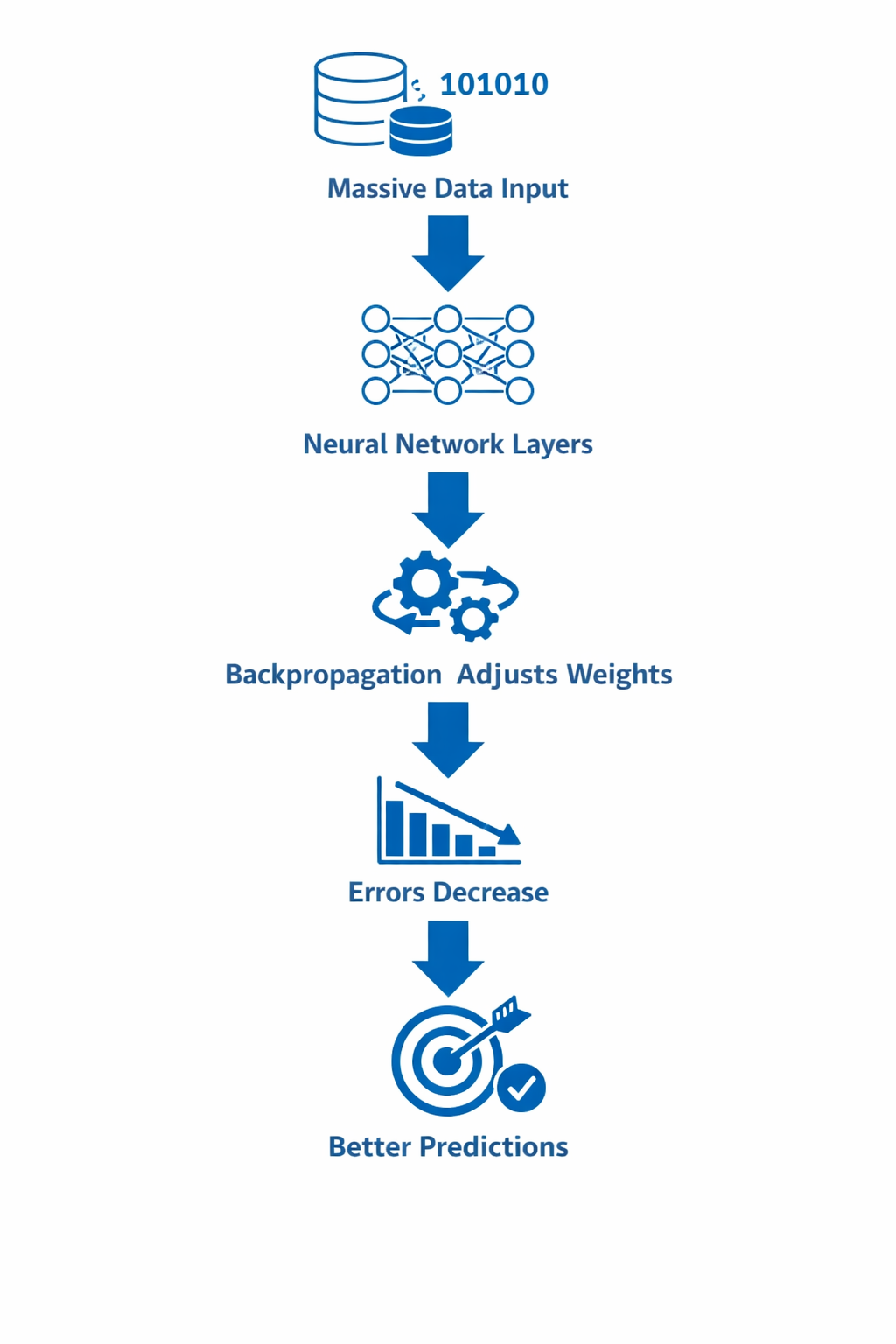
Deep learning works best when data is large and complex like images, speech, or natural language.
Applications of Machine Learning
The applications of machine learning are everywhere:
- Fraud detection
- Recommendation systems
- Predictive analytics
- Chatbots
- Credit scoring
- Healthcare diagnosis
Businesses use machine learning to predict outcomes and automate decisions.
Applications of Deep Learning
The applications of deep learning go even further:
- Facial recognition
- Voice assistants
- Autonomous vehicles
- Medical image analysis
- Language translation
- Generative AI systems
These are advanced uses of deep learning that require massive data and computing power.
History of Machine Learning and Deep Learning
History of Machine Learning
Machine learning began in the 1950s. Early researchers explored pattern recognition. The field grew rapidly with better computing in the 1990s and 2000s.
History of Deep Learning
Deep learning concepts existed in the 1980s. But it exploded after 2012 when neural networks beat traditional systems in image recognition tasks.
Cheap data. Powerful GPUs. Better algorithms. That changed everything.
Scope of Machine Learning in the Future
The scope of machine learning in the future is enormous. AI is not replacing all jobs. But it is reshaping them.
Industries hiring ML professionals include:
- Finance
- Healthcare
- Retail
- Cybersecurity
- Marketing
- Manufacturing
AI and machine learning specialization programs are growing because demand is rising fast.
How to Learn Machine Learning From Scratch
If you’re serious about entering this field, here’s a simple path:
Step 1: Learn Python
Start with Basics of Python.
Step 2: Understand Algorithms
Take a course like Basics of Machine Learning Algorithms.
Step 3: Build Foundation
Enroll in a Diploma in Fundamentals of Machine Learning.
Step 4: Advance Your Skills
Upgrade with an Executive Diploma in Machine Learning.
If you’re searching for a machine learning course free with an international certification, start with beginner-friendly online platforms like UniAthena.
For deeper growth, explore a full machine learning and deep learning course or a machine learning specialization to master real-world projects.
Conclusion
Machine learning and deep learning are not rivals in a tech boxing ring.
Deep learning is simply a more advanced part of machine learning. If you’re working with smaller, structured data, machine learning is often enough. If the data is huge and complex like images, voice, or text, deep learning takes the lead. The real edge isn’t choosing one over the other; it’s understanding both. Because AI is no longer a trending word it’s a practical tool shaping every industry.
Start small, stay consistent, build projects, and keep learning. This difference is just your first step into a much bigger opportunity.
FAQs
Q1. Is ChatGPT Deep Learning?
A. Yes. ChatGPT is built using deep learning. Specifically, it uses transformer-based neural networks trained on massive text datasets.
Q2. What is the main difference between machine learning and deep learning?
A: Deep learning uses neural networks with many layers. Machine learning uses broader algorithms and often needs manual feature selection.
Q3. Is deep learning better than machine learning?
A: Not always. It depends on the problem and data size.
Q4. What are the uses of deep learning?
A: Image recognition, speech processing, generative AI, medical imaging.
Q5. Can I learn machine learning without coding?
A: Basic understanding is possible, but coding, especially Python, is essential for practical work.
Q6. Which is harder to learn?
A: Deep learning is more complex due to neural networks and math depth.
Explore Related Courses









COMMENTS(0)
Explore Related Courses
Our Popular Insights
Careers are shifting faster than ever, and staying relevant takes more than experience. Explore UniAthena’s most-read blogs for sharp insights, emerging skills, and practical pathways that help you move forward with clarity and confidence in a changing professional world.

🌟 Top Project Performer – June 2026 🌟
Read More
1
mins read


🌟 Top Project Performer – May 2026 🌟
Read More
1
mins read



🌟 Top Project Performer – April 2026 🌟
Read More
1
mins read
🌟 Top Project Performer – June 2026 🌟
Read more
1
mins read
🌟 Top Project Performer – May 2026 🌟
Read more
1
mins read
🌟 Top Project Performer – April 2026 🌟
Read more
1
mins read
Get in Touch

It’s Time to Start
Join NowMost Popular Online Specialization
- Master of International Business Administration
- Master of Business Administration
- MBA in General Management- FastTrack
- Master in Innovation and Entrepreneurship
- MBA-Family Business Management
- Master in Procurement and Contract Management
- Extended Diploma in Business Analytics (SCQF Level 11)
- Diploma in Supply Chain and Logistics Management (SCQF Level 11)
- Strategic Human Resource Management Practitioner
- Master in Data Science
- Master in Engineering Management
Trending Online
- Integrated Doctorate of Business Administration
- Postgraduate Certificate in Finance for Next Generation Managers
- Master of Business Administration- General Management (Fast Track)
- Postgraduate Certificate in Socio-Economic and Legal Framework
- Postgraduate Certificate in Business Sustainability
- Certified Manager
- Supply Chain Management Practitioner
- MBA - AI in Business
- MBA - Accounting & Finance
- Master in Supply Chain and Logistics Management
Top Universities Online Certificates
- Postgraduate Certificate in International Marketing Management
- Postgraduate Certificate In International Human Resource Management
- Postgraduate Certificate in Strategic Management
- Postgraduate Certificate in Procurement & Contracts Management
- Postgraduate Certificate in Business Analytics
- Postgraduate Certificate in Strategic Supply Chain & Logistics Management
- Postgraduate Certificate in Human Resource and Leadership
- Project Management Practitioner
- Postgraduate Certificate in Supply Chain Design & Implementation
- Postgraduate Certificate in Management Accounting and Finance
Accredited Online Degree Program
- MBA - Digital Transformation
- MBA - Family Business Management
- MBA - Marketing Management
- MBA in Quality Management
- MBA - Business Intelligence & Data Analytics
- MBA in Operations & Project Management
- MBA in Energy Management
- MBA In Construction & Safety Management
- Master in Organisational Leadership
- Master in Public Health
- Master in Construction Management
- Bachelor of Arts in Business Administration


 Install Now


UniAthena is an Ed-Tech, offering flexible, affordable learning solutions, including Free-Learning Upskilling Courses and Academic Programs in partnerships with accredited and globally renowned universities and professional qualification bodies.


Do you have any questions ?
Feel free to send us your questions or request a free consultation
Send a message
UK
Athena Global Education
Magdalen Centre,
Robert Robinson Avenue,
Oxford, OX4 4GA, UK
Phone : 01865 784299
MIDDLE EAST
Athena Global Education FZE
Block L-03, First Floor,
P O Box 519265, Sharjah Publishing City,
Free Zone, Sharjah, UAE
Phone : +971 55 879 5492
INDIA
Uniathena Private Limited
9A,Midas Tower
Phase 1
Hinjewadi Rajiv Gandhi Infotech Park
Pune-411057
Phone: +91 9145665544
All Copyrights Reserved @ Athena Global Education 2021-2026