-

Bachelor's

-

Masters
-

MBA
-

Doctorate
-

Micro Credit
-

Explore all Courses
-
Postgraduate Certifications

-
Postgraduate Diploma
-
Undergraduate Diploma
-
Diploma



From Machines to Malware: Why IT-OT Convergence Demands Stronger Security

Author: lynn lawrence
|6
MINS READ
| 0
| 203
Created On: 10 December, 2025
Share




Table of Contents (TOC):
- Introduction
- Key Takeaways
- Why IT-OT Convergence Is Happening Now
- Understanding IT vs OT
- What Is IT-OT Convergence?
- Benefits and Challenges of Convergence
- The Cybersecurity Risks Organisations Cannot Ignore
- Building a Secure IT-OT Convergence Strategy
- Conclusion
- FAQs
Introduction
Cyberattacks in IT systems are now easily spreading into OT environments. Operational Technology (OT) refers to the industrial systems that control physical processes—such as machinery, sensors, production lines, and building automation.
As these systems become increasingly connected to IT networks, their exposure to cyber threats grows. This makes IT-OT convergence a growing priority for organisations, but also a major cybersecurity concern. This blog explains this dynamic with real-world examples and practical insights.
Key Takeaways:
- IT-OT convergence is accelerating due to automation, smart infrastructure, and the growing need for real-time operational visibility.
- IT and OT systems differ greatly in purpose, security priorities, and maintenance practices, making integration complex.
- Connecting legacy OT systems to modern IT networks significantly increases cybersecurity exposure.
- Cyberattacks can easily move from IT networks into OT environments, causing physical disruption, safety risks, and financial losses.
- A secure IT-OT convergence strategy depends on asset visibility, strong network segmentation, Zero Trust principles, and coordinated IT-OT governance.
Imagine a manufacturing plant running smoothly on a Monday morning. Machines humming. Operators monitoring screens. Production is right on schedule.
Then, suddenly, everything stops. A ransomware attack that began on an office laptop in the IT network quietly spread to a production controller in the OT environment. Within minutes, conveyor belts froze. Robots stopped mid-task. The plant lost 4 hours of production, causing delays, financial losses, and a safety scare.
This is exactly how a small IT breach can become a big OT problem. And it shows why organisations are embracing IT-OT convergence, but also why cybersecurity risks are increasing.
Why IT-OT Convergence is Happening Now
Across industries, from manufacturing and utilities to logistics and smart buildings, technology is evolving rapidly. Automation is increasing, sensors are becoming more intelligent, and leaders are demanding real-time dashboards that show what is happening on the ground. For this level of visibility, systems can’t operate in silos anymore; they need to share data continuously.
This is where IT-OT convergence becomes essential. When both worlds communicate, decision-making becomes faster and more accurate, predictive maintenance reduces unplanned downtime, and businesses gain a unified, end-to-end view of their operations. The ability to make immediate, data-driven decisions is now a competitive necessity, not just an advantage.
But to understand convergence, it’s important to recognise what makes IT and OT fundamentally different.
Understanding IT vs OT (Simple and Clear)
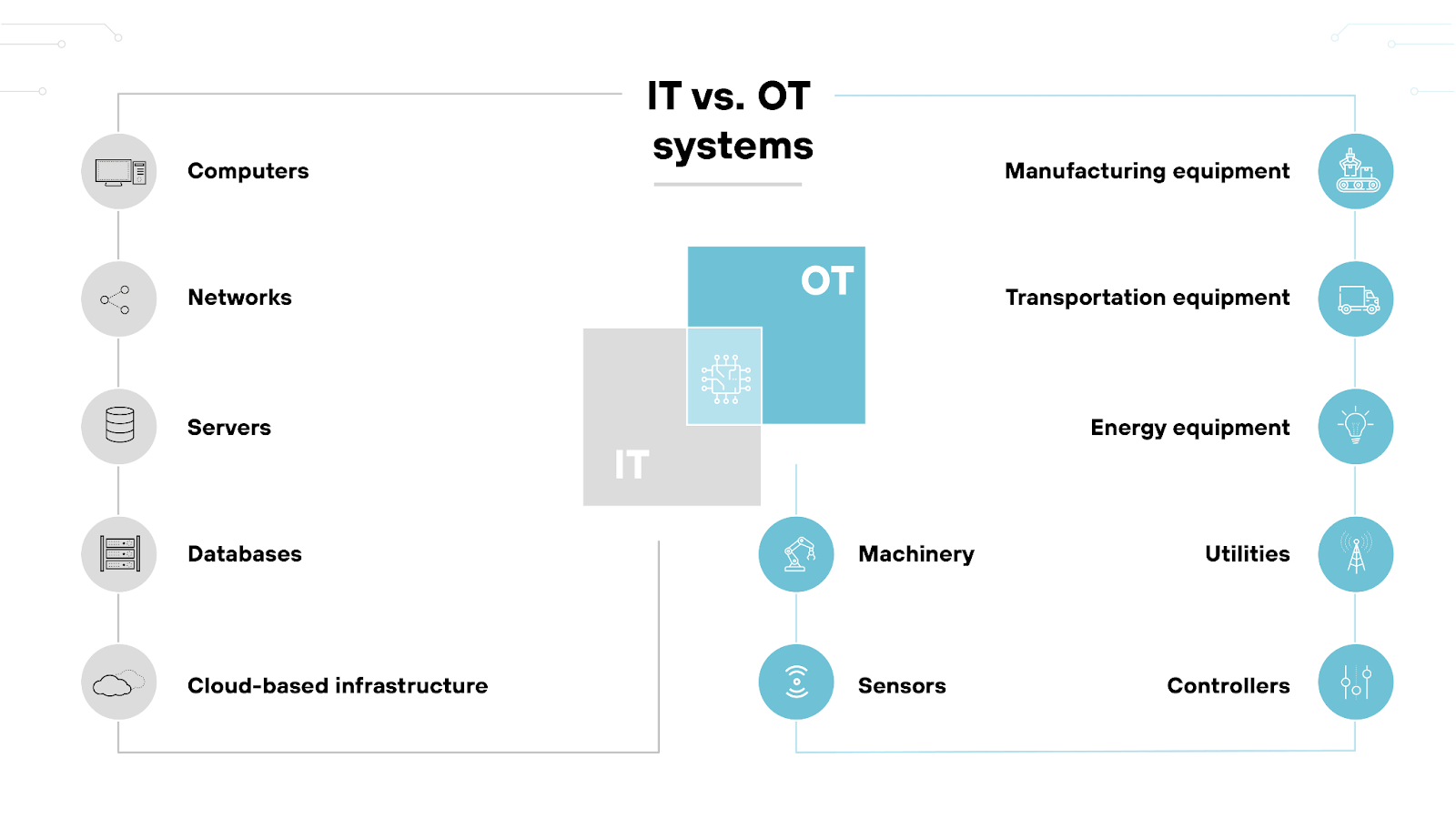
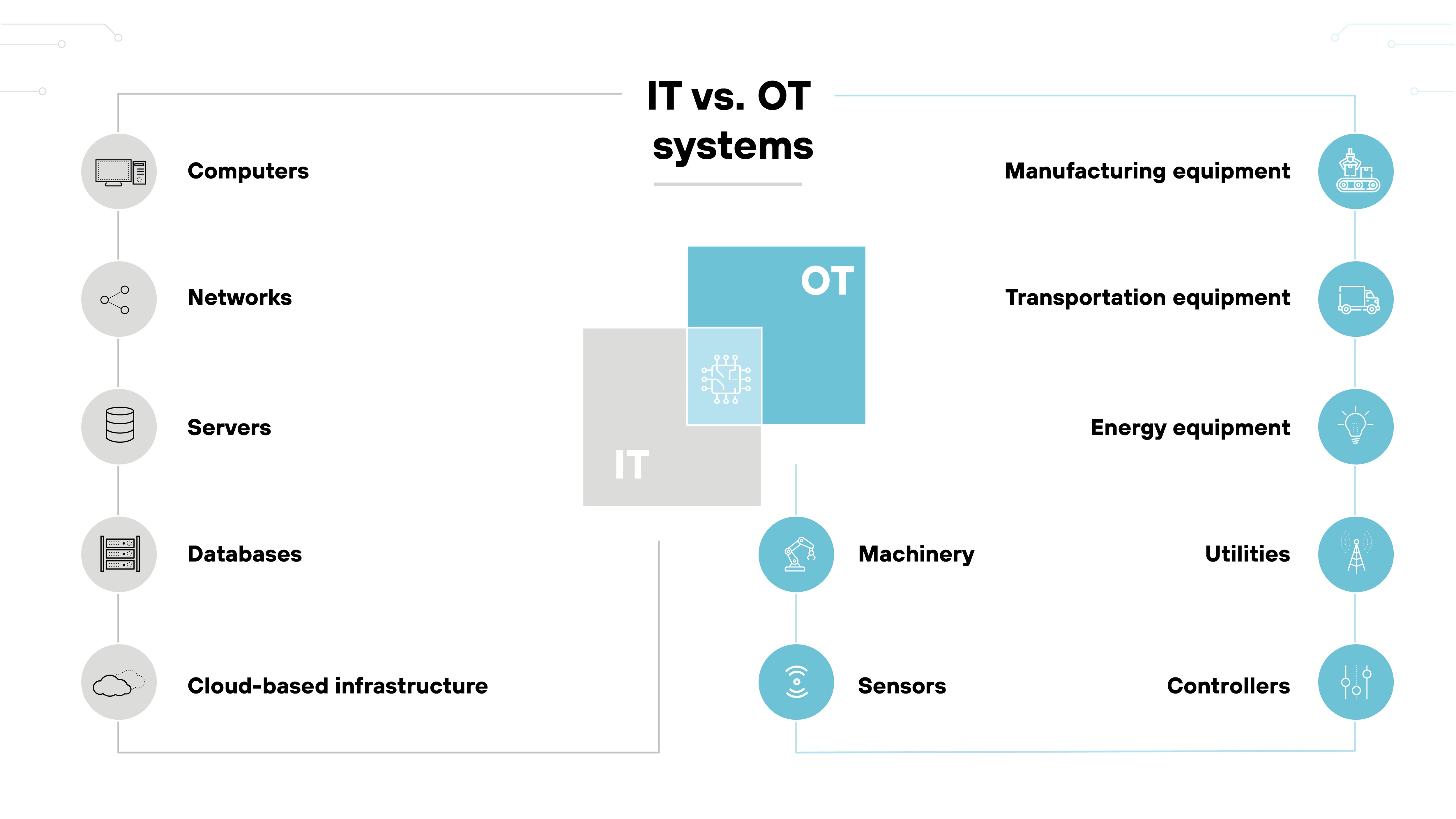
Although people often assume IT and OT are similar because both involve technology, their foundations and priorities could not be more different
The most simple distinction: IT manages digital assets, whereas OT manages physical assets.
For decades, both systems evolved separately. Today, however, digital transformation and automation are bringing them together faster than ever
What is IT-OT Convergence?
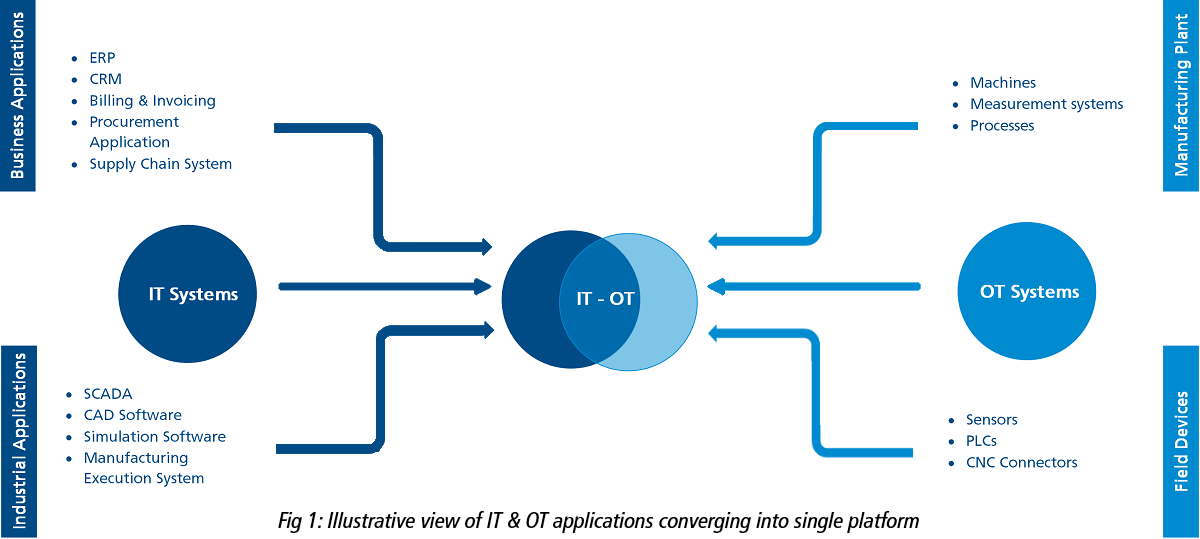
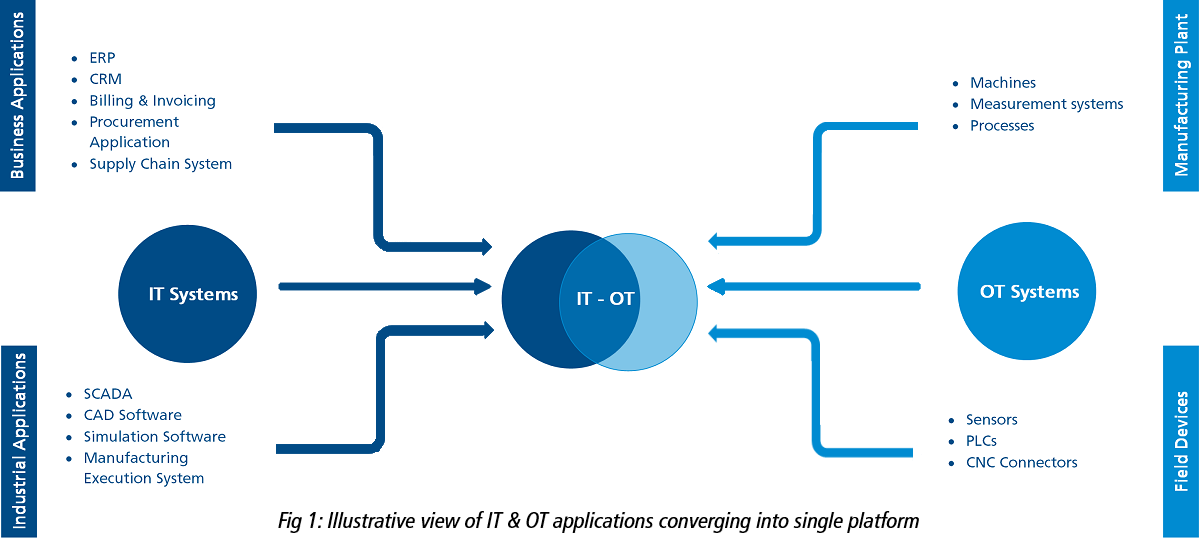
After understanding both sides, the meaning of convergence becomes clearer. IT-OT convergence refers to the integration of digital systems with operational machinery so that data, insights, and control can flow in a unified manner. It creates smarter, more responsive environments where machines, people, and software operate in sync.
A simple view of IT-OT convergence architecture:
- Enterprise IT Layer: apps, analytics, cloud, business systems
- Control Systems Layer: PLCs, SCADA, field devices
- Edge/IIoT Devices: sensors, gateways, data collectors
- Cloud Platforms: centralised dashboards and monitoring tools
Benefits and Challenges of Convergence
The advantages of IT-OT convergence are significant. Organisations gain improved operational efficiency, faster response times to operational issues, enhanced insights for forecasting, and a centralised view of critical processes. However, the journey is not without complications.
Legacy OT systems were not designed for internet connectivity and can become vulnerable when exposed. Skill gaps between IT professionals and OT engineers often create misunderstandings in priorities. Cultural differences, such as IT focusing on cybersecurity while OT focuses on continuity, can slow down progress. Moreover, many OT devices cannot be patched or taken offline easily, making them difficult to secure.
This blend of benefits and operational friction is exactly what makes cybersecurity so crucial.
The Cybersecurity Risks Organisations Cannot Ignore
When IT and OT networks come together, their vulnerabilities also merge. A weak password on an industrial controller, a misconfigured remote-access tool, or a simple malware infection on an employee's laptop can become an entry point for attackers. Once inside, threats can move from IT systems into OT environments, where the consequences shift from digital inconvenience to physical disruption.
These risks are not theoretical. A European steel mill experienced major furnace damage when attackers breached its IT systems and then accessed OT controls. A major US pipeline operator was forced to halt operations because ransomware spread from IT networks into critical operational interfaces. Such incidents highlight that traditional IT cybersecurity is not enough to protect converged environments.
Building a Secure IT-OT Convergence Strategy
For convergence to succeed, organisations need a structured security approach. The first step is gaining complete visibility of all IT and OT assets. Without knowing what exists, nothing can be protected. Next, network segmentation ensures that IT and OT environments remain logically separated, limiting the lateral movement of threats.
Adopting a Zero Trust security model becomes essential, where no device or user is automatically trusted. Joint governance between IT and OT teams helps align objectives, ensuring cybersecurity decisions consider both data protection and operational safety. Continuous monitoring must be implemented to detect anomalies early, and incident response plans must be adapted for OT environments, where shutting down equipment is often not a straightforward option.
Conclusion
IT-OT convergence has become a natural part of digital transformation. It enables smarter operations, deeper insights, and greater efficiency. But when systems that were once separated become interconnected, cybersecurity risk increases. The key is not to avoid convergence, but to approach it with clarity, careful planning, and strong security principles.
Start small. Map your systems. Align your teams. Build security into every layer. When organisations do this, IT-OT convergence becomes not just a technological upgrade, but a foundation for safer, more resilient, and future-ready operations.
FAQs
Q1. Why is IT-OT convergence risky for organisations?
A: Because IT and OT systems merge into a single connected environment, exposing previously isolated OT systems to IT-based attacks like ransomware.
Q2. Are legacy OT systems more vulnerable?
A: Yes. They were not designed for internet connectivity or modern cybersecurity controls.
Q3. How do attackers usually enter OT systems?
A: Through IT networks via weak passwords, phishing, remote-access tools, or malware-infected laptops.
Q4. What industries benefit most from IT-OT convergence?
A: Manufacturing, utilities, logistics, energy, smart buildings, and any sector requiring automation and real-time monitoring.
Q5. What is the first step in securing IT-OT convergence?
A: Complete asset visibility, knowing every IT and OT device connected to your network.
Explore Related Courses











COMMENTS(0)
Explore Related Courses
Our Popular Insights
Careers are shifting faster than ever, and staying relevant takes more than experience. Explore UniAthena’s most-read blogs for sharp insights, emerging skills, and practical pathways that help you move forward with clarity and confidence in a changing professional world.





🌟 Top Project Performer – June 2026 🌟
Read More
1
mins read


🌟 Top Project Performer – May 2026 🌟
Read More
1
mins read

🌟 Top Project Performer – June 2026 🌟
Read more
1
mins read

🌟 Top Project Performer – May 2026 🌟
Read more
1
mins read
Get in Touch

It’s Time to Start
Join NowMost Popular Online Specialization
- Master of International Business Administration
- Master of Business Administration
- MBA in General Management- FastTrack
- Master in Innovation and Entrepreneurship
- MBA-Family Business Management
- Master in Procurement and Contract Management
- Extended Diploma in Business Analytics (SCQF Level 11)
- Diploma in Supply Chain and Logistics Management (SCQF Level 11)
- Strategic Human Resource Management Practitioner
- Master in Data Science
- Master in Engineering Management
Trending Online
- Integrated Doctorate of Business Administration
- Postgraduate Certificate in Finance for Next Generation Managers
- Master of Business Administration- General Management (Fast Track)
- Postgraduate Certificate in Socio-Economic and Legal Framework
- Postgraduate Certificate in Business Sustainability
- Certified Manager
- Supply Chain Management Practitioner
- MBA - AI in Business
- MBA - Accounting & Finance
- Master in Supply Chain and Logistics Management
Top Universities Online Certificates
- Postgraduate Certificate in International Marketing Management
- Postgraduate Certificate In International Human Resource Management
- Postgraduate Certificate in Strategic Management
- Postgraduate Certificate in Procurement & Contracts Management
- Postgraduate Certificate in Business Analytics
- Postgraduate Certificate in Strategic Supply Chain & Logistics Management
- Postgraduate Certificate in Human Resource and Leadership
- Project Management Practitioner
- Postgraduate Certificate in Supply Chain Design & Implementation
- Postgraduate Certificate in Management Accounting and Finance
Accredited Online Degree Program
- MBA - Digital Transformation
- MBA - Family Business Management
- MBA - Marketing Management
- MBA in Quality Management
- MBA - Business Intelligence & Data Analytics
- MBA in Operations & Project Management
- MBA in Energy Management
- MBA In Construction & Safety Management
- Master in Organisational Leadership
- Master in Public Health
- Master in Construction Management
- Bachelor of Arts in Business Administration


 Install Now


UniAthena is an Ed-Tech, offering flexible, affordable learning solutions, including Free-Learning Upskilling Courses and Academic Programs in partnerships with accredited and globally renowned universities and professional qualification bodies.


Do you have any questions ?
Feel free to send us your questions or request a free consultation
Send a message
UK
Athena Global Education
Magdalen Centre,
Robert Robinson Avenue,
Oxford, OX4 4GA, UK
Phone : 01865 784299
MIDDLE EAST
Athena Global Education FZE
Block L-03, First Floor,
P O Box 519265, Sharjah Publishing City,
Free Zone, Sharjah, UAE
Phone : +971 55 879 5492
INDIA
Uniathena Private Limited
9A,Midas Tower
Phase 1
Hinjewadi Rajiv Gandhi Infotech Park
Pune-411057
Phone: +91 9145665544
All Copyrights Reserved @ Athena Global Education 2021-2026