-

Bachelor's

-

Masters
-

MBA
-

Doctorate
-

Micro Credit
-

Explore all Courses
-
Postgraduate Certifications

-
Postgraduate Diploma
-
Undergraduate Diploma
-
Diploma



Goodbye Cable Clutter: The Tiny Port That Does It All
Author: lynn lawrence
|4
MINS READ
| 0
| 1,057
Created On: 19 August, 2025
Share




If you've ever tried connecting a monitor, speaker, charger, and external hard drive all at once, you know the frustration of having different cables, different ports, and never enough room on your device.
Now, imagine replacing all of that with a single connector.
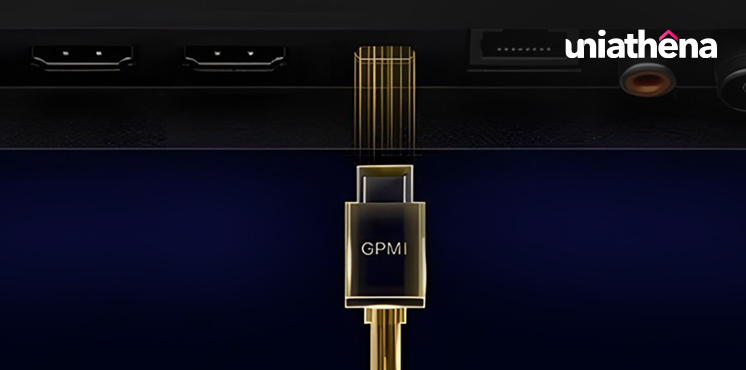
That’s the promise of GPMI, short for General Purpose Media Interface—a compact but powerful technology that’s quietly stepping up to change the way we connect everything.
It’s not just smaller. It’s smarter.
What Is GPMI?
GPMI stands for General Purpose Media Interface, and it's built to consolidate audio, video, data, and power delivery into a single, streamlined connection.
While traditional ports like HDMI, USB, or DisplayPort focus on one function, GPMI combines them all.
You can think of GPMI as a universal port: one that simplifies cables, reduces clutter, and enables fast, flexible, high-performance connectivity across devices.
It’s especially designed for the next generation of setups, where simplicity meets speed.
How GPMI Works – A Bit of the Tech
Under the hood, GPMI is built on a multi-lane architecture that allows multiple types of signals to travel through the same cable without interference.
It supports:
- High-bandwidth data transfer: enough to stream ultra-high-definition content, transfer large files, and maintain fast internet speeds.
- Power delivery up to 240W: enough to charge laptops, tablets, and even small desktop monitors.
- Low-latency audio and video output: crucial for real-time applications like gaming and VR.
- Universal compatibility: because it’s designed to work across platforms and operating systems.
And just like USB-C, GPMI is reversible and compact, so there’s no more fumbling or forcing cables in the wrong way.
Why It Could Be a Game-Changer
GPMI’s strength lies in its versatility.
Instead of needing one cable for video, another for data, and yet another for charging, you get a single cable that does it all.
For consumers, that means:
- Fewer cables
- Cleaner desk setups
- Simpler device pairing
- Faster charging and transfer speeds
For manufacturers, it offers reduced port requirements, making devices thinner, lighter, and easier to design for cross-functionality.
And yes, it is projected to be capable of handling 8K video output — though this remains subject to standardization and real-world implementation.
GPMI vs Traditional Interfaces
Let’s break it down simply:
- HDMI is great for video, but it can’t charge your device or handle data.
- USB does data and power, but not high-res video.
- DisplayPort supports high-resolution video, but not universal data or charging.
GPMI aims to support all three and more.
Instead of switching between cables, GPMI offers a one-stop solution for media, data, and power. That makes it a natural upgrade for modern workflows, especially in remote work environments, hybrid classrooms, and creative studios.
GPMI Cable and Connector Design
The GPMI cable uses advanced shielding to minimize interference and signal loss. It’s also optimized for long-distance transmission, so you get consistent performance even in extended setups.
The GPMI connector is designed with smart switching logic. This means it can dynamically prioritize the type of signal that needs the most bandwidth, whether it’s video, file transfers, or charging, without compromising speed or quality.
This adaptability is what sets GPMI apart. It's not just a physical plug. It’s a flexible media pipeline that adjusts based on what you need at that moment.
So, is GPMI the Future?
It's still early, but signs point to yes.
With growing demand for simpler, faster, and more integrated technology, GPMI has all the ingredients to become the next universal standard.
Some hardware makers are exploring GPMI-enabled monitors, docks, and ultrabooks. It’s gaining attention as a cleaner, leaner alternative to the messy port combinations we’ve become used to.
As more industries adopt 8K video, AR/VR, and ultra-fast data workflows, the need for a multi-functional, high-capacity connector like GPMI becomes clearer.
[As with any new tech, adoption challenges, compatibility with legacy systems, and standardization efforts will shape its future role in the market.]
Final Thought: A Small Port with a Big Future
In a world where minimalism meets multitasking, GPMI offers an elegant solution to an old problem.
It’s not just about saving space; it’s about boosting performance while reducing complexity. And in today’s tech environment, that’s a major win.
So the next time you find yourself untangling a nest of cables, remember, there’s a simpler way on the horizon. And it’s called GPMI.
What Do You Think?
Could GPMI replace HDMI, USB, and DisplayPort in your setup?
Would you switch to a one-cable solution?
Explore Related Courses










COMMENTS(0)
Explore Related Courses
Our Popular Insights
Careers are shifting faster than ever, and staying relevant takes more than experience. Explore UniAthena’s most-read blogs for sharp insights, emerging skills, and practical pathways that help you move forward with clarity and confidence in a changing professional world.

What is the usage of Power BI?
Read More
5
mins read




How to Switch Career to Data Analytics?
Read More
6
mins read

What is the usage of Power BI?
Read more
5
mins read
How to Switch Career to Data Analytics?
Read more
6
mins read

Get in Touch

It’s Time to Start
Join NowMost Popular Online Specialization
- Master of International Business Administration
- Master of Business Administration
- MBA in General Management- FastTrack
- Master in Innovation and Entrepreneurship
- MBA-Family Business Management
- Master in Procurement and Contract Management
- Extended Diploma in Business Analytics (SCQF Level 11)
- Diploma in Supply Chain and Logistics Management (SCQF Level 11)
- Strategic Human Resource Management Practitioner
- Master in Data Science
- Master in Engineering Management
Trending Online
- Integrated Doctorate of Business Administration
- Postgraduate Certificate in Finance for Next Generation Managers
- Master of Business Administration- General Management (Fast Track)
- Postgraduate Certificate in Socio-Economic and Legal Framework
- Postgraduate Certificate in Business Sustainability
- Certified Manager
- Supply Chain Management Practitioner
- MBA - AI in Business
- MBA - Accounting & Finance
- Master in Supply Chain and Logistics Management
Top Universities Online Certificates
- Postgraduate Certificate in International Marketing Management
- Postgraduate Certificate In International Human Resource Management
- Postgraduate Certificate in Strategic Management
- Postgraduate Certificate in Procurement & Contracts Management
- Postgraduate Certificate in Business Analytics
- Postgraduate Certificate in Strategic Supply Chain & Logistics Management
- Postgraduate Certificate in Human Resource and Leadership
- Project Management Practitioner
- Postgraduate Certificate in Supply Chain Design & Implementation
- Postgraduate Certificate in Management Accounting and Finance
Accredited Online Degree Program
- MBA - Digital Transformation
- MBA - Family Business Management
- MBA - Marketing Management
- MBA in Quality Management
- MBA - Business Intelligence & Data Analytics
- MBA in Operations & Project Management
- MBA in Energy Management
- MBA In Construction & Safety Management
- Master in Organisational Leadership
- Master in Public Health
- Master in Construction Management
- Bachelor of Arts in Business Administration


 Install Now


UniAthena is an Ed-Tech, offering flexible, affordable learning solutions, including Free-Learning Upskilling Courses and Academic Programs in partnerships with accredited and globally renowned universities and professional qualification bodies.


Do you have any questions ?
Feel free to send us your questions or request a free consultation
Send a message
UK
Athena Global Education
Magdalen Centre,
Robert Robinson Avenue,
Oxford, OX4 4GA, UK
Phone : 01865 784299
MIDDLE EAST
Athena Global Education FZE
Block L-03, First Floor,
P O Box 519265, Sharjah Publishing City,
Free Zone, Sharjah, UAE
Phone : +971 55 879 5492
INDIA
Uniathena Private Limited
9A,Midas Tower
Phase 1
Hinjewadi Rajiv Gandhi Infotech Park
Pune-411057
Phone: +91 9145665544
All Copyrights Reserved @ Athena Global Education 2021-2026