-

Bachelor's

-

Masters
-

MBA
-

Doctorate
-

Micro Credit
-

Explore all Courses
-
Postgraduate Certifications

-
Postgraduate Diploma
-
Undergraduate Diploma
-
Diploma



AI vs ML vs DL: What’s the Difference?
Author: munazzah ali
|7
MINS READ
| 0
| 295
Created On: 19 November, 2025
Share




Table Of Contents (TOC):
- Key Takeaways
- AI, ML, and DL: The Big Picture
- Decoding Artificial Intelligence: When Machines Think
- Understanding Machine Learning: When Systems Learn by Themselves
- Deep Learning: The Brain Behind Modern AI
- Bringing It All Together: The Learning Curve
- Conclusion
- FAQ’s
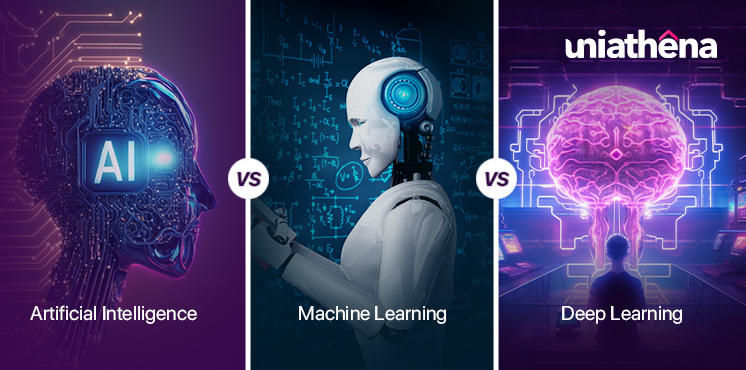
Behind every intelligent chatbot, predictive app, or automated decision-making, there is a hierarchy of intelligence: AI, ML, and DL. They are not buzzwords; they are engines that are transforming the manner in which machines think, learn, and act. Learning about their distinctions is not just tech literacy, but it is the foundation of next-generation innovation.
Let’s explore the relationship between Artificial Intelligence, Machine Learning, and Deep Learning, and how learning them can make a professional stay ahead in a data-driven world.
Key Takeaways:
- AI, ML, and DL are hierarchical, with each layer being an improvement of machine intelligence.
- Their practical applications are in the areas of healthcare, finance, transport, and entertainment.
- The awareness of these types of technologies creates many career opportunities in the data and automation economy.
- Lifelong learning is the key to staying relevant in the accelerated AI-driven innovation.
AI, ML, and DL: The Big Picture
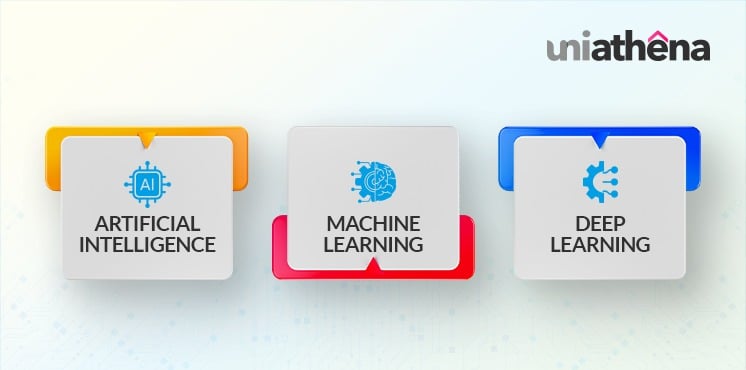
Consider Artificial Intelligence (AI) as the general science of thinking, acting intelligently, and reasoning. Machine Learning (ML) goes a step further; such systems learn based on the patterns in data and evolve with experience.
The bottommost layer is Deep Learning (DL), whereby highly complex neural networks process large amounts of information to provide insights and accuracy that were considered impossible for computers a few years ago.
In short:
- AI = Decision-making
- ML = Learning from data
- DL = Learning with massive data by layered neural networks.
Decoding Artificial Intelligence: When Machines Think
What is Artificial Intelligence, then? Artificial intelligence is essentially concerned with creating systems that can perceive, reason, and act. From language translation to self-driving automobiles, AI is expected to imitate human intelligence and decision-making capabilities.
These algorithms are logic and pattern recognition on which the AI systems are premised to make intelligent decisions.
Key Applications of Artificial Intelligence
- Machine Translation and Natural Language Processing: AI-based language tools such as Google Translate and ChatGPT are supported by analyzing linguistic patterns and context, and thus, multilingual communication becomes smooth.
- Self-Driving and Autonomous Vehicles: These vehicles can analyze their environment with sensors and AI-based decision models, hence can navigate safely without human assistance.
- AI-Powered Robotics: AI allows machines to execute complex tasks accurately and flexibly, whether it is in a warehouse or in a surgical area.
- Voice and Speech Recognition Systems: Virtual assistants such as Alexa or Siri are AI-based algorithms, and they can comprehend, analyze, and respond to human voice and constantly evolve with feedback.
Understanding Machine Learning: When Systems Learn by Themselves
Machine Learning (ML) is the branch of AI that allows systems to learn and improve without being explicitly programmed. Rather than relying on predefined rules, the ML algorithms will extract trends from historical data, allowing them to make predictions and decisions in the best way possible, and change with time.
Machine Learning works on three fundamental methods:
- Supervised Learning: The models are trained using labelled datasets in order to determine the relationships between the inputs and the results.
- Unsupervised Learning: Algorithms are trained on unlabeled data to find patterns, groupings, or underlying structures.
- Reinforcement Learning: Systems are taught through interaction with the environment, and decisions are improved through rewards and feedback.
Top Applications of Machine Learning
- Proactive Sales and Demand Forecasting: ML helps organizations to predict their future sales through trends and consumer behaviour.
- Fraud Detection in Banking: The algorithms process millions of operations and prevent financial fraud by detecting suspicious activity.
- Individualized Product Recommendations: In e-commerce systems, the ML models are utilized in identifying user needs and proposing products that can lead to further conversions.
- Stock Market Predictions: Financial analysts can rely on ML to provide models of historical price data, trends, and to predict potential market trends.
Deep Learning: The Brain Behind Modern AI
Have you ever questioned yourself about how Deep Learning relates to Machine Learning? Deep Learning (DL) is a better version of ML based on neural networks and capable of working with a significant amount of unstructured data, such as images, video, or audio.
DL is resource-intensive and needs much computing power; thus, it is at the core of the most advanced AI systems of the modern age, including face recognition systems and generative art systems.
Notable Applications of Deep Learning
- Automated Image Captioning: DL models do not focus on a single image but analyse its content and generate accurate captions, bridging the gap between images and language.
- AI-Generated Music and Art: The possibility of AI is now demonstrated by the capability of a neural network to generate music or visual art as a human being can.
- Image Restoration and Colouring: The models based on deep learning restore old or black-and-white images and add realistic colours and textures automatically.
- Object Detection and Recognition: DL has found application in security surveillance and medical imaging, and can detect and classify objects with accuracy.
Bringing It All Together: The Learning Curve
AI provides the machines with intelligence. ML provides them with learning power. DL provides them with the ability to think in a profound way, transforming industries and redefining the ways human beings are interacting with technology.
For professionals looking to stay ahead, practical knowledge is essential. UniAthena provides self-paced, flexible courses to assist you in beginning or developing your AI career:
1. Basics of Artificial Intelligence: Learning Models
This self-paced course is an introduction to the world of AI Learning Frameworks. Learn fundamental principles of Deep Learning, Probabilistic Models, and Fuzzy Logic, and find out how Artificial Intelligence relates to Natural Language Processing to drive intelligent applications.
After finishing, you get a chance to earn yourself a CIQ, UK, certificate that certifies your ability to navigate AI-driven systems and innovations.
2. Diploma in Artificial Intelligence
This diploma course will provide you with an overview of AI, its development, types, and its increasing importance. Learn about the application of AI in various fields and explore the major algorithms, problem-solving techniques, and the decisive role of intelligent agents in dynamic settings.
The course is flexible and can be completed in just 1-2 weeks of self-paced learning while getting a Blockchain-verified certification, which means that your credentials are credible and future-ready.
3. Basics of Machine Learning Algorithms
It is a beginner-friendly course that provides an introduction to the world of Machine Learning. Learn major algorithms such as Logistic Regression, K-Nearest Neighbours (K-NN), Support Vector Machines (SVM), and Decision Trees. You will also gain insights into fundamental concepts such as overfitting, model evaluation, Conditional Probability, Bayes' Theorem, and Naive Bayes analysis.
This self-paced course aims to simplify complex concepts and can be completed in just 4-6 hours of free learning with a certification from CIQ, UK.
4. MBA Essentials with Machine Learning
The MBA Essentials program is a brief 4-5 week, self-paced course that aims to provide the learner with a firm grasp of the major management concepts. The course consists of five modules, which include Strategic HR and Leadership, Operations Management, Marketing Essentials, Financial Management, and a specialization in Machine Learning.
Students also learn some of the basics of machine learning, the machine learning life cycle, and applications. Plus, the course, upon completion, will get you certified with an AUPD certification.
Conclusion
With the development of technology, AI, ML, and DL are getting increasingly more intertwined. However, knowledge of their differences enables practitioners to use them better.
From smarter cities to predictive healthcare, these technologies are defining our world, and the need to employ professionals is only increasing. It is time to establish your ground, whether you are learning about what Machine Learning is and how it works, or how Deep Learning relates to Machine Learning.
FAQ’s
Q1. What is the main difference between AI, ML, and DL?
A: AI replicates human thought; ML lets systems learn; DL employs neural networks to make complicated decisions.
Q2. What is the relationship between Machine Learning and Artificial Intelligence?
A: ML is a branch of AI that allows machines to learn and become better with data, making AI systems more precise and adaptable.
Q3. What is the significance of Deep Learning?
A: DL is driving innovative technologies, such as autonomous vehicles, facial recognition, and generative artificial intelligence tools, to change the contemporary industries.
Q4. What is the best way to learn AI and ML?
A: The ideal way to learn AI and ML is to get started with short online programs and build a strong foundation.
Explore Related Courses








COMMENTS(0)
Explore Related Courses
Our Popular Insights
Careers are shifting faster than ever, and staying relevant takes more than experience. Explore UniAthena’s most-read blogs for sharp insights, emerging skills, and practical pathways that help you move forward with clarity and confidence in a changing professional world.

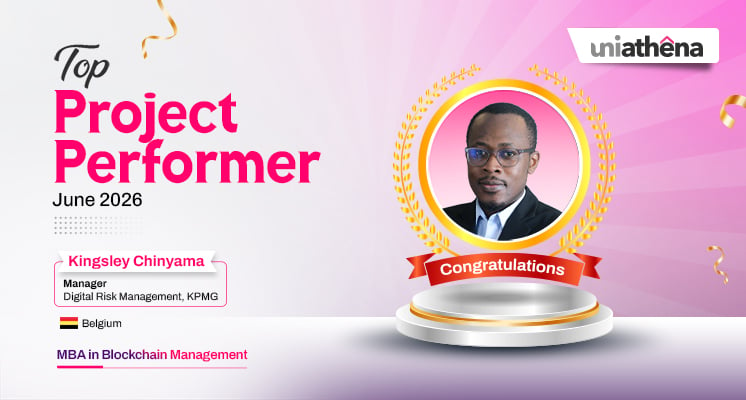
🌟 Top Project Performer – June 2026 🌟
Read More
1
mins read



🌟 Top Project Performer – May 2026 🌟
Read More
1
mins read


🌟 Top Project Performer – April 2026 🌟
Read More
1
mins read

🌟 Top Project Performer – June 2026 🌟
Read more
1
mins read
🌟 Top Project Performer – May 2026 🌟
Read more
1
mins read
🌟 Top Project Performer – April 2026 🌟
Read more
1
mins read
Get in Touch

It’s Time to Start
Join NowMost Popular Online Specialization
- Master of International Business Administration
- Master of Business Administration
- MBA in General Management- FastTrack
- Master in Innovation and Entrepreneurship
- MBA-Family Business Management
- Master in Procurement and Contract Management
- Extended Diploma in Business Analytics (SCQF Level 11)
- Diploma in Supply Chain and Logistics Management (SCQF Level 11)
- Strategic Human Resource Management Practitioner
- Master in Data Science
- Master in Engineering Management
Trending Online
- Integrated Doctorate of Business Administration
- Postgraduate Certificate in Finance for Next Generation Managers
- Master of Business Administration- General Management (Fast Track)
- Postgraduate Certificate in Socio-Economic and Legal Framework
- Postgraduate Certificate in Business Sustainability
- Certified Manager
- Supply Chain Management Practitioner
- MBA - AI in Business
- MBA - Accounting & Finance
- Master in Supply Chain and Logistics Management
Top Universities Online Certificates
- Postgraduate Certificate in International Marketing Management
- Postgraduate Certificate In International Human Resource Management
- Postgraduate Certificate in Strategic Management
- Postgraduate Certificate in Procurement & Contracts Management
- Postgraduate Certificate in Business Analytics
- Postgraduate Certificate in Strategic Supply Chain & Logistics Management
- Postgraduate Certificate in Human Resource and Leadership
- Project Management Practitioner
- Postgraduate Certificate in Supply Chain Design & Implementation
- Postgraduate Certificate in Management Accounting and Finance
Accredited Online Degree Program
- MBA - Digital Transformation
- MBA - Family Business Management
- MBA - Marketing Management
- MBA in Quality Management
- MBA - Business Intelligence & Data Analytics
- MBA in Operations & Project Management
- MBA in Energy Management
- MBA In Construction & Safety Management
- Master in Organisational Leadership
- Master in Public Health
- Master in Construction Management
- Bachelor of Arts in Business Administration


 Install Now


UniAthena is an Ed-Tech, offering flexible, affordable learning solutions, including Free-Learning Upskilling Courses and Academic Programs in partnerships with accredited and globally renowned universities and professional qualification bodies.


Do you have any questions ?
Feel free to send us your questions or request a free consultation
Send a message
UK
Athena Global Education
Magdalen Centre,
Robert Robinson Avenue,
Oxford, OX4 4GA, UK
Phone : 01865 784299
MIDDLE EAST
Athena Global Education FZE
Block L-03, First Floor,
P O Box 519265, Sharjah Publishing City,
Free Zone, Sharjah, UAE
Phone : +971 55 879 5492
INDIA
Uniathena Private Limited
9A,Midas Tower
Phase 1
Hinjewadi Rajiv Gandhi Infotech Park
Pune-411057
Phone: +91 9145665544
All Copyrights Reserved @ Athena Global Education 2021-2026