-

Bachelor's

-

Masters
-

MBA
-

Doctorate
-

Micro Credit
-

Explore all Courses
-
Postgraduate Certifications

-
Postgraduate Diploma
-
Undergraduate Diploma
-
Diploma



Silver Demand in 2026: Technology, Industry, and the Future of Global Markets
Author: aishwarya sancheti
|7
MINS READ
| 0
| 3,509
Created On: 24 January, 2026
Share




Table of Contents (TOC):
- Introduction
- Key Takeaways
- Top 5 Reasons for Silver Price Fluctuations
- Silver Price Snapshot - Recent Rally
- What This Means for Investors, Tech, and the Future
- Why Knowledge Matters More Than Ever
- Conclusion
- FAQs
Introduction
Silver’s recent performance has attracted growing attention across commodity markets and policy discussions.
Silver, long dismissed as gold’s quieter cousin, has seen a sustained rise in silver prices over recent years. By 2026, silver rates across major global markets have moved significantly higher, crossing long-standing technical and psychological levels observed in historical price cycles.
This shift is not driven by a single event or short-term market reaction. Instead, data points toward a combination of structural supply constraints, rising industrial demand, and evolving macroeconomic conditions. Together, these factors are shaping the silver price trend and influencing expectations around the future of silver in both industrial and investment contexts.
This article examines the reasons for the silver price increase, grounded in verified market dynamics rather than speculation.
Key Takeaways:
- Why silver prices are rising can be traced to structural demand and supply fundamentals.
- Prices crossed ₹3 lakh/kg in India and ~US$94/oz globally, breaking decades-old resistance.
- Industrial usage (solar, EVs, AI, semiconductors) now plays a dominant role in how the silver price is determined.
- Persistent supply constraints continue to affect silver value.
- Macroeconomic factors influence the silver price outlook and silver price expectations.
- Investor participation impacts the silver futures price and physical availability.
- Silver’s role in clean energy and technology affects the future of silver investment.
Top 5 Reasons for Silver Price Fluctuations
1) Historic Price Breakouts and Record Highs
Silver has blasted through key price barriers in early 2026, crossing ₹3 lakh/kg in India and hitting ~US$94/oz globally, levels not seen in decades.
An analysis of the silver price history and price of silver over time shows that silver has moved through multiple demand-supply cycles. In 2026, silver rates today reflect a continuation of trends that began accelerating post-2020.
In India, the silver price per kg has crossed notable historical levels, while global markets have observed sustained strength in silver futures prices. Rather than a short-term spike, these movements align with long-term silver technical analysis and broader commodity market behavior.
This phase highlights how silver price trend development differs from episodic rallies seen in previous decades.
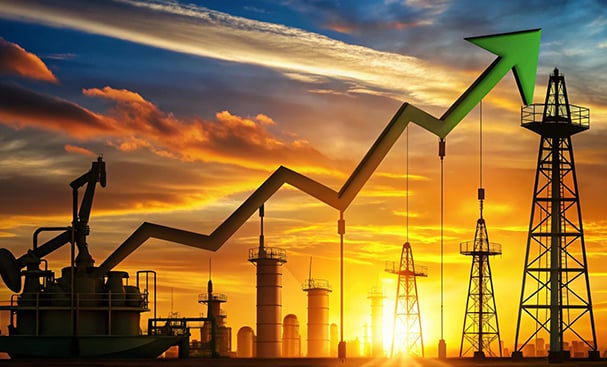
Notably, silver is now priced above a barrel of oil, an unusual benchmark that reflects shifts in demand and supply dynamics.
2) Structural Supply Deficits - Not Temporary Tightness
One of the most important factors affecting the silver price is supply rigidity.
Silver has been in a persistent global supply deficit for years, and 2026 continues this streak.
Silver production remains relatively inelastic because:
- A large portion of silver output is derived as a by-product of base metal mining.
- Production decisions depend on copper, zinc, and lead economics rather than the silver price today.
- Recycling and secondary supply growth remain limited.
Trade policies and export regulations in key producing regions have also influenced silver rates, reinforcing the supply-side pressure visible in silver price chart data.
Even China’s tightening of silver export licenses from Jan 2026 is squeezing global physical supply further, reinforcing scarcity.
3) Explosion of Industrial Demand - Silver Is No Longer Just Jewelry
The most significant contributor to the rise in silver price is industrial demand.
Silver is increasingly essential in:
- Solar photovoltaic systems
- Electric vehicles and charging infrastructure
- Semiconductors, AI data centers, and high-performance electronics
- 5G and advanced communication networks
In 2025, industrial demand accounted for the majority (~59%) of total silver usage. This shift has fundamentally altered how the silver price is determined, linking silver more closely to technology and infrastructure growth than to traditional jewelry demand.
This trend is central to discussions around the future of silver and the silver price outlook.
4) Macro Forces: Geopolitics, Safe-Haven Flows & Monetary Tailwinds
Silver is also borrowing a lift from broader market tensions. Macroeconomic variables continue to influence silver price expectations:
- Geopolitical uncertainty - tariff threats between major economies and foreign policy flashpoints are pushing investors toward precious metals, especially silver, as a partial hedge alongside gold.
- Monetary policy adjustments affect opportunity costs related to silver investment.
- Expectations of interest rate cuts and a weaker US dollar are reducing the opportunity cost of holding non-yielding assets like silver, boosting demand. Thus, currency movement impacts silver value in international markets.
Unlike gold, silver responds simultaneously to industrial cycles and macroeconomic signals, making silver price prediction more sensitive to real-economy data. This dual engine (industrial plus safe-haven demand) is fuelling unusually strong returns.
5) Investment Participation, ETFs, and Silver Market Structure
Investment participation plays a measurable role in the rise in silver price, particularly through its influence on silver futures price, liquidity, and short- to medium-term market dynamics.
Flows into silver-backed exchange-traded products (ETFs) and other regulated investment instruments have contributed to changes in physical silver availability, as these products require metal-backed holdings. At the same time, institutional participation and growing interest among retail investors who invest in silver have increased activity across futures, spot, and physical markets.
While investment demand is not the sole factor affecting silver value, it interacts closely with industrial consumption and supply constraints. This interaction influences the silver price trend, especially during periods when physical demand from energy, electronics, and manufacturing sectors remains strong.
Market structure indicators such as futures positioning, inventory levels at major exchanges, and price differentials between spot and futures markets are closely monitored in silver technical analysis. These signals are often referenced in silver price forecasts and silver price outlook assessments, helping analysts evaluate near-term momentum without relying on speculation.
Importantly, long-term discussions around the future of silver and silver price prediction 2030 increasingly emphasize the balance between physical demand and financial market participation. Rather than driving prices independently, investment flows act as an amplifier of broader factors affecting the silver price, reinforcing existing trends rooted in supply limitations and industrial usage.
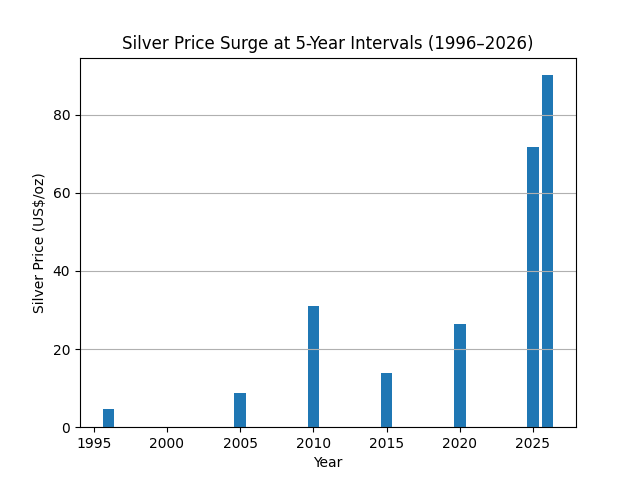
Silver Price Snapshot - Recent Rally
What This Means for Investors, Tech, and the Future
Silver’s role has expanded beyond its identity as a store of value. Today, it functions as a strategic input in:
- Clean energy transition
- Electrification
- AI infrastructure
- Global tech supply chains
The metal has transformed from a passive store of wealth to an active input in future technologies. Understanding these linkages is critical when evaluating silver investment, silver price prediction, and long-term silver price expectations.
Why Knowledge Matters More Than Ever
Understanding why the silver price is increasing requires cross-disciplinary insight, spanning technology, economics, and data analysis. Silver’s surge now is more than investing, but about skills alignment with future industries.
Learn What the Market Demands:
- UniAthena Artificial Intelligence Courses
Learn how AI optimizes EV systems, energy grids, and semiconductor efficiency — the very sectors driving silver demand.
- UniAthena Financial Modeling & Business Analytics
Analyze commodity cycles, interpret supply-demand dynamics, and develop analytical frameworks for understanding metals markets such as silver.
- UniAthena Technology & Sustainability Programs
Gain insight into renewable energy systems and digital infrastructure shaping global commodity markets from blockchain, offering solutions for transparency, authenticity, and trading to technology immaterial management.
Understanding data, technology, and financial systems is increasingly important for interpreting complex changes in global commodity markets.
Conclusion
The reasons for the silver price increase in 2026 are rooted in structural changes rather than short-term market sentiment.
Supply limitations, rising industrial demand, macroeconomic factors, and evolving investment frameworks are collectively shaping the silver price trend. The key question moving forward is not simply silver price prediction, but how individuals and organizations build the knowledge required to interpret and respond to these changes effectively.
FAQs
Q1. Why are silver prices rising so fast in 2026?
A: Silver prices are rising due to a mix of industrial demand growth, global supply shortages, investor inflows, and macroeconomic uncertainty.
Q2. Is silver’s 2026 rally a bubble?
A: Opinions differ among analysts. While structural supply and industrial demand are important factors, market cycles, financial participation, and macroeconomic conditions continue to influence silver price movements.
Q3. How does industrial demand impact silver prices?
A: Industries like solar energy, EVs, AI, and semiconductors rely on silver, making demand persistent and price-supportive.
Q4. Why is silver more volatile than gold?
A: Silver has both industrial and investment demand, making it more sensitive to economic cycles and technological growth.
Q5. What role does geopolitics play in silver’s surge?
A: Trade tensions, currency weakness, and global uncertainty push investors toward silver as a partial safe-haven asset.
Q6. Is silver a good long-term investment?
A: Silver’s long-term outlook is supported by clean energy adoption, electrification, and global tech expansion.
Q7. How can professionals benefit from the silver boom?
A: By gaining skills in financial modeling, AI, sustainability, and technology analysis to understand and act on market shifts.
Explore Related Courses









COMMENTS(0)
Explore Related Courses
Our Popular Insights
Careers are shifting faster than ever, and staying relevant takes more than experience. Explore UniAthena’s most-read blogs for sharp insights, emerging skills, and practical pathways that help you move forward with clarity and confidence in a changing professional world.

🌟 Top Project Performer – June 2026 🌟
Read More
1
mins read



🌟 Top Project Performer – May 2026 🌟
Read More
1
mins read
Best AI Tools for Content Creation
Read More
9
mins read

How to Start Freelancing With No Experience
Read More
8
mins read

🌟 Top Project Performer – April 2026 🌟
Read More
1
mins read
🌟 Top Project Performer – June 2026 🌟
Read more
1
mins read
🌟 Top Project Performer – May 2026 🌟
Read more
1
mins read
Best AI Tools for Content Creation
Read more
9
mins read
How to Start Freelancing With No Experience
Read more
8
mins read
🌟 Top Project Performer – April 2026 🌟
Read more
1
mins read
Get in Touch

It’s Time to Start
Join NowMost Popular Online Specialization
- Master of International Business Administration
- Master of Business Administration
- MBA in General Management- FastTrack
- Master in Innovation and Entrepreneurship
- MBA-Family Business Management
- Master in Procurement and Contract Management
- Extended Diploma in Business Analytics (SCQF Level 11)
- Diploma in Supply Chain and Logistics Management (SCQF Level 11)
- Strategic Human Resource Management Practitioner
- Master in Data Science
- Master in Engineering Management
Trending Online
- Integrated Doctorate of Business Administration
- Postgraduate Certificate in Finance for Next Generation Managers
- Master of Business Administration- General Management (Fast Track)
- Postgraduate Certificate in Socio-Economic and Legal Framework
- Postgraduate Certificate in Business Sustainability
- Certified Manager
- Supply Chain Management Practitioner
- MBA - AI in Business
- MBA - Accounting & Finance
- Master in Supply Chain and Logistics Management
Top Universities Online Certificates
- Postgraduate Certificate in International Marketing Management
- Postgraduate Certificate In International Human Resource Management
- Postgraduate Certificate in Strategic Management
- Postgraduate Certificate in Procurement & Contracts Management
- Postgraduate Certificate in Business Analytics
- Postgraduate Certificate in Strategic Supply Chain & Logistics Management
- Postgraduate Certificate in Human Resource and Leadership
- Project Management Practitioner
- Postgraduate Certificate in Supply Chain Design & Implementation
- Postgraduate Certificate in Management Accounting and Finance
Accredited Online Degree Program
- MBA - Digital Transformation
- MBA - Family Business Management
- MBA - Marketing Management
- MBA in Quality Management
- MBA - Business Intelligence & Data Analytics
- MBA in Operations & Project Management
- MBA in Energy Management
- MBA In Construction & Safety Management
- Master in Organisational Leadership
- Master in Public Health
- Master in Construction Management
- Bachelor of Arts in Business Administration


 Install Now


UniAthena is an Ed-Tech, offering flexible, affordable learning solutions, including Free-Learning Upskilling Courses and Academic Programs in partnerships with accredited and globally renowned universities and professional qualification bodies.


Do you have any questions ?
Feel free to send us your questions or request a free consultation
Send a message
UK
Athena Global Education
Magdalen Centre,
Robert Robinson Avenue,
Oxford, OX4 4GA, UK
Phone : 01865 784299
MIDDLE EAST
Athena Global Education FZE
Block L-03, First Floor,
P O Box 519265, Sharjah Publishing City,
Free Zone, Sharjah, UAE
Phone : +971 55 879 5492
INDIA
Uniathena Private Limited
9A,Midas Tower
Phase 1
Hinjewadi Rajiv Gandhi Infotech Park
Pune-411057
Phone: +91 9145665544
All Copyrights Reserved @ Athena Global Education 2021-2026