-

Bachelor's

-

Masters
-

MBA
-

Doctorate
-

Micro Credit
-

Explore all Courses
-
Postgraduate Certifications

-
Postgraduate Diploma
-
Undergraduate Diploma
-
Diploma



How On-Device AI Is Shaping the Future of Cloud and Edge Analytics
Author: omkar hankare
|5
MINS READ
| 1
| 104
Created On: 18 June, 2025
Share




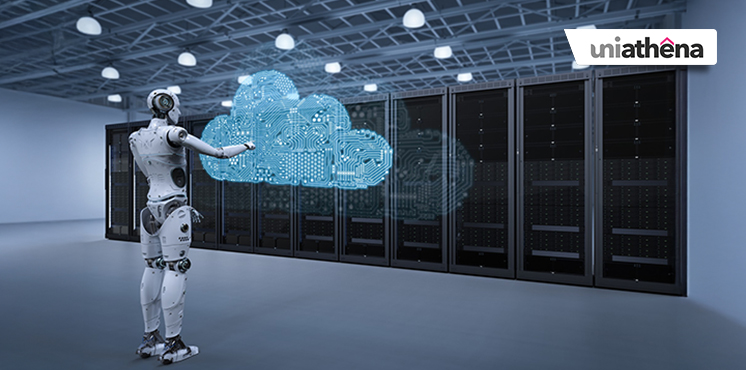
Artificial Intelligence has grown rapidly, but most AI tasks still run in cloud data centers. While this approach offers power and scalability, it comes with drawbacks like internet dependency, slower response times, and privacy concerns.
Nonetheless, we’re seeing a shift. Tech leaders like Apple, Google, Samsung, and Qualcomm are moving AI processing closer to users—directly onto devices. This move to on-device AI is changing how data is handled and challenging the long-standing dominance of cloud-based analytics.
Cloud Analytics: The Traditional Paradigm and Its Constraints
For over ten years, cloud computing has been the king of data analysis, centralising processing power in massive server infrastructures. This model had many benefits:
- Unlimited scalability for growing companies and growing datasets.
- Powerful computing beyond what any single device could offer
- Centralized AI model training and deployment
But cloud analytics isn’t without flaws:
- Latency: Data must travel to the cloud and back, which delays real-time responses—something that products like the Humane AI Pin struggle with.
- Privacy risks: Sending data off-device increases the chances of security breaches.
- Internet dependency: Without a strong connection, cloud AI doesn’t work—limiting use in remote or low-signal areas.
- High cost: Running large AI models in the cloud is expensive; doing it on-device can be more economical.
- Sustainability: Data centers consume a lot of electricity, but on-device AI reduces the carbon footprint of AI workloads.
These limitations of traditional cloud analytics have opened up alternative approaches that address these growing concerns and still deliver the power.
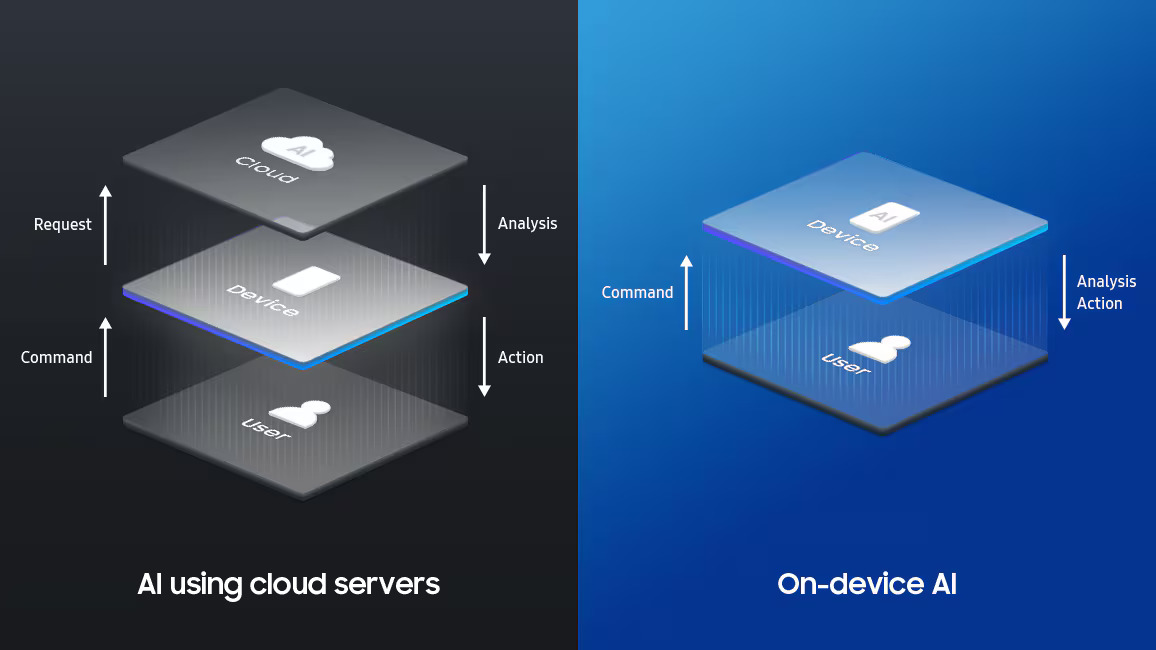
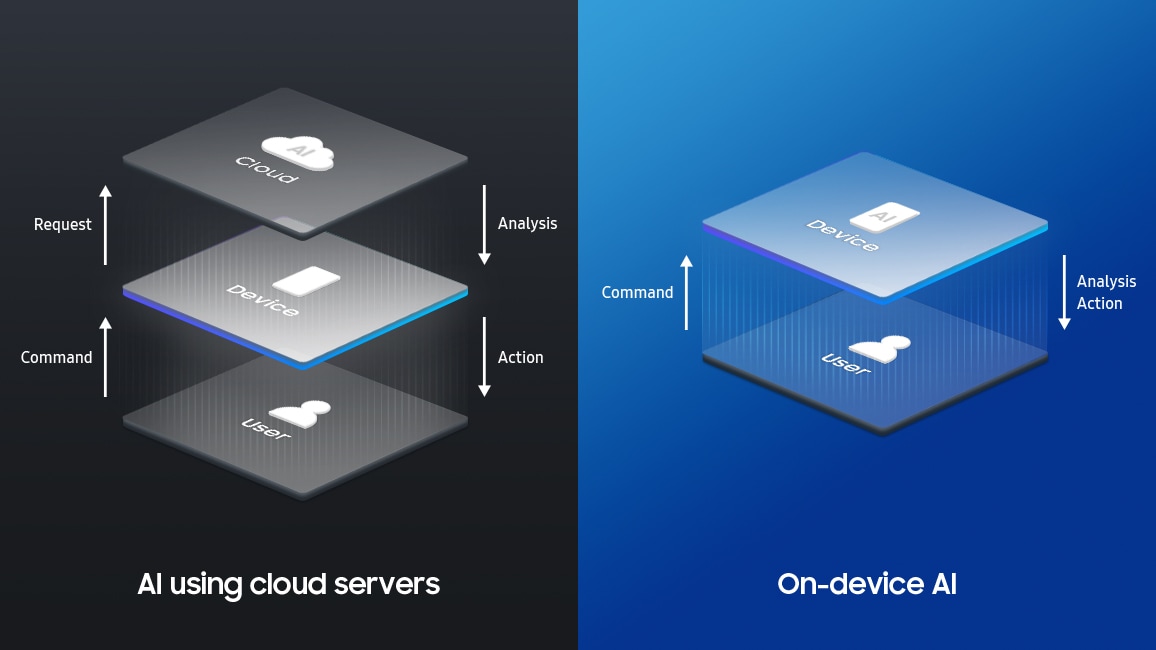
Credits - SAMSUNG
The Rise of AI on the Device
On-device AI brings smart computing directly to your smartphone, tablet, or PC. It allows real-time decisions without needing an internet connection and keeps your data safely on your device.
Here’s how some of the biggest players are using it:
- Apple uses custom chips like the A17 Pro and M-series to run features such as image generation, auto-reply suggestions, and personalized system awareness locally. If a task is too demanding, Apple offloads it to a tightly controlled “Private Cloud Compute” system designed with privacy at its core.
- Google has been using on-device machine learning for years in Pixel phones. Voice typing, spam filtering, and Magic Eraser in Google Photos all run without needing a data connection.
- Samsung offers on-device AI via Galaxy AI, enabling live translation, note summaries, and transcriptions—thanks to partnerships with both in-house and external chipmakers.
- Qualcomm’s Snapdragon processors power many Android devices with built-in AI engines that can handle text, image, and audio processing locally.
- Microsoft is embedding local inference into Windows Copilot on new Surface and Windows-powered PCs, helping reduce reliance on the cloud and improve performance.
These aren’t isolated features. Together, they show that on-device AI is becoming the new standard across every major platform.
The Hybrid Model: When Devices Still Need the Cloud
Of course, not all tasks can be handled locally. Generating detailed images or analyzing multiple documents might require more horsepower than a phone or laptop can offer.
That’s where hybrid models come in. These approaches combine on-device processing for simple tasks with cloud support for more complex ones.
- Apple’s Private Cloud Compute uses Apple-run servers that maintain strict privacy standards to handle intensive workloads.
- Google and Microsoft also use hybrid cloud-edge models, blending speed and data protection.
This way, you get fast, private results for basic tasks and secure cloud help only when needed.
Why On-Device AI Matters
On-device AI comes with a host of advantages:
- Faster Performance: No need to wait for the cloud—your device handles it instantly.
- Stronger Privacy: Personal data stays with you, not floating through the internet.
- Works Offline: Whether you’re flying or in a remote area, AI tools still function.
- Lower Costs: Less reliance on cloud infrastructure can save money.
- More Sustainable: Cutting down on data center use lowers energy consumption.
- User Control: Keeping data on-device helps meet privacy laws and puts you in charge.
What’s Next: Industry Trends and Future Outlook
On-device AI is not a gimmick—it’s a fundamental change in how we use and build technology. IDC estimates global spending on edge computing will reach nearly $380 billion by 2028. That’s a strong indicator of where things are headed.
But the road ahead isn’t without challenges. Running AI models on-device demands compact, energy-efficient chips, smaller AI models, and smooth coordination between local and cloud operations. For now, lightweight tasks stay on-device while heavier ones rely on the cloud.
The future isn’t about choosing one over the other—it’s about balance. The best systems will be flexible, adjusting to the task and context at hand. Whether it’s blazing speed, strict privacy, or raw power that’s needed, cloud and edge will work together.
Conclusion
On-device AI is redefining how we interact with technology. It’s faster, more private, and keeps your data close. Apple may have led the way in spotlighting this shift, but every major tech company is now moving in the same direction.
As devices become smarter and more powerful, on-device AI will continue to grow. Meanwhile, cloud analytics won’t vanish—it will evolve to support big, complex tasks in a more secure and privacy-conscious way.
The future of AI isn’t about cloud versus edge—it’s about using both, in the right ways, at the right times.
Explore Related Courses










COMMENTS(1)

Explore Related Courses
Our Popular Insights
Careers are shifting faster than ever, and staying relevant takes more than experience. Explore UniAthena’s most-read blogs for sharp insights, emerging skills, and practical pathways that help you move forward with clarity and confidence in a changing professional world.



🌟 Students of the Month | May – June 2026 🌟
Read More
1
mins read




🌟 Students of the Month | May – June 2026 🌟
Read more
1
mins read
Get in Touch

It’s Time to Start
Join NowMost Popular Online Specialization
- Master of International Business Administration
- Master of Business Administration
- MBA in General Management- FastTrack
- Master in Innovation and Entrepreneurship
- MBA-Family Business Management
- Master in Procurement and Contract Management
- Extended Diploma in Business Analytics (SCQF Level 11)
- Diploma in Supply Chain and Logistics Management (SCQF Level 11)
- Strategic Human Resource Management Practitioner
- Master in Data Science
- Master in Engineering Management
Trending Online
- Integrated Doctorate of Business Administration
- Postgraduate Certificate in Finance for Next Generation Managers
- Master of Business Administration- General Management (Fast Track)
- Postgraduate Certificate in Socio-Economic and Legal Framework
- Postgraduate Certificate in Business Sustainability
- Certified Manager
- Supply Chain Management Practitioner
- MBA - AI in Business
- MBA - Accounting & Finance
- Master in Supply Chain and Logistics Management
Top Universities Online Certificates
- Postgraduate Certificate in International Marketing Management
- Postgraduate Certificate In International Human Resource Management
- Postgraduate Certificate in Strategic Management
- Postgraduate Certificate in Procurement & Contracts Management
- Postgraduate Certificate in Business Analytics
- Postgraduate Certificate in Strategic Supply Chain & Logistics Management
- Postgraduate Certificate in Human Resource and Leadership
- Project Management Practitioner
- Postgraduate Certificate in Supply Chain Design & Implementation
- Postgraduate Certificate in Management Accounting and Finance
Accredited Online Degree Program
- MBA - Digital Transformation
- MBA - Family Business Management
- MBA - Marketing Management
- MBA in Quality Management
- MBA - Business Intelligence & Data Analytics
- MBA in Operations & Project Management
- MBA in Energy Management
- MBA In Construction & Safety Management
- Master in Organisational Leadership
- Master in Public Health
- Master in Construction Management
- Bachelor of Arts in Business Administration


 Install Now


UniAthena is an Ed-Tech, offering flexible, affordable learning solutions, including Free-Learning Upskilling Courses and Academic Programs in partnerships with accredited and globally renowned universities and professional qualification bodies.


Do you have any questions ?
Feel free to send us your questions or request a free consultation
Send a message
UK
Athena Global Education
Magdalen Centre,
Robert Robinson Avenue,
Oxford, OX4 4GA, UK
Phone : 01865 784299
MIDDLE EAST
Athena Global Education FZE
Block L-03, First Floor,
P O Box 519265, Sharjah Publishing City,
Free Zone, Sharjah, UAE
Phone : +971 55 879 5492
INDIA
Uniathena Private Limited
9A,Midas Tower
Phase 1
Hinjewadi Rajiv Gandhi Infotech Park
Pune-411057
Phone: +91 9145665544
All Copyrights Reserved @ Athena Global Education 2021-2026