-

Bachelor's

-

Masters
-

MBA
-

Doctorate
-

Micro Credit
-

Explore all Courses
-
Postgraduate Certifications

-
Postgraduate Diploma
-
Undergraduate Diploma
-
Diploma



Top Challenges HR Professionals Face in International Organizations and Easy Solutions

Author: munazzah ali
|5
MINS READ
| 0
| 307
Created On: 06 March, 2026
Share




Table Of Contents (TOC):
- Introduction
- Key Takeaways
- What Is International Human Resource Management?
- International HR vs Domestic HR: What Really Changes?
- Core Responsibilities and Scope of International HR Management
- International HR Challenges in the Global Workforce
- Practical Solutions That Actually Work
- Preparing for the Future of Global HR
- Conclusion
- FAQ’s
Introduction
A single policy error in a new nation can cost a business millions—or its reputation. For HR leaders operating in global organizations, current HR challenges extend beyond managing individuals in a single system. They now include aligning cultures, laws, and expectations across borders—some of the most complex challenges in international human resource management.
As workforces become more distributed and diverse, these human resource challenges place HR decisions at the center of business continuity, trust, and long-term growth. The early identification of changing IHRM challenges will be critical in developing a global team that is strong, compliant, and people-centered.
Key Takeaways:
- Global HR issues transcend conventional HR and require a strategic fit.
- The largest areas of pressure are compliance, culture, and consistency.
- The global workforce management needs local thinking and global standards.
- Structured learning can significantly help eliminate risks of implementation in global HR functions to a great extent.
What Is International Human Resource Management?
To understand what international human resources is, think of HR operating internationally as opposed to operating within a single country. International HR management is concerned with the management of people according to the various legal frameworks, cultures, and economies, and aligning them to a single organizational vision.
Unlike domestic HR, it deals with expatriates, local employees, and third-country nationals—often at the same time. This makes international HR challenges more strategic, particularly in multinational companies that are growing at a rapid pace.
International HR vs Domestic HR: What Really Changes?
Core Responsibilities and Scope of International HR Management
Global Talent Acquisition
The international HR deals with recruiting internationally, but tries to balance between global and local recruitment. This involves learning about the regional workforce and cultural demands.
Risk Management and Compliance
Remaining in agreement with the local labor legislation, taxation, and employee entitlement is key to evading fines and negative publicity.
Workforce Development
The training of global teams demands the adjustment of the learning practices to various cultural and professional settings in a way that ensures the existence of stable performance standards.
Compensation and Benefits Strategy
At the cross-border, fair and competitive compensation should be designed taking into consideration currency fluctuations, tax regulations, and cost of living differences.
International HR Challenges in the Global Workforce
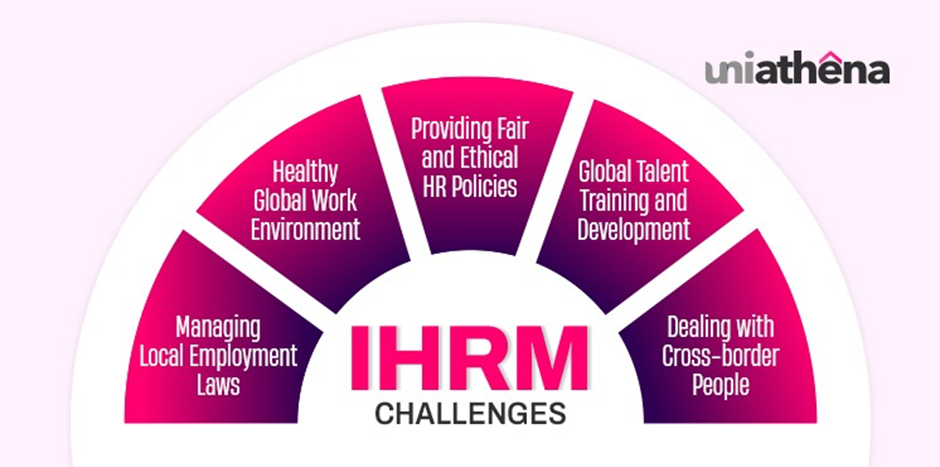
1. Managing Local Employment Laws
The violation of local employment laws is one of the most prevalent HR problems nowadays. Regulations vary across the board, and when one does not comply, high penalties may be imposed.
2. Healthy Global Work Environment
Cultural misunderstandings, time zone issues, and communication barriers are the factors that affect the co-operation and motivation in global teams.
3. Providing Fair and Ethical HR Policies
It is hard to implement steady but adaptable policies in case employee expectations and workplace standards vary in different regions
4. Global Talent Training and Development
The standardized training is not likely to work globally. HR teams find it hard to come up with development initiatives that will cut across cultures and learning styles.
5. Dealing with Cross-border People
The global management of people involves balancing local autonomy with centralized control, which is the fundamental issue in HR.
Also Read: Why IHRM Skills are Crucial for Career Growth?
Practical Solutions That Actually Work
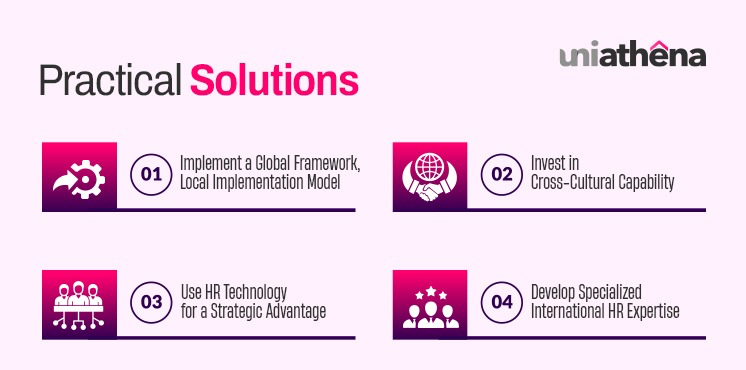
Implement a Global Framework, Local Implementation Model
Standardize HR policies, but allow regionalization. This approach is risk-preventive while respecting local realities.
Invest in Cross-Cultural Capability
Cultural intelligence training of HR teams enhances communication, effective leadership, and involvement of employees in different regions.
Use HR Technology for a Strategic Advantage
Digital HR solutions also make it easier to track compliance, international payroll, and workforce analytics, which are important in addressing existing challenges in human resource management.
Develop Specialized International HR Expertise
With the growing complexity of the world, organizations are now enjoying the advantages of having HR professionals who have received training in international workforce management as opposed to general HR functions.
Preparing for the Future of Global HR
The need to have structured HR knowledge is on the increase as international bodies continue to expand.
- Basics of International Human Resource Management,
- Essentials of International Human Resources Management,
- Diploma in Strategic International Human Resource Management, and
- Essentials of International Recruitment
at UniAthena are some of the programs that enable professionals to close the skill gaps without interfering with their careers.
Designed to align with the realities of today’s global workforce, these programs are aimed at developing applied knowledge and strategic competence–helping HR professionals to drive through the complexities of international people issues with a sense of competence and confidence.
Also Read: Career Options After a Diploma in International HRM
Conclusion
International HR is no longer a support service; it is a business driver. HR professionals can transform complexity into a competitive advantage by learning the underlying causes of human resource issues and by applying practical and scalable solutions. The future of HR is in the hands of the thinkers, the doers, and the leaders of the world.
FAQ’s
Q1. Why is international human resource management more complicated than domestic HR?
A: International HR entails dealing with employees in various countries, each having its own labor laws, culture, and expectations of the workforce. This introduces a level of complexity in legal, cultural, and operational aspects that is not the case with domestic HR.
Q2. What skills are essential for handling international HR challenges effectively?
A: To effectively manage international teams, HR specialists should have a solid understanding of international labour laws, cross-cultural intelligence, compliance management, and strategic planning of the workforce.
Q3. How can HR professionals prepare for future global workforce demands?
A: Developing a strong understanding of international HR practices, keeping updated on international regulations, and cross-cultural leadership skills enable professionals to remain functional in the global work environment, which is changing fast.
Explore Related Courses







.jpg)





COMMENTS(0)
Explore Related Courses
Our Popular Insights
Careers are shifting faster than ever, and staying relevant takes more than experience. Explore UniAthena’s most-read blogs for sharp insights, emerging skills, and practical pathways that help you move forward with clarity and confidence in a changing professional world.

What is the Role of AI in Education?
Read More
4
mins read






What is the Role of AI in Education?
Read more
4
mins read

Get in Touch

It’s Time to Start
Join NowMost Popular Online Specialization
- Master of International Business Administration
- Master of Business Administration
- MBA in General Management- FastTrack
- Master in Innovation and Entrepreneurship
- MBA-Family Business Management
- Master in Procurement and Contract Management
- Extended Diploma in Business Analytics (SCQF Level 11)
- Diploma in Supply Chain and Logistics Management (SCQF Level 11)
- Strategic Human Resource Management Practitioner
- Master in Data Science
- Master in Engineering Management
Trending Online
- Integrated Doctorate of Business Administration
- Postgraduate Certificate in Finance for Next Generation Managers
- Master of Business Administration- General Management (Fast Track)
- Postgraduate Certificate in Socio-Economic and Legal Framework
- Postgraduate Certificate in Business Sustainability
- Certified Manager
- Supply Chain Management Practitioner
- MBA - AI in Business
- MBA - Accounting & Finance
- Master in Supply Chain and Logistics Management
Top Universities Online Certificates
- Postgraduate Certificate in International Marketing Management
- Postgraduate Certificate In International Human Resource Management
- Postgraduate Certificate in Strategic Management
- Postgraduate Certificate in Procurement & Contracts Management
- Postgraduate Certificate in Business Analytics
- Postgraduate Certificate in Strategic Supply Chain & Logistics Management
- Postgraduate Certificate in Human Resource and Leadership
- Project Management Practitioner
- Postgraduate Certificate in Supply Chain Design & Implementation
- Postgraduate Certificate in Management Accounting and Finance
Accredited Online Degree Program
- MBA - Digital Transformation
- MBA - Family Business Management
- MBA - Marketing Management
- MBA in Quality Management
- MBA - Business Intelligence & Data Analytics
- MBA in Operations & Project Management
- MBA in Energy Management
- MBA In Construction & Safety Management
- Master in Organisational Leadership
- Master in Public Health
- Master in Construction Management
- Bachelor of Arts in Business Administration


 Install Now


UniAthena is an Ed-Tech, offering flexible, affordable learning solutions, including Free-Learning Upskilling Courses and Academic Programs in partnerships with accredited and globally renowned universities and professional qualification bodies.


Do you have any questions ?
Feel free to send us your questions or request a free consultation
Send a message
UK
Athena Global Education
Magdalen Centre,
Robert Robinson Avenue,
Oxford, OX4 4GA, UK
Phone : 01865 784299
MIDDLE EAST
Athena Global Education FZE
Block L-03, First Floor,
P O Box 519265, Sharjah Publishing City,
Free Zone, Sharjah, UAE
Phone : +971 55 879 5492
INDIA
Uniathena Private Limited
9A,Midas Tower
Phase 1
Hinjewadi Rajiv Gandhi Infotech Park
Pune-411057
Phone: +91 9145665544
All Copyrights Reserved @ Athena Global Education 2021-2026